Classic form
Child psychology intake form with two guardian signatures
A child psychologist needs three histories before the first session: the development, the school and the household, and the consent of everyone with parental responsibility. This twenty two field intake form collects all four, and ends with two signature boxes rather than one.
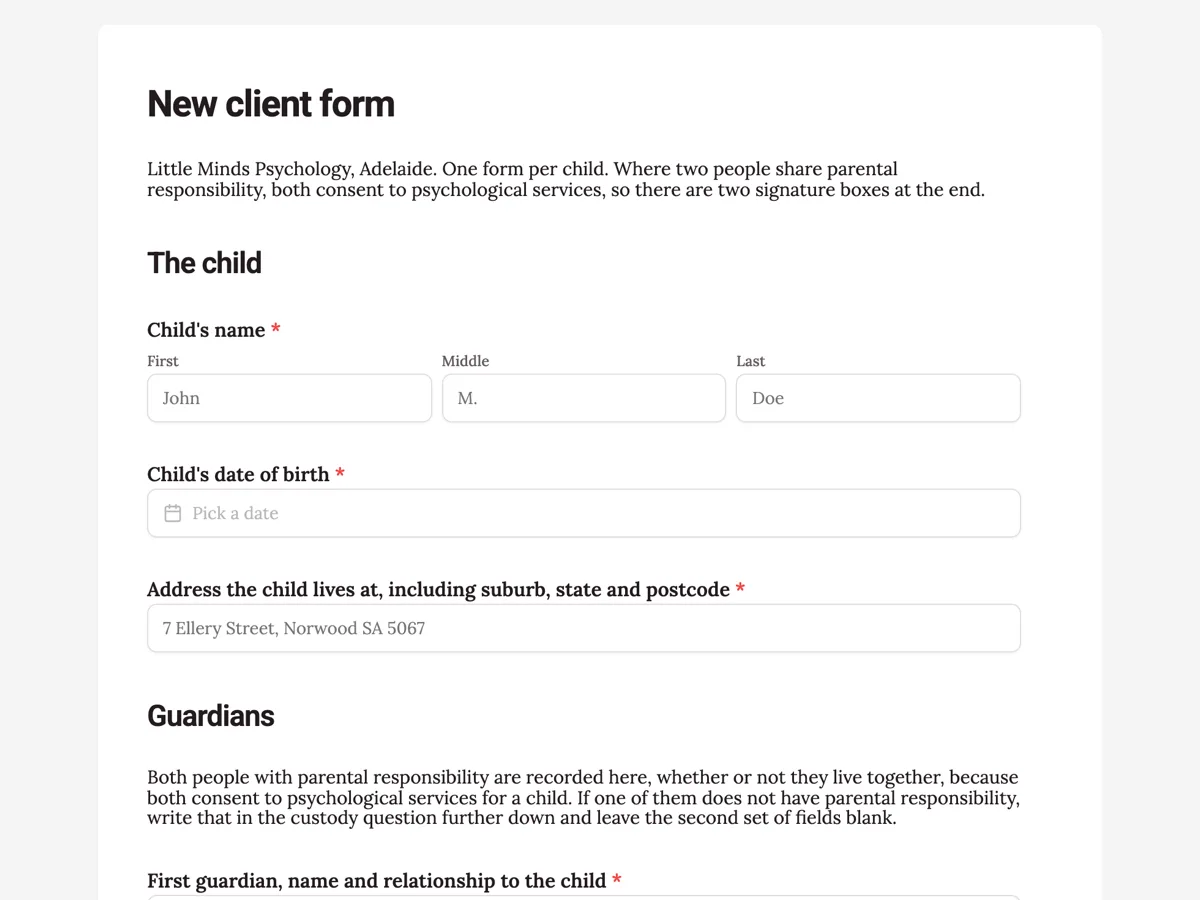
The form itself
A static copy of the finished form, exactly as it renders. Nothing here can be filled in or submitted, so read it as a reference and build your own from the button above.
Every field, and what it collects
The complete field list, in the order respondents meet it.
- Child's nameNameRequired
- Child's date of birthDateRequired
- Address the child lives at, including suburb, state and postcodeShort textRequired
- First guardian, name and relationship to the childShort textRequired
- First guardian mobileShort textRequired
- First guardian emailShort textRequired
- Second guardian, name and relationship to the childShort text
- Second guardian emailShort text
- Who suggested this appointment?Single choiceRequired
- Options: Nobody, this was our own decision · GP, on a mental health treatment plan · Paediatrician · School wellbeing team or counsellor · Another psychologist or therapist · A court or family report writer
- What are you noticing?Multiple choiceRequired
- Options: Worry, or fear of being away from a parent · Low mood or loss of interest · Big feelings that take a long time to settle · Anger, or damage to things and people · Trouble making or keeping friends · School refusal or morning meltdowns · Trouble focusing or finishing things · Sleep problems · Eating or body image worries · Toileting difficulties · Something that happened that they have not got over · Nobody knows what is going on, including us
- Describe a recent hard day, start to finishLong textRequired
- Developmental historyTable
- Columns: Milestone · Age it happened · Anything you noticed at the time
- Has your child been diagnosed with, or assessed for, any of these?Multiple choiceRequired
- Options: Autism · Attention deficit hyperactivity disorder · A specific learning disorder · A language or speech disorder · Anxiety or depression · Epilepsy or another neurological condition · A hearing or vision problem · A chronic illness · Assessed, but nothing was diagnosed · None of these
- Medications your child takesLong text
- School and year levelShort textRequired
- Teacher, and what the school has saidShort text
- What support is in place at school?Single choiceRequired
- Options: Nothing formal · Informal adjustments by the classroom teacher · A documented learning or behaviour plan · Support from a school services officer · Attending a special education setting · The school does not know we are seeking help
- What are the care arrangements for your child?Single choiceRequired
- Options: Lives with both parents, no orders · Separated parents, arrangements agreed between us · Separated parents, parenting orders in place · Separated parents, a matter currently before a court · Lives with one parent, no contact with the other · Lives with a guardian who is not a parent · In the care of the state
- Who lives in each household, and who else matters to your child?Long textRequired
- Previous assessments and reportsFile upload
- A psychologist or paediatrician report, a speech or occupational therapy assessment, a school learning plan or a recent report card. Photos of printed pages are fine. Images or PDF, up to 10 MB each.
- First guardian signatureSignatureRequired
- Second guardian signature, where parental responsibility is sharedSignature
The child
Guardians
Why you are here
Development and health
School
Family and legal arrangements
Consent
What each block of this form collects
The child block is three fields, and the address is asked as the address the child lives at rather than the respondent's, because in separated families those differ. The guardian block records two people, with a paragraph above it explaining why, and the second guardian email exists so a consent form can be sent to somebody who is not filling this in. The concerns block pairs a twelve item tick list with one open question, describe a recent hard day start to finish, which is the single most useful field on the form. Development, diagnoses and medications follow. School is three fields including what the teacher has actually said. The family block holds the care arrangements radio and a household question that asks who else matters to the child, and the uploads carry the reports.
The Australian pieces on this form
Two things here are shaped by Australian practice. The referral radio names a GP mental health treatment plan, which is the route most children reach a private psychologist by and which comes with a limited number of rebated sessions and a report back to the referring doctor. It also names a court or family report writer, because a child referred that way arrives with a different purpose and the practice needs to know before the first session. The consent paragraph then draws the line: reports for a court are a separate service and are not produced from therapy notes, which protects the therapy from becoming evidence. The care arrangements radio covers parenting orders and a matter currently before a court, since both change who may consent and who may be given information.
How to adapt this form
An assessment only practice doing cognitive and learning testing replaces the hard day question with the referral question in writing, what decision the assessment is meant to inform, and adds previous test dates, because cognitive tests cannot be repeated too soon. A school based service drops the two signature blocks for a single school consent and adds the year coordinator as a named contact. A practice working with adolescents moves the consent conversation to the young person, adds a field for what they know about the referral and whether they agreed to it, and keeps only one guardian signature where the young person can consent for themselves.
What makes this form work
The tick list ends in nobody knows what is going on
Twelve things a guardian might be noticing, and a last option that admits confusion. Plenty of families arrive without a label, and forcing them to pick one produces a wrong answer that the first session then has to undo.
Two guardian fields and two signatures, not one of each
The second guardian email exists so a consent copy can be sent to somebody who is not filling this in, and the second signature is optional so a sole guardian can still submit. The requirement is made visible rather than assumed.
The household question asks who else matters
Siblings with ages, step parents, grandparents, pets, and anybody the child would mention first. That last instruction is what turns a family composition field into something a psychologist can open the first session with.
Questions people ask
Why does the form need two guardian signatures?
Because consent to psychological services for a child normally comes from everyone with parental responsibility, and that does not stop at separation. Two boxes make the requirement visible rather than assumed, the second one is not required so a sole guardian can still submit, and the second guardian email lets the practice send a copy where one is needed.
Why ask a guardian to describe a recent hard day?
Because a tick list gives categories and a hard day gives sequence. What happened first, what the child did, what the adult tried and how it ended tells a psychologist about triggers, pacing and the family response in a way that worry or anger never could. It is the field most often read twice.
What does the care arrangements question change?
Who may consent, who may be told what, and how carefully notes are written. Parenting orders and a matter before a court both mean a third party may eventually see the file, and the consent paragraph says plainly that reports for a court are a separate service rather than something drawn from therapy notes.
Why is the school support question ending in the school does not know?
Because that is a real and common position, and a psychologist who assumes the school is involved will suggest things that expose the family. Naming it as an option lets the guardian say so once rather than manage the misunderstanding in session, and it shapes what the psychologist offers to do next.
What can be uploaded to the reports field?
A psychologist or paediatrician report, a speech or occupational therapy assessment, a school learning plan or a recent report card. The upload takes images or PDF at up to 10 MB a file, which covers a full assessment report plus a couple of school documents. Photos of printed pages are fine.
Is what my child says in therapy confidential from me?
Partly, and the consent paragraph says the psychologist will explain how at the first session. Children are given age appropriate confidentiality because therapy does not work without it, while a guardian is kept informed of the direction and of anything that affects safety. The limits are risk to anyone and a legal requirement to disclose.
Build your own in about a minute
The button below opens the generator with this use case already described. Change the wording to match your own, generate, then edit anything you like.
Make one like thisOther form examples
Speech pathology intake form as a child case history
A paediatric speech pathologist starts from a case history that reaches back to birth, because prematurity, early feeding and the age of first words each change what a delay is likely to be. This twenty one field intake form collects that history, the hearing testing, the languages spoken at home and the funding, before the first forty five minute session begins.
Lactation consultant intake form built around a feeding log
A lactation consultation is decided by two things a parent already has: the last twenty four hours of feeds, and how the first week went. This sixteen field intake form collects both as an eight row log and a first week checklist, alongside the pain, the supply worries and the pumping.
Midwifery intake form for a private booking visit
A booking visit with a private midwife is ninety minutes and should mostly be about what the woman wants, not about reconstructing her history out loud. This twenty field intake form takes the due date, the previous pregnancies, the blood group and the birth preferences beforehand, and asks who will be in the room.
Want the steps in the builder? Read Every form field and when to use it, then Control who can fill in your form. For everything this generator can do, see the form maker.
Written and checked by the OneCraft team. Last checked .