Classic form
Lactation consultant intake form built around a feeding log
A lactation consultation is decided by two things a parent already has: the last twenty four hours of feeds, and how the first week went. This sixteen field intake form collects both as an eight row log and a first week checklist, alongside the pain, the supply worries and the pumping.
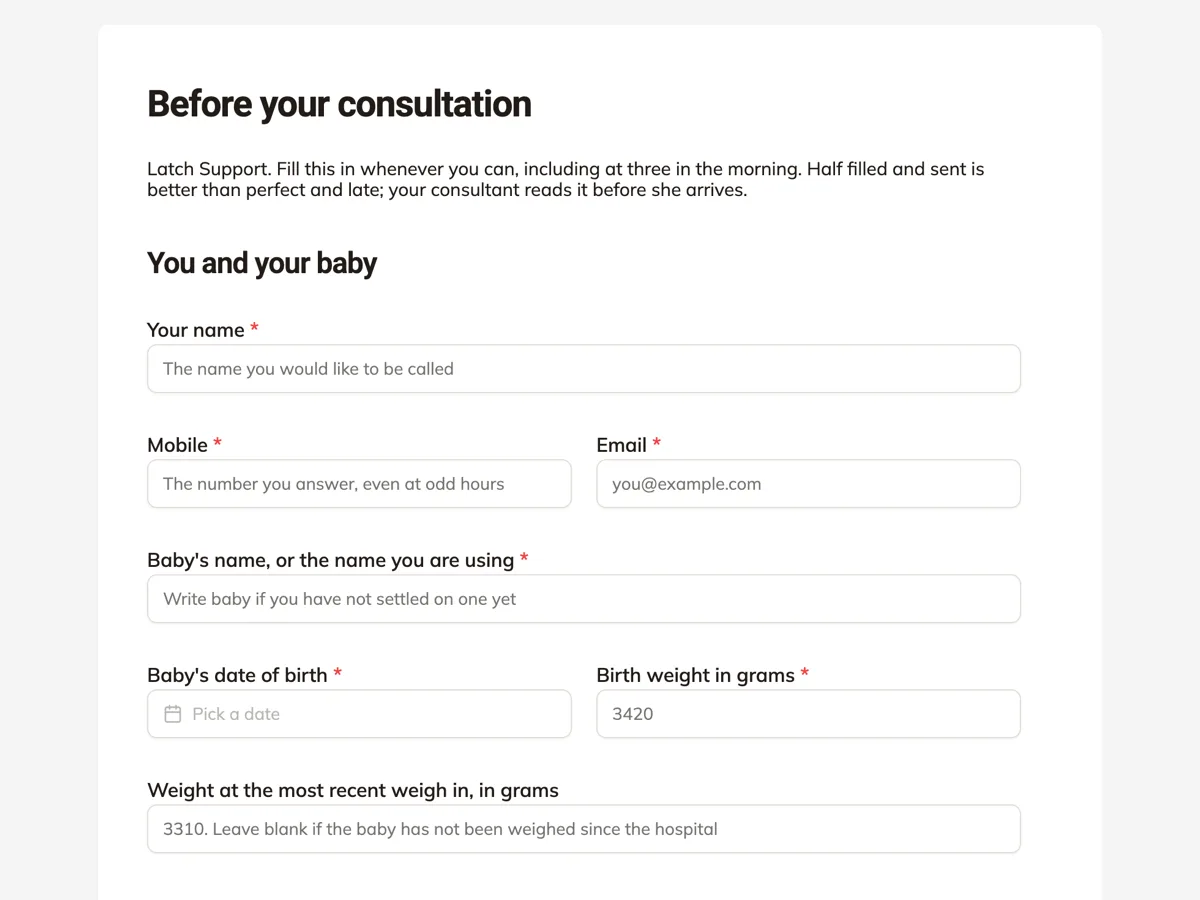
The form itself
A static copy of the finished form, exactly as it renders. Nothing here can be filled in or submitted, so read it as a reference and build your own from the button above.
Every field, and what it collects
The complete field list, in the order respondents meet it.
- Your nameShort textRequired
- MobileShort textRequired
- EmailShort textRequired
- Baby's name, or the name you are usingShort textRequired
- Baby's date of birthDateRequired
- Birth weight in gramsNumberRequired
- Weight at the most recent weigh in, in gramsNumber
- What kind of birth was it?Single choiceRequired
- Options: Vaginal, no assistance · Vaginal, with forceps or vacuum · Planned caesarean · Caesarean after labour started · Preterm, before 37 weeks · Twins or more
- What happened in the first week?Multiple choiceRequired
- Options: Skin to skin in the first hour · First feed within the first hour · Time in special care or the neonatal unit · Jaundice, with or without lights · Formula top ups started in hospital · A tongue tie was looked at · A tongue tie was divided · Antibiotics for me or the baby · None of these
- Does feeding hurt?Single choiceRequired
- Options: No pain at all · A few seconds at the start, then it settles · Pain for the whole feed · Pain between feeds as well · Cracked, bleeding or blistered nipples · A deep ache or burning after feeds
- What are you worried about?Multiple choiceRequired
- Options: Not making enough milk · Making too much, and spraying or choking · Baby not gaining weight · Baby slipping off or clicking · Baby falling asleep at the breast · Feeds taking over an hour · Feeds every hour and a half or less · A blocked duct or mastitis · Going back to work · Wanting to stop, and how to do that well
- Are you expressing?Single choiceRequired
- Options: Not at all · By hand, occasionally · Single electric pump, once or twice a day · Double electric pump, three to five times a day · Exclusively pumping · I have a pump but cannot get it to work
- Feeding logTable
- Columns: Time · Side · Minutes · Top up and amount
- What would a good outcome look like for you?Long textRequired
- Your own health, medications and anything else worth knowingLong text
- SignatureSignatureRequired
You and your baby
The birth
How feeding is going
The last twenty four hours
What you want and consent
What each block of this form collects
The identity block is short on purpose and the baby name field says to write baby if nothing has been settled on, because this form is often filled in on day four. Birth weight and the most recent weight sit as two numbers rather than a growth history, since the difference between them is the number that drives the consultation. The birth block is a type radio and a first week checklist, which together explain most of what is happening two weeks later. How feeding is going is two questions: pain described as six recognisable experiences, and a worry list that names ten of them. The log is the centre of the form. The last block asks what a good outcome would be, and it is the field that most changes how the visit is run.
How to adapt this form
A hospital based service seeing mothers on day two replaces the twenty four hour log with a since birth version, every feed from delivery, and adds the cot card observations, wet and dirty nappies and any blood sugar results, because at that point the numbers exist and the memory does not. A practice that mostly does tongue tie assessments promotes the two tongue tie lines into a block: who assessed it, what was found, whether it was divided, and what changed afterwards. A return to work service drops the birth block entirely and adds the return date, the hours, the distance to the baby and what storage and expressing space the workplace offers.
What makes this form work
Four columns hold a whole day of feeds
Time, side, minutes and top up amount across eight numbered rows. Eight lines cover a day for most babies, and the top up column is where the real supply picture shows up without anyone having to ask about it directly.
Pain is described, not scored
Six recognisable experiences from a few seconds at the start to a deep ache after feeds. Each one points at a different cause, which a number between one and ten never would, and every parent recognises themselves in one of the six.
The first week is a checklist, not a story
Skin to skin, a first feed within the hour, special care, jaundice, early formula, a tongue tie looked at, a tongue tie divided and antibiotics for either of you. Eight ticks explain most of what is happening two weeks later, and they take fifteen seconds.
Questions people ask
Why does a lactation consultant want a twenty four hour feeding log?
Because the pattern is the diagnosis. Eight feeds of forty minutes with top ups is a different problem from fourteen feeds of ten minutes, and neither is recalled accurately in conversation. Times, side, minutes and top ups across eight rows give the consultant the shape of the day before she walks in the door.
What if the last twenty four hours were not typical?
Send them anyway. A bad night is information, and the consultant would rather see a real day than a reconstructed average. The paragraph above the table asks for rough times and approximate minutes for the same reason, since precision that is invented is worse than an estimate that is honest.
Why ask about the birth at a feeding consultation?
Because how feeding starts is shaped by it. An assisted birth, a caesarean after labour, time in special care, jaundice or early formula top ups each change milk supply, the baby's ability to latch or both. The first week checklist collects eight of those in one question.
Why is wanting to stop on the list of worries?
Because it is one of the most common reasons a parent books, and a list that offers only supply and pain tells them this is not the place to say it. Printing it as an option, phrased as wanting to stop and how to do that well, makes the question askable and the answer honest.
Does the consultant send a report to anyone else?
Only if asked. The consent paragraph says a summary is written for the parent and sent to a GP, midwife or child health nurse only on request. That keeps the decision with the person whose information it is, which matters more here than in most health settings because the subject is often mixed up with feelings of judgement.
Why does the thank you screen ask not to feed before the visit?
Because the consultant needs to watch a full feed and a recently fed baby will not oblige. An hour without a feed before the appointment is the single most useful thing a parent can do to make the visit worth the money, so it is said on the thank you screen rather than buried in a confirmation email.
Build your own in about a minute
The button below opens the generator with this use case already described. Change the wording to match your own, generate, then edit anything you like.
Make one like thisOther form examples
Sleep consultant intake form with a three day sleep diary
No sleep plan can be written from one night, because one night is either the good one a parent remembers or the terrible one that made them book. This fifteen field intake form collects three days as a diary table, plus the room, the routine and the way the child actually falls asleep at bedtime.
Naturopath intake form with an eight system review grid
A naturopathic consultation asks about eight body systems and everything already being swallowed, and doing that inventory out loud costs most of a first appointment. This nineteen field intake form takes the grid and the supplements table beforehand, so the ninety minutes go on the conversation instead.
Couples counselling intake form, one form for each partner
A couples intake form that is filled in together gets one story twice, which is exactly what the counsellor did not need. This fourteen field intake form is sent to each partner separately, and it carries the two questions that only work in private: the safety screen, and where each person actually is with the relationship.
Want the steps in the builder? Read Every form field and when to use it, then View, export and manage your responses. For everything this generator can do, see the form maker.
Written and checked by the OneCraft team. Last checked .