Classic form
Couples counselling intake form, one form for each partner
A couples intake form that is filled in together gets one story twice, which is exactly what the counsellor did not need. This fourteen field intake form is sent to each partner separately, and it carries the two questions that only work in private: the safety screen, and where each person actually is with the relationship.
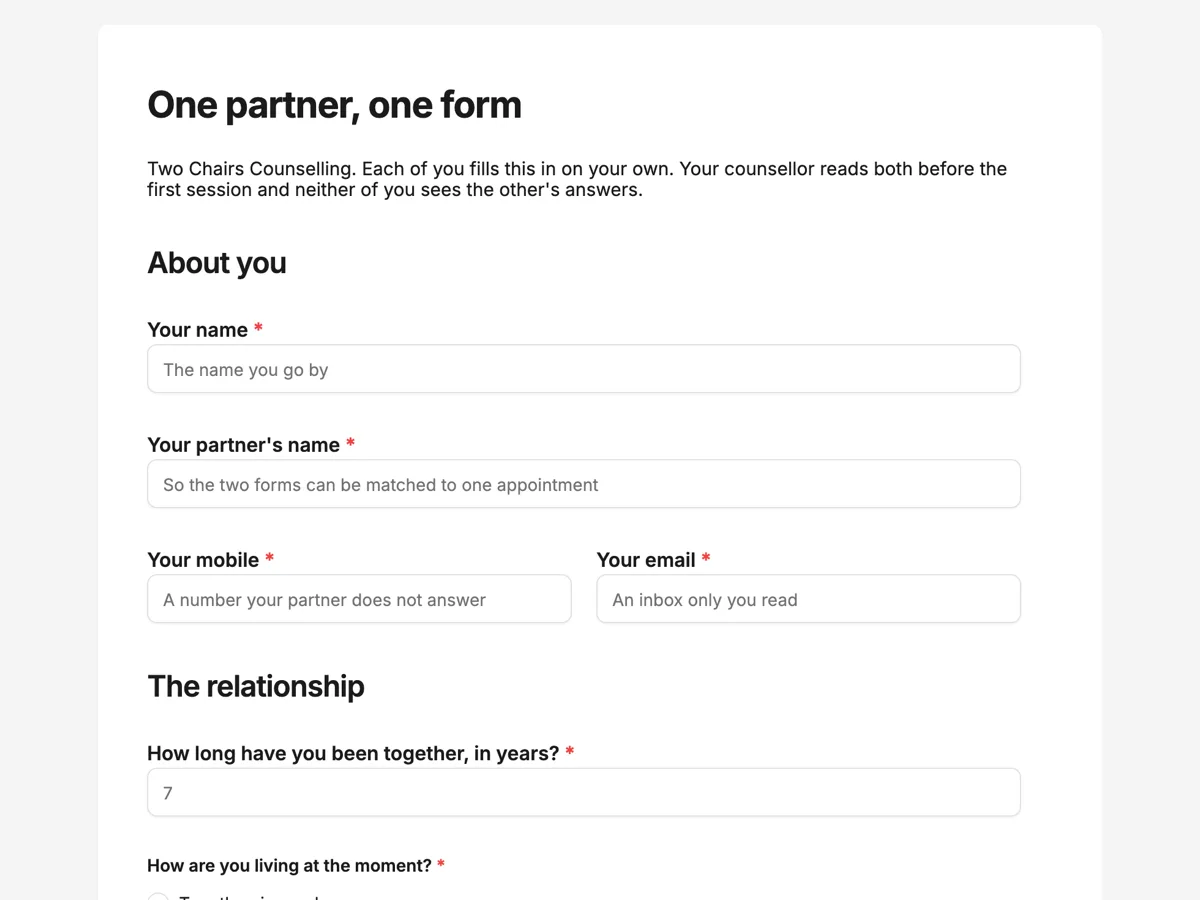
The form itself
A static copy of the finished form, exactly as it renders. Nothing here can be filled in or submitted, so read it as a reference and build your own from the button above.
Every field, and what it collects
The complete field list, in the order respondents meet it.
- Your nameShort textRequired
- Your partner's nameShort textRequired
- Your mobileShort textRequired
- Your emailShort textRequired
- How long have you been together, in years?NumberRequired
- How are you living at the moment?Single choiceRequired
- Options: Together, in one home · Together, but sleeping separately · Living apart by choice, seeing each other · Living apart because of work or distance · Recently separated, still in the same house · Separated, living in different homes
- Are there children in either household?Single choiceRequired
- Options: No children · Children we have together, living with us · Children from earlier relationships, living with us · Both, in a blended household · Children who live somewhere else some of the time · Expecting a child now
- What would you like to be different in six months?Long textRequired
- What do you think your partner would say is the problem?Long text
- Where are you with the relationship right now?Single choiceRequired
- Options: Committed, and wanting it to work better · Committed, but running out of patience · Unsure whether to stay · Leaning towards ending it · Already decided to end it, and want help doing that well · I would rather say this in the session
- Have you had counselling before, together or separately?Single choiceRequired
- Options: Neither of us, ever · Me, on my own · My partner, on their own · Both of us, separately · The two of us together, with somebody else · The two of us together, and it did not go well
- Is there anything in the relationship that frightens you, or that you feel you cannot say in front of your partner?Single choiceRequired
- Options: No · Yes · I would rather speak to the counsellor privately first
- Confidentiality between partnersMultiple choiceRequired
- Options: I have read how confidentiality works between partners and agree to counselling on that basis
- SignatureSignatureRequired
About you
The relationship
Why you are here
Safety
Confidentiality and consent
What each block of this form collects
The identity block asks for the partner name so two separately submitted forms can be matched to one appointment, and it asks for a mobile the partner does not answer and an inbox only the respondent reads. Those two placeholders are doing real work: a couple sharing a phone or an email account cannot be contacted privately, and the practice needs to know that before it sends anything. The relationship block is three structured questions, length, living arrangement and children, which together describe the situation in about fifteen seconds. The why you are here block holds the two open questions and the commitment question. The safety block is one radio with a paragraph above it. The last block is confidentiality, which in couples work is a different thing from confidentiality anywhere else.
How to adapt this form
A family therapy practice adds a household map, every person living in the home with their age and relationship, and replaces the commitment question with one about which relationship in the family is under the most strain. A separation or mediation service keeps the safety screen unchanged, drops the six month goal question and adds property, parenting arrangements and whether legal advice has been taken, since the work there has a different destination. A practice offering discernment counselling for couples where one person is leaning out promotes the commitment question to the top of the form, because in that model it decides which of two completely different processes is offered.
What makes this form work
The contact fields ask for a private channel
A number your partner does not answer, and an inbox only you read. Two placeholders that assume nothing about a shared phone, and give the practice the information it needs before it sends a single reminder.
The safety question has three answers and a paragraph
No, yes, and I would rather speak to the counsellor privately first. Above it, four sentences say everybody is asked, what a yes leads to, and where to go in an emergency. The question only produces true answers because those sentences are there.
Confidentiality between partners is stated before consent
The practice holds no secrets on behalf of one partner, the counsellor will say so openly if asked to carry one, and safety disclosures are handled separately. The tick sits directly under that paragraph, so nobody agrees to a rule they have not read.
Questions people ask
Why does each partner fill in a separate form?
Because a form completed together produces one negotiated story and hides the disagreement, which is the thing the counsellor needs to see. Separate forms also make the safety question answerable. The welcome screen says explicitly not to fill it in together or read it out afterwards, which is the instruction that makes the rest work.
Why ask what the partner would say the problem is?
Because the answer shows how much each person can hold the other's view, which predicts how the work will go more reliably than the complaint itself does. It is optional, and an empty box is informative too. A counsellor reads the two answers side by side before the first session.
What happens if somebody answers yes to the safety question?
The counsellor arranges an individual conversation before any joint session, which the paragraph above the question states before it is answered. Couples work is not appropriate where one person is afraid of the other, so the answer changes what is offered rather than being held against anybody or repeated in the room.
Why does the commitment question have six answers?
Because committed and wanting it to work is a different piece of work from already decided and wanting to end it well, and both are real reasons to book. The sixth option, I would rather say this in the session, is the pressure valve that keeps the other five honest for somebody not ready to type it.
How is confidentiality different in couples counselling?
The client is the relationship rather than either person, so this practice holds no ongoing secret on behalf of one partner. The paragraph says the counsellor will not repeat what is on the form but will also not carry a secret through the work, and that safety disclosures are handled separately. The tick records that this was read.
Can one partner send their form before the other?
Yes, and the thank you screen says the first session goes ahead regardless. Waiting for both would mean the appointment is held hostage by whoever is least keen, which in couples work is usually the person the session most needs to reach.
Build your own in about a minute
The button below opens the generator with this use case already described. Change the wording to match your own, generate, then edit anything you like.
Make one like thisOther form examples
Psychology intake form with the limits of confidentiality on it
A first psychology session has fifty minutes and a person who has usually waited weeks for it, so the history should not eat the first twenty. This twenty field intake form takes the referral pathway, a ten item distress baseline and the supports already in place, and states the limits of confidentiality above the signature.
Cosmetic clinic consultation form with a treatment history table
The question that decides a cosmetic appointment is rarely what the client wants, it is what they have already had and when. This seventeen field consultation form takes a dated table of previous treatments alongside the skin type, the medications and the pregnancy question, and is explicit that it books nothing.
Dietitian intake form built around a 24 hour recall
A dietitian cannot plan anything from a person saying they eat pretty well, which is why the first appointment usually burns twenty minutes reconstructing yesterday. This sixteen field intake form takes that reconstruction as a six row table the night before, alongside the conditions, allergies and funding pathway the practice needs.
Want the steps in the builder? Read Control who can fill in your form, then Every form field and when to use it. For everything this generator can do, see the form maker.
Written and checked by the OneCraft team. Last checked .