Classic form
Dietitian intake form built around a 24 hour recall
A dietitian cannot plan anything from a person saying they eat pretty well, which is why the first appointment usually burns twenty minutes reconstructing yesterday. This sixteen field intake form takes that reconstruction as a six row table the night before, alongside the conditions, allergies and funding pathway the practice needs.
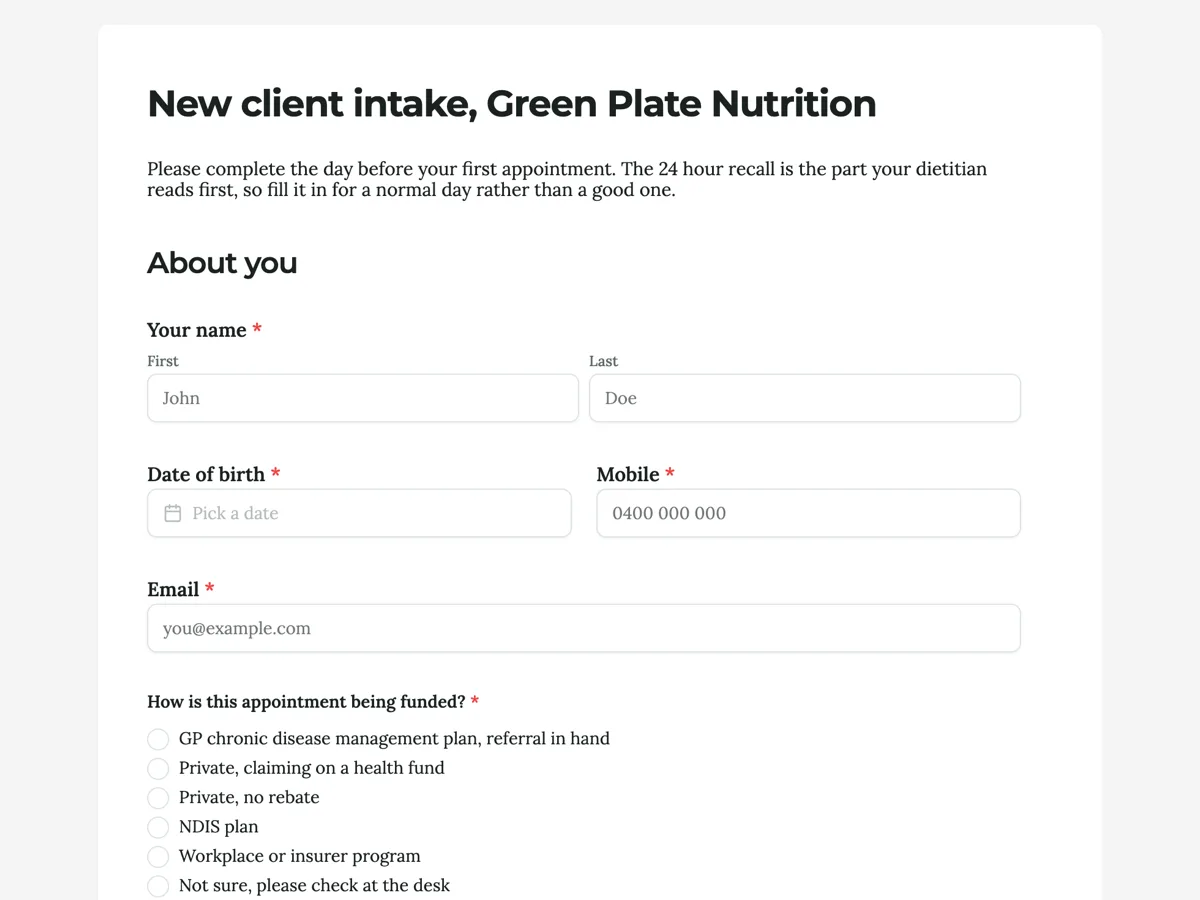
The form itself
A static copy of the finished form, exactly as it renders. Nothing here can be filled in or submitted, so read it as a reference and build your own from the button above.
Every field, and what it collects
The complete field list, in the order respondents meet it.
- Your nameNameRequired
- Date of birthDateRequired
- MobileShort textRequired
- EmailShort textRequired
- How is this appointment being funded?Single choiceRequired
- Options: GP chronic disease management plan, referral in hand · Private, claiming on a health fund · Private, no rebate · NDIS plan · Workplace or insurer program · Not sure, please check at the desk
- Referral or plan number, if you have oneShort text
- What would you like to work on?Multiple choiceRequired
- Options: Blood glucose control · Cholesterol or blood pressure · Losing weight · Gaining weight · Settling gut symptoms · Eating enough around training · Iron or other low results · Planning meals for a busy week · Reading labels with confidence · Feeding a fussy child
- Do any of these apply to you?Multiple choiceRequired
- Options: Type 1 or type 2 diabetes · High cholesterol or high blood pressure · Coeliac disease · Irritable bowel syndrome or another gut condition · Reflux · Kidney disease · Thyroid condition · Polycystic ovary syndrome · Pregnant or breastfeeding · An eating disorder, now or in the past · None of these
- Allergies, intolerances and foods you will not eatLong text
- Medications and supplements, with dosesLong text
- Height in centimetresNumber
- Weight today in kilogramsNumber
- Heaviest adult weight in kilograms, if you know itNumber
- 24 hour food recallTable
- Columns: Time · What you ate or drank · How much
- On a normal week, how often is dinner cooked at home?Single choiceRequired
- Options: Almost every night · Four or five nights · Two or three nights · Rarely, mostly bought or delivered
- SignatureSignatureRequired
About you
What you want from this
Your health
Yesterday, from waking to sleeping
Consent
What each block of this form collects
The first block is four identity fields and the funding question, which is asked early because it decides whether a report goes back to a GP and how many appointments are covered. The goals block is a single ten option tick list, written as things a person would actually say out loud rather than as clinical outcomes, so it can be answered in fifteen seconds and still tell the dietitian which appointment this is going to be. The health block opens with the privacy paragraph, then the ten condition checklist with its none of these line, then the two free text fields that no checklist can replace: allergies with intolerances and avoided foods separated out, and medications with supplements folded in because protein powders and pharmacy vitamins are where half the surprises live. Height, weight today and heaviest adult weight sit together as three numbers rather than a history the client has to write out.
The Australian pieces on this form
Funding is what makes this an Australian form. A GP chronic disease management plan is the first option because it is the most common route to a rebated dietitian appointment here, it comes with a referral the client physically has, and it obliges the dietitian to report back to the referring doctor, which is why the consent paragraph names that report explicitly. No Medicare number and no health fund membership number is collected anywhere on the form: the referral is handed over at reception and the card is swiped there, which keeps identifiers out of a web submission. The consent paragraph names Accredited Practising Dietitian status, which is the credential an Australian client is looking for.
How to adapt this form
A diabetes education practice replaces the goals list with a glucose monitoring block: meter or sensor, typical morning reading, and whether insulin is in use, then keeps the recall table but adds a column for what the reading was afterwards. A paediatric practice swaps the recall for a three day plate description filled in by a parent and adds growth chart percentiles, since a single day of a toddler eating tells nobody anything. A sports dietitian keeps the table and adds a training load row set, session times and session types, because the question there is not what was eaten but when it was eaten relative to the work.
What makes this form work
The recall is a table, not a long text box
Time, what you ate or drank, and how much, across six numbered rows. A free text box gets three lines and a shrug; three narrow columns get six eating occasions with amounts, because the shape of the table tells the client what a complete answer looks like.
Amounts are asked in the units people think in
The paragraph above the table says a mug, two slices, a palm sized piece. Asking for grams produces guesses dressed as precision, and a dietitian converts household measures every day anyway, so the form asks for the thing the client actually knows.
Funding is asked before anything clinical
Six options, with a GP chronic disease management plan first and not sure last. The answer decides the rebate, the appointment length and whether a report goes back to the referring doctor, so the desk settles it before the dietitian opens the health section at all.
Questions people ask
Why does a dietitian ask for a 24 hour recall before the appointment?
Because doing it live eats the session. Reconstructing yesterday takes a client ten minutes of honest thinking and a dietitian twenty minutes of prompting, so the table moves that work to the night before. It also produces a more truthful record, since nobody is editing themselves in front of a professional while they write it.
Does the table grow if a day had more than six eating occasions?
No. A table on this form renders exactly the number of rows it was built with, and this one is six. Six covers breakfast, a morning snack, lunch, an afternoon snack, dinner and something in the evening, which is the shape of most days. Anything extra goes in the last row alongside what is already there.
Why ask for heaviest adult weight rather than a weight history?
Because one number answers the clinical question and a history does not get filled in. The gap between today and the heaviest adult weight tells the dietitian about the direction of travel and whether weight has been lost before, which is the conversation the first appointment opens with. It is optional, since plenty of people genuinely do not know.
Should an intake form ask about eating disorders?
Yes, and it belongs in the condition list rather than in a separate question that singles it out. This form puts it as the tenth item, phrased as now or in the past, so it is answered in the same tick as diabetes or reflux. It changes how the first appointment is run, which is the whole reason for asking before rather than during.
Who sees the answers, and does the GP get a copy?
The dietitian and the practice, under their login. Where a client arrives on a chronic disease management plan the referring GP receives a report, and the consent paragraph above the signature says so in those words. No employer, insurer or health fund receives anything without separate written consent, which is what the privacy paragraph in the health block sets out.
Can the recall be filled in on a phone?
Yes. The six row table scrolls sideways on a narrow screen with the time column staying readable, and the three columns are short enough to type with a thumb. Most clients complete this form in the evening, which is convenient, because yesterday is still close enough to remember properly.
Build your own in about a minute
The button below opens the generator with this use case already described. Change the wording to match your own, generate, then edit anything you like.
Make one like thisOther form examples
Occupational therapy intake form built on a daily living grid
An occupational therapist is asked to change how a day works, so the intake has to describe the day rather than the diagnosis. This eighteen field intake form takes an eight task support grid, the equipment already in the house, and the funding with its plan dates, before the first home visit is booked.
Podiatry intake form that asks about diabetes first
Two answers decide how a podiatry appointment is run before the podiatrist has seen a foot: whether the patient has diabetes, and whether the circulation and nerve supply are intact. This fifteen field intake form asks both in the first health block, then collects the footwear, the standing hours and the orthotics history that explain the rest.
Psychology intake form with the limits of confidentiality on it
A first psychology session has fifty minutes and a person who has usually waited weeks for it, so the history should not eat the first twenty. This twenty field intake form takes the referral pathway, a ten item distress baseline and the supports already in place, and states the limits of confidentiality above the signature.
Want the steps in the builder? Read Every form field and when to use it, then View, export and manage your responses. For everything this generator can do, see the form maker.
Written and checked by the OneCraft team. Last checked .