Classic form
Psychology intake form with the limits of confidentiality on it
A first psychology session has fifty minutes and a person who has usually waited weeks for it, so the history should not eat the first twenty. This twenty field intake form takes the referral pathway, a ten item distress baseline and the supports already in place, and states the limits of confidentiality above the signature.
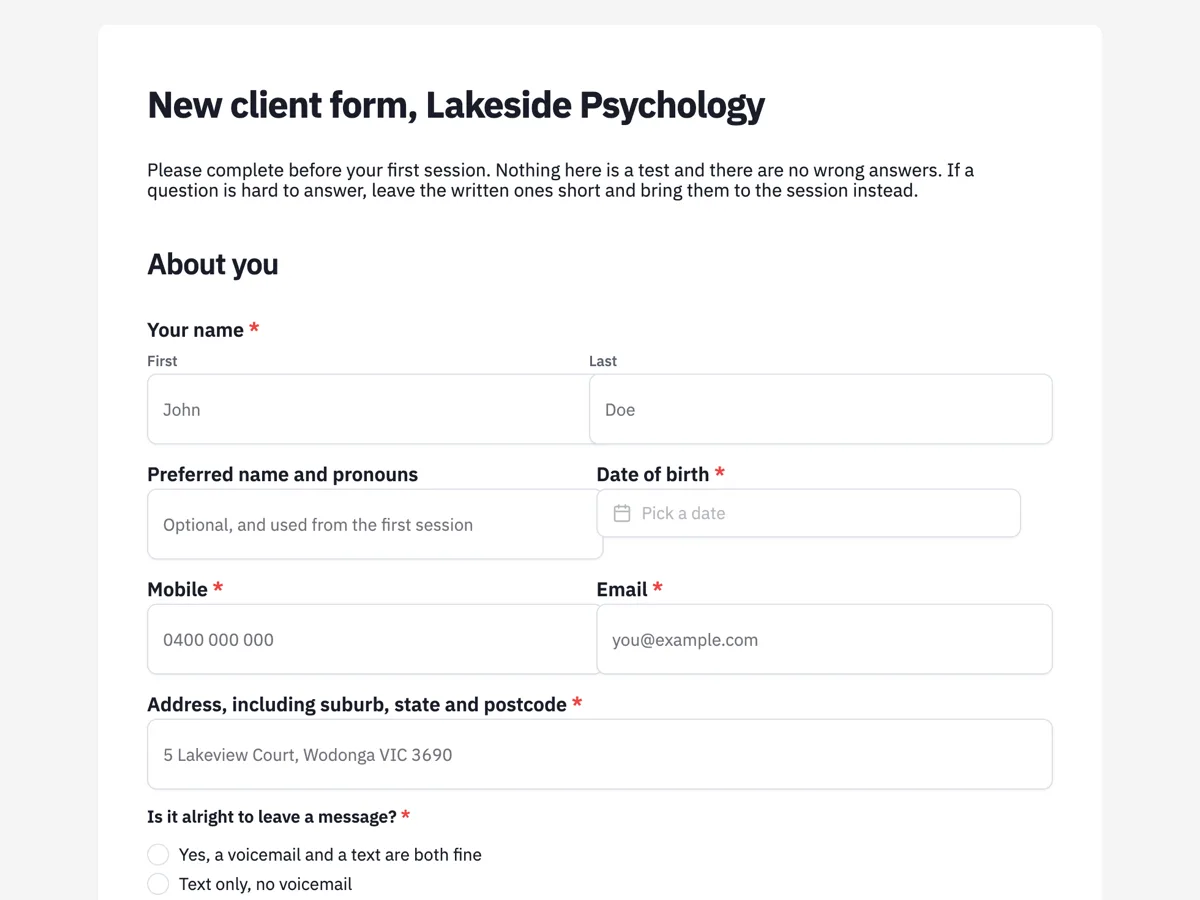
The form itself
A static copy of the finished form, exactly as it renders. Nothing here can be filled in or submitted, so read it as a reference and build your own from the button above.
Every field, and what it collects
The complete field list, in the order respondents meet it.
- Your nameNameRequired
- Preferred name and pronounsShort text
- Date of birthDateRequired
- MobileShort textRequired
- EmailShort textRequired
- Address, including suburb, state and postcodeShort textRequired
- Is it alright to leave a message?Single choiceRequired
- Options: Yes, a voicemail and a text are both fine · Text only, no voicemail · Voicemail only · Neither, please just try again · Email only
- Referral pathwaySingle choiceRequired
- Options: GP mental health treatment plan · Referral from a psychiatrist · Self referred, paying privately · NDIS, self managed or plan managed · Workers compensation · Employee assistance programme through my work · Not sure, please check for me
- Referring doctor and clinic, if you have a referralShort text
- Sessions already used under a plan this calendar yearNumber
- What would you like help with?Long textRequired
- How long has this been going on?Single choiceRequired
- Options: Weeks · A few months · 6 to 12 months · 1 to 3 years · Longer than 3 years · On and off for as long as I remember
- In the last four weeks, how often have you felt this way?Rating gridRequired
- Statements:
- Worn out without a clear reason
- On edge or keyed up
- So on edge that nothing settled you
- That things were not going to get better
- Unable to sit still or settle
- So unsettled that you had to keep moving
- Flat or low in mood
- That ordinary tasks took more out of you than they should
- That nothing lifted your mood
- That you were of little value
- Which of these have been part of the last month?Multiple choiceRequired
- Options: Sleep that is broken, too short or too long · Appetite or weight has changed noticeably · Drinking more, or using something more than usual · Withdrawing from people I would normally see · Trouble at work or with study · Conflict at home or in a relationship · Panic attacks · Grief or a recent loss · None of these
- Have you seen a psychologist, counsellor or psychiatrist before?Single choiceRequired
- Options: No, this is the first time · Yes, and it helped · Yes, and it was not the right fit · Yes, and I stopped going before I meant to · Yes, I am seeing someone else at the moment
- Medications and supplementsTable
- Columns: Name · Dose · How long you have taken it · What it is for
- What support do you already have?Multiple choiceRequired
- Options: A GP I see regularly · Family I can talk to · Close friends · A partner · A support group or community · Faith or a spiritual community · A case manager or support coordinator · Not much at the moment
- Emergency contact: name, relationship and phoneShort textRequired
- ConsentMultiple choiceRequired
- Options: I have read the limits of confidentiality above and I understand them · I consent to assessment and to psychological treatment · I agree to the fee and cancellation terms sent with my booking confirmation
- SignatureSignatureRequired
About you
How you are coming to see us
What brings you here
History and support
Consent and the limits of confidentiality
What each block of this form collects
The identity block includes a preferred name and pronouns field that is optional and used from the first session, and a question about leaving a message that offers text only and voicemail only as separate answers, because for a lot of clients that is the difference between a practice being safe to contact them and not. The referral block asks the pathway, the referring doctor and the number of plan sessions already used this year, which is the number that decides how many remain. The history block opens with a written question that the placeholder deliberately keeps low pressure, then the distress grid, then a tick list of what has been part of the last month. Support asks about previous therapy and about who is already around the person.
The Australian pieces on this form
The referral radio names the pathways an Australian practice actually bills against, starting with a GP mental health treatment plan, which carries a set number of rebated sessions in a calendar year, and including NDIS, workers compensation and an employee assistance programme. The sessions used number is asked because the count resets annually and clients routinely lose track of it, and getting it before the first appointment stops a rebate failing at the desk. No Medicare number is collected anywhere on the form; the card is sighted at reception. Psychologists are registered with the national board and bound by a professional code of conduct, and the two crisis numbers named in the consent paragraph and the thank you screen are the national ones.
How to adapt this form
A child and adolescent practice adds a parent or guardian block, a school and year field, and a question about who else is involved such as a paediatrician or a school wellbeing team, and splits the distress grid into a version the young person answers and a shorter one the parent answers. A couples practice removes the distress grid entirely, since it is an individual measure, and replaces it with a relationship history block and a question about whether both partners are attending. A practice doing a lot of workers compensation adds an employer, insurer and claim number block and a separate consent tick for reporting to the insurer, which should never be folded into general consent.
What makes this form work
Ten statements, one five point scale
Worn out without a clear reason through to feeling of little value, each rated none of the time to all of the time over the last four weeks. One grid gives the psychologist a baseline in two minutes, and the paragraph above it says plainly that it is a screen and not a diagnosis.
Four named limits, not a general clause
Serious and imminent risk, a child at risk of harm, a subpoena, and written consent to release. Naming them individually above the consent ticks is what makes the first tick meaningful, and the paragraph promises the same conversation again in the first session.
Plan sessions used is a number field
One field, capped between zero and forty, asked beside the referring doctor. It is the figure that decides how many rebated sessions remain in the calendar year, and getting it here stops a rebate failing at reception after a first appointment.
Questions people ask
Why does an intake form ask whether it is alright to leave a message?
Because a voicemail can be heard by someone else in the house, and for a client managing a difficult relationship that is a real risk. Offering text only and voicemail only as separate options, plus neither, lets the practice make contact in a way that is safe. It takes one question and it is asked before anything sensitive.
What is the ten item screen actually measuring?
General psychological distress over the last four weeks, rated on a five point frequency scale from none of the time to all of the time. The paragraph above calls it a baseline rather than a diagnosis and says the statements are the practice own wording, which is the honest description of what a screening measure does.
Why ask how many plan sessions have been used this year?
Because rebated sessions under a mental health treatment plan are counted per calendar year and clients rarely track them. Asking before the first appointment means the practice can tell somebody they have two sessions left rather than discovering it when a claim is rejected at the desk, which is a bad way to end a first session.
Should the limits of confidentiality be on the form or left to the session?
Both, and this form says so. The paragraph names four specific exceptions, serious and imminent risk, a child at risk of harm, a subpoena and written consent to release, and then says the psychologist will talk it through in the first session including who would be contacted. Reading it beforehand means the conversation starts from understanding.
Why is the medications table optional?
Because a required table forces somebody who takes nothing to type none into four rows, and because a client who cannot remember a dose should not be blocked from submitting. The paragraph above says to leave it blank if there is nothing.
What if somebody cannot finish the form?
The welcome screen says to send it half finished and say so, and the introduction says to keep the written answers short and bring them to the session instead. An intake form that a distressed person cannot complete simply does not get sent, and a first appointment with a partly filled form is far better than a cancelled one.
Build your own in about a minute
The button below opens the generator with this use case already described. Change the wording to match your own, generate, then edit anything you like.
Make my psychology intake form with the limits of confidentiality on itOther form examples
Physiotherapy intake form built around one injury
A physiotherapist has about forty minutes and needs a third of it to examine, so the history has to arrive before the patient does. This eighteen field intake form maps the region and side, the onset, the pain score and what aggravates it, then records which funding pathway is paying.
Massage intake form that asks about pressure before the table
A client lying face down with their eyes closed will almost never ask for lighter pressure or say that they would rather their feet were left alone. This fourteen field intake form asks both in advance, alongside a contraindication screen that adapts the technique rather than cancelling the booking.
Chiropractic intake form with a spine history grid
A chiropractor examining a lower back needs to know what the neck, the mid back and the jaw have been doing for the last three months, and asking that one region at a time takes the whole appointment. This seventeen field form puts eight regions in a single grid and screens for the conditions that change the plan.
Want the steps in the builder? Read Every form field and when to use it, then Control who can fill in your form. For everything this generator can do, see the form maker.
Written and checked by the OneCraft team. Last checked .