Classic form
Cosmetic clinic consultation form with a treatment history table
The question that decides a cosmetic appointment is rarely what the client wants, it is what they have already had and when. This seventeen field consultation form takes a dated table of previous treatments alongside the skin type, the medications and the pregnancy question, and is explicit that it books nothing.
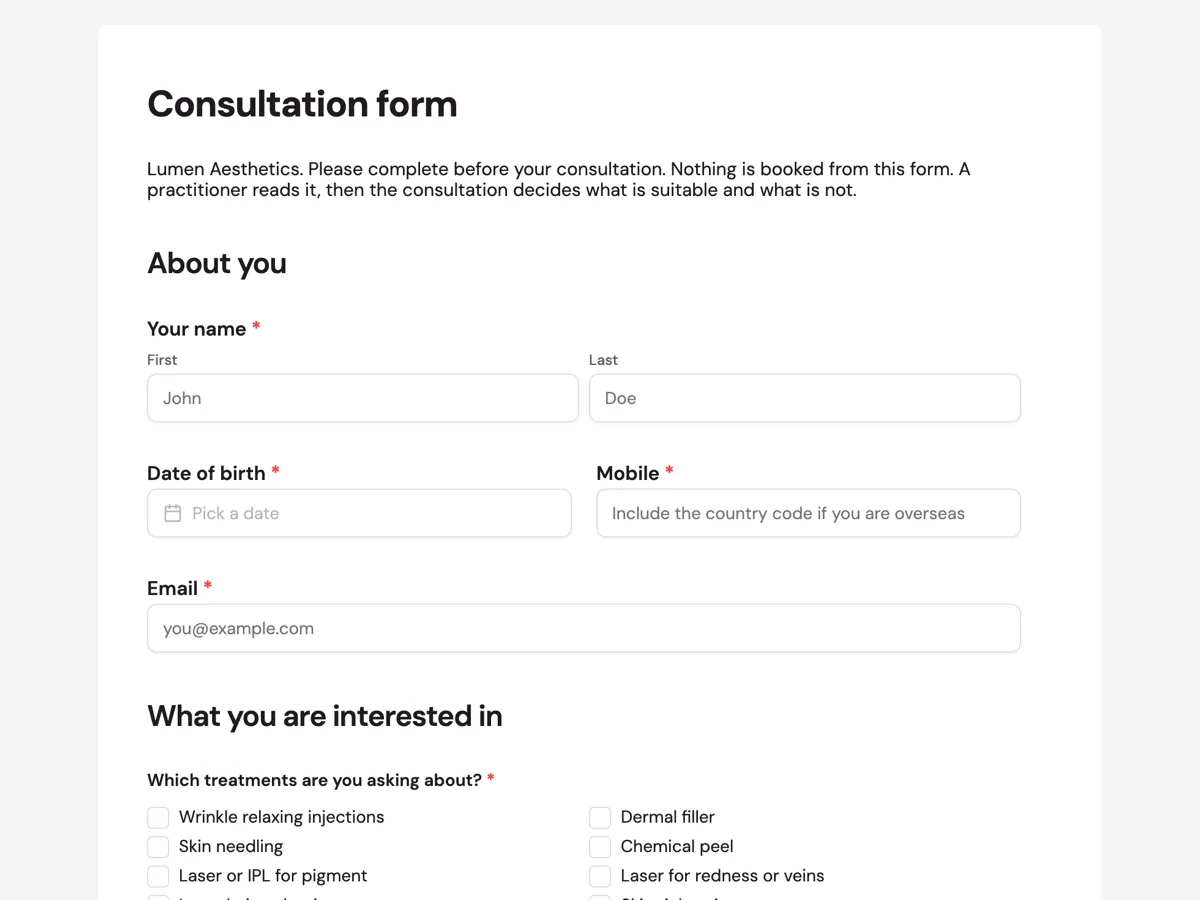
The form itself
A static copy of the finished form, exactly as it renders. Nothing here can be filled in or submitted, so read it as a reference and build your own from the button above.
Every field, and what it collects
The complete field list, in the order respondents meet it.
- Your nameNameRequired
- Date of birthDateRequired
- MobileShort textRequired
- EmailShort textRequired
- Which treatments are you asking about?Multiple choiceRequired
- Options: Wrinkle relaxing injections · Dermal filler · Skin needling · Chemical peel · Laser or IPL for pigment · Laser for redness or veins · Laser hair reduction · Skin tightening · Medical grade skincare only · Not sure, I want advice
- What would you like to be different, in your own words?Long textRequired
- How does your skin behave in the sun?Single choiceRequired
- Options: Always burns, never tans · Burns easily, tans a little · Sometimes burns, tans gradually · Rarely burns, tans easily · Very rarely burns, tans deeply · Never burns, deeply pigmented
- Do any of these apply to your skin?Multiple choiceRequired
- Options: Acne, active now · Rosacea or easy flushing · Melasma or patchy pigmentation · Eczema or dermatitis · Psoriasis · Keloid or thick raised scars · Cold sores that recur · Very sensitive or reactive skin · Recent sunburn or a tan · None of these
- Previous cosmetic treatmentsTable
- Columns: Treatment · Approximate date · Where it was done · How it went
- Are you pregnant, breastfeeding or trying to conceive?Single choiceRequired
- Options: No, none of these · Pregnant · Breastfeeding · Trying to conceive · Prefer to discuss at the consultation
- Medications and supplements, with dosesLong text
- Health conditions and historyMultiple choiceRequired
- Options: An autoimmune condition · Diabetes · A bleeding disorder or blood thinning medication · A neurological condition affecting the face or muscles · Immune system suppressed by medication or illness · Cancer treatment in the last two years · Isotretinoin in the last twelve months · A permanent implant, thread or facial surgery · A known allergy to a local anaesthetic · None of these
- Is there an event you are planning around?Single choiceRequired
- Options: No, nothing in particular · Something within the next two weeks · Something in two to six weeks · Something two to six months away · A wedding, and I am in it
- Sun, tanning and travel in the next four weeksSingle choiceRequired
- Options: Nothing planned, normal daily sun only · A beach or snow holiday booked · Regular outdoor sport or work · Planning to use fake tan or a solarium
- A photo of the area you want to discussPhoto upload
- Clean skin, no makeup, in daylight near a window rather than under a downlight. A front on shot is enough. It is used to plan the consultation and is stored in your clinic record.
- Before you signMultiple choiceRequired
- Options: I understand this form books nothing and that suitability is decided at the consultation
- SignatureSignatureRequired
About you
What you are interested in
Your skin
What you have had done before
Health
Photo and consent
What each block of this form collects
Four identity fields, then the two questions that frame the consultation: which treatments are being asked about, and what the client actually wants to be different. Those are deliberately separate, because a client who ticks filler and then writes that they look tired in photographs may be better served by something else entirely, and a practitioner would rather read both. The skin block is a sun behaviour radio and a ten item condition list, which together set what can be used on that skin at all. The history table is the centre of the form. The health block is the set of conditions and medications that rule treatments out for a period, and the two timing questions, an upcoming event and planned sun exposure, decide scheduling rather than suitability.
How to adapt this form
A clinic doing mostly skin treatments rather than injectables replaces the treatment tick list with a routine block: cleanser, active ingredients, retinoid use, sunscreen habit and how long the current routine has run, because in that work the home routine is half the result. A laser hair reduction service adds hair colour, previous methods used, hormonal conditions and the date of the last wax, since waxing inside four weeks makes a session pointless. A clinic with a surgical arm adds a general anaesthetic history, a smoking question and a body mass question, which belong to a different consent conversation and should not be mixed into this one.
What makes this form work
The table asks how it went, not just what it was
Treatment, approximate date, where it was done and how it went. The fourth column is where a client mentions bruising for two weeks or a result they hated, which is the sentence that changes the plan more than the treatment name ever does.
Skin type is described by behaviour in the sun
Always burns and never tans, through to never burns and deeply pigmented. Six plain descriptions beat any scale a client has to look up, and the answer sets the laser and peel settings before anybody has seen the skin.
Two questions separate suitability from scheduling
An upcoming event and planned sun or tanning in the next four weeks both change when a treatment happens rather than whether it can. Keeping them out of the health block means neither gets mistaken for a contraindication.
Questions people ask
Why is a previous treatment table more useful than a yes or no question?
Because timing decides suitability. Filler placed eight weeks ago, a peel three weeks ago and a laser course still running each change what can safely be done at the next appointment, and none of that survives a question that asks only whether the client has had treatment before. Four columns and four rows collect it in a minute.
What if the client cannot remember the dates?
Approximate is fine and the paragraph above the table says so in those words. A month and a year is enough to decide whether something sits inside or outside the window that matters, and where it is genuinely unknown the how it went column often gives the practitioner more to work with than the date would have.
Why does the form ask about an upcoming event?
Because it changes the timing rather than the treatment. Most injectable and skin work looks its worst in the first week and its best at four to six, so somebody with a wedding in ten days is scheduled differently from somebody with nothing planned. Asking on the form avoids finding out after the appointment is made.
Is the consultation photo required?
No, it is optional, and it does not replace being seen in person. It lets the practitioner think about the area before the consultation, which makes the conversation more specific. The field says to take it on clean skin in daylight near a window, because a downlight flattens exactly the things it is meant to show.
What happens to the photo afterwards?
It goes into the client record and stays there. The consent paragraph states that treatment photographs are never used for marketing without separate written permission, which is a different consent taken at a different time. A clinic that folds marketing rights into an intake signature has not really obtained them.
Does this form consent to treatment?
No, and it says so twice, on the welcome screen and in the consent paragraph. What is signed here is that the information given is accurate and that suitability is decided at the consultation. Consent to a specific procedure, with its specific risks, is taken separately once a practitioner has examined the area and explained them.
Build your own in about a minute
The button below opens the generator with this use case already described. Change the wording to match your own, generate, then edit anything you like.
Make one like thisOther form examples
Optometry intake form that asks about the family too
Half of what an optometrist looks for at a first examination is decided by two things the patient already knows: how their eyes are used, and what runs in their family. This fourteen field intake form collects both, along with the screen hours, the driving pattern and the general health that change what the examination tests.
Lactation consultant intake form built around a feeding log
A lactation consultation is decided by two things a parent already has: the last twenty four hours of feeds, and how the first week went. This sixteen field intake form collects both as an eight row log and a first week checklist, alongside the pain, the supply worries and the pumping.
Psychology intake form with the limits of confidentiality on it
A first psychology session has fifty minutes and a person who has usually waited weeks for it, so the history should not eat the first twenty. This twenty field intake form takes the referral pathway, a ten item distress baseline and the supports already in place, and states the limits of confidentiality above the signature.
Want the steps in the builder? Read Every form field and when to use it, then Design your welcome and thank you screens. For everything this generator can do, see the form maker.
Sources
Written and checked by the OneCraft team. Last checked .