Classic form
Sleep consultant intake form with a three day sleep diary
No sleep plan can be written from one night, because one night is either the good one a parent remembers or the terrible one that made them book. This fifteen field intake form collects three days as a diary table, plus the room, the routine and the way the child actually falls asleep at bedtime.
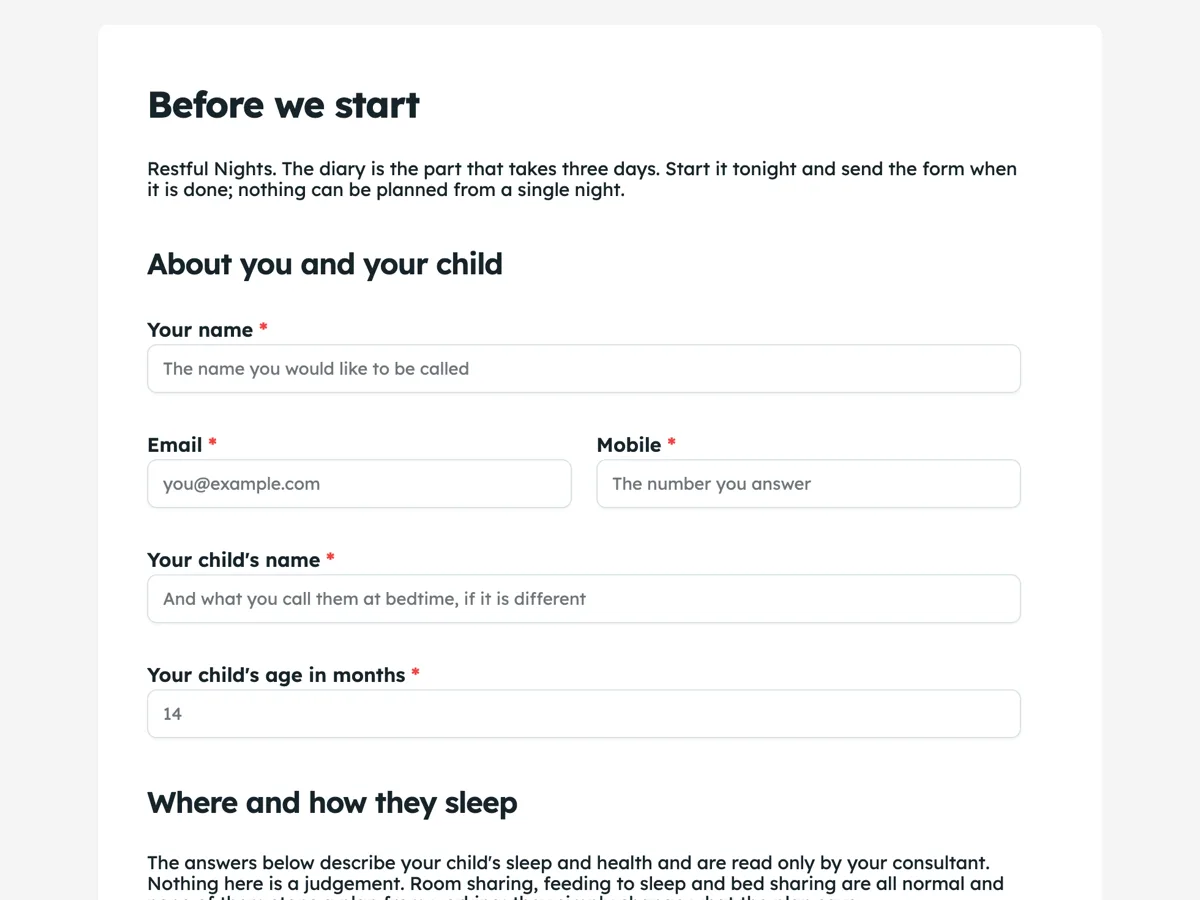
The form itself
A static copy of the finished form, exactly as it renders. Nothing here can be filled in or submitted, so read it as a reference and build your own from the button above.
Every field, and what it collects
The complete field list, in the order respondents meet it.
- Your nameShort textRequired
- EmailShort textRequired
- MobileShort textRequired
- Your child's nameShort textRequired
- Your child's age in monthsNumberRequired
- Where does your child start the night?Single choiceRequired
- Options: Own cot in their own room · Own cot in your room · Own bed in their own room · A bed shared with a sibling · In your bed · Somewhere else, such as a pram or the lounge
- What is the room like?Multiple choiceRequired
- Options: Dark enough that you cannot read in it · Light comes in at dawn · A night light is on · White noise is playing · A heater or air conditioner runs · Street or household noise carries in · A sibling sleeps in the same room · A screen is in the room · A sleeping bag is used · A comforter or soft toy is in the cot
- The current routine, from dinner to lights outLong textRequired
- How does your child actually fall asleep at bedtime?Single choiceRequired
- Options: Put down awake, falls asleep alone · Fed to sleep · Rocked or carried to sleep · Patted or held until asleep · A parent lies beside them · A parent sits in the room, not touching · In a pram, a car or a carrier
- On a normal night, how many times do you go in?Single choiceRequired
- Options: None · Once · Two or three times · Four to six times · More than six · We stopped counting
- Three day sleep diaryTable
- Columns: Day · Naps and times · Bedtime · Night wakes and what settled them · Morning wake
- What have you already tried?Multiple choiceRequired
- Options: A later bedtime · An earlier bedtime · Dropping or shortening a nap · Controlled comforting or timed checks · Staying in the room until asleep, then leaving · A gradual withdrawal over several nights · A dream feed · Cutting night feeds · A book, an app or an online program · Nothing structured yet
- What would make this worth it for you?Long textRequired
- Has a GP, paediatrician or child health nurse reviewed your child's sleep?Single choiceRequired
- Options: Yes, and nothing medical was found · Yes, and something is being treated · Yes, and we are waiting on a referral · No, but there is nothing I am worried about · No, and there are things I am worried about
- SignatureSignatureRequired
About you and your child
Where and how they sleep
Three days of diary
What you have tried and what you want
Consent
What each block of this form collects
Four identity fields and one number, the age in months, which is the single figure every recommendation is indexed against. The where and how block is four questions that between them describe the sleep setting exactly: where the night starts, what the room is like, what the evening actually looks like written out, and the way the child gets from awake to asleep. That last one is asked as seven described methods rather than as a yes or no about self settling, because the difference between being patted and having a parent lie beside them is the whole plan. The diary is the evidence. The final block is what has already been tried, which stops a consultant proposing a failed method, what the family actually wants, and whether anyone medical has looked.
How to adapt this form
A newborn service for the first twelve weeks replaces the diary with a twenty four hour version, feeds included, and swaps the tried list for a feeding and settling question, since at that age the answer is rarely a routine change. A service working with school aged children drops the naps column, adds screen use in the two hours before bed, worries at bedtime and what time they actually have to wake, because the constraint there is the school bell rather than the nap. A practice supporting parents of children with additional needs keeps the structure and adds the diagnosis, sensory sensitivities and any medication that affects sleep, and lengthens the diary to seven days.
What makes this form work
Five columns across three days
Day, naps and times, bedtime, night wakes and what settled them, and the morning wake. Those five together show whether the problem is the bedtime, the naps or the wake time, which is the first decision a plan makes.
The going in question ends in we stopped counting
None, once, two or three, four to six, more than six, and we stopped counting. That last option is not a joke; it is the most accurate answer a parent of a four month old can give, and offering it keeps the rest of the answers honest.
The privacy paragraph says nothing here is a judgement
Room sharing, feeding to sleep and bed sharing are named as normal before any question is asked. Without that line, the form gets the sanitised version of the routine, which is the one no plan can be built on.
Questions people ask
Why does a sleep consultant need three days rather than one?
Because one night is not data. Parents book after the worst night of the month and remember the best one, so a single entry tells a consultant about the memory rather than the pattern. Three consecutive days show whether naps, bedtime and wakes are drifting together, which is what most plans actually fix.
What if the three days were unusual?
Send them anyway and say so in the routine field. A teething week or a trip away is still information, and a consultant would rather work from what happened than from a tidied version. The paragraph above the diary asks specifically for the night the child ended up in the parents' bed, since that is the night a plan has to account for.
Why ask how the child falls asleep rather than whether they self settle?
Because self settling is a phrase parents interpret differently. Seven described methods, from put down awake through fed to sleep, rocked, patted, a parent lying beside them and a parent sitting in the room, place every family precisely. The distance between the current method and the goal is what the plan has to cross.
Is a sleep consultant a medical service?
No, and the consent paragraph says so plainly. It is education and support. Snoring, mouth breathing, choking in sleep, reflux and poor weight gain are named in that paragraph as things referred to a doctor before any plan starts, which is why the form also asks whether a GP, paediatrician or child health nurse has already looked.
Why does the form ask what has already been tried?
To stop the consultant recommending something that has already failed, and to hear how it failed. Ten options cover the usual attempts, from a later bedtime to cutting night feeds, and ending the list with nothing structured yet lets a family who has simply been surviving answer honestly.
Does the room checklist really change anything?
More than most parents expect. Whether the room is dark enough to fail a reading test, whether light arrives at dawn, whether white noise is already running and whether a sibling shares the room each change what can be asked of the child. Ten ticks collect it faster than a description would.
Build your own in about a minute
The button below opens the generator with this use case already described. Change the wording to match your own, generate, then edit anything you like.
Make one like thisOther form examples
Lactation consultant intake form built around a feeding log
A lactation consultation is decided by two things a parent already has: the last twenty four hours of feeds, and how the first week went. This sixteen field intake form collects both as an eight row log and a first week checklist, alongside the pain, the supply worries and the pumping.
Naturopath intake form with an eight system review grid
A naturopathic consultation asks about eight body systems and everything already being swallowed, and doing that inventory out loud costs most of a first appointment. This nineteen field intake form takes the grid and the supplements table beforehand, so the ninety minutes go on the conversation instead.
Dietitian intake form built around a 24 hour recall
A dietitian cannot plan anything from a person saying they eat pretty well, which is why the first appointment usually burns twenty minutes reconstructing yesterday. This sixteen field intake form takes that reconstruction as a six row table the night before, alongside the conditions, allergies and funding pathway the practice needs.
Want the steps in the builder? Read Every form field and when to use it, then Create a form with AI. For everything this generator can do, see the form maker.
Written and checked by the OneCraft team. Last checked .