Classic form
Acupuncture intake form that asks the traditional questions
An acupuncturist needs answers that sound irrelevant to the person giving them, because temperature, thirst, digestion and sleep are read together as a pattern rather than as separate complaints. This fifteen field intake form asks all five of the traditional questions, then screens for the nine things that change how needling is done.
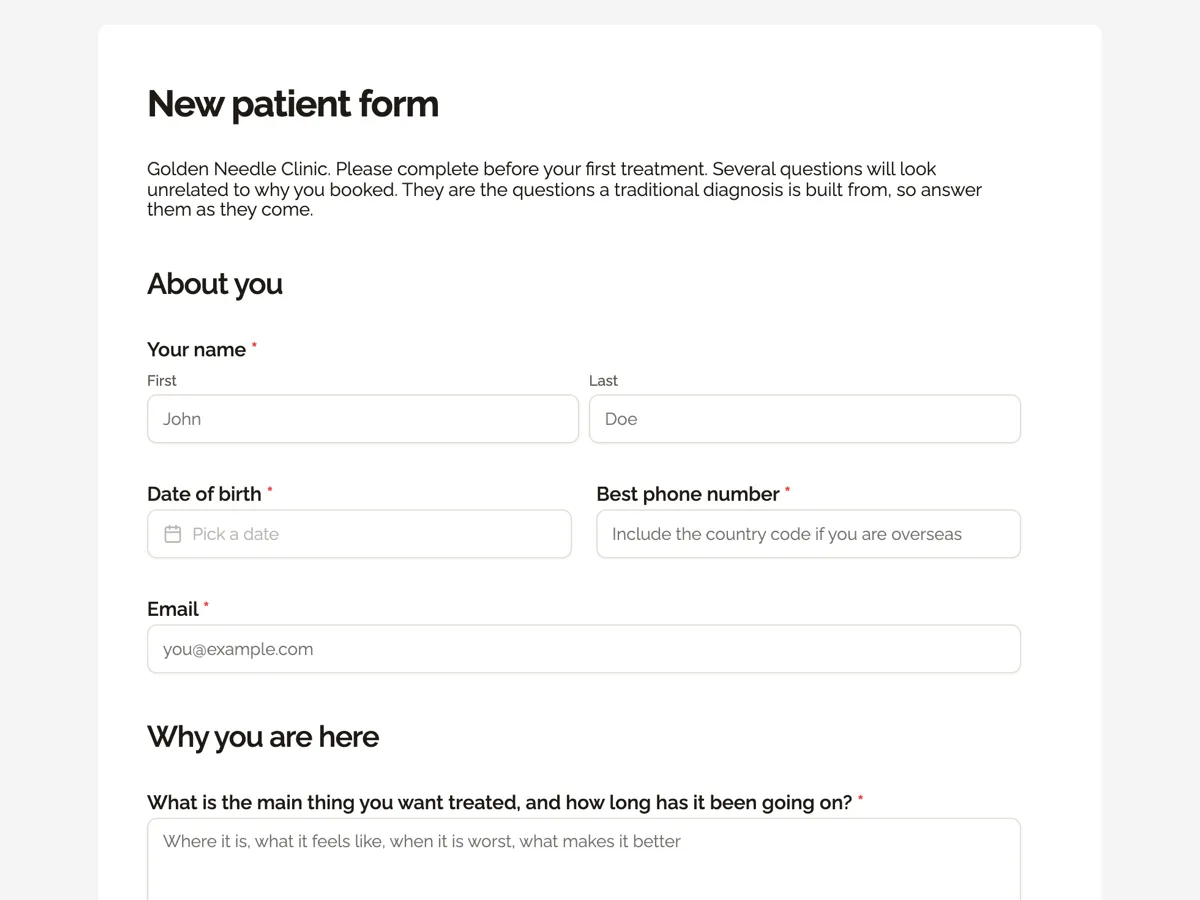
The form itself
A static copy of the finished form, exactly as it renders. Nothing here can be filled in or submitted, so read it as a reference and build your own from the button above.
Every field, and what it collects
The complete field list, in the order respondents meet it.
- Your nameNameRequired
- Date of birthDateRequired
- Best phone numberShort textRequired
- EmailShort textRequired
- What is the main thing you want treated, and how long has it been going on?Long textRequired
- Do you run hot or cold compared with people around you?Single choiceRequired
- Options: Always cold, first to put a jumper on · Cold hands and feet, but otherwise comfortable · About the same as everyone else · Warm, first to open a window · Hot at night, comfortable by day · It swings between the two
- Which of these do you notice most weeks?Multiple choiceRequired
- Options: Dry mouth or constant thirst · Prefer hot drinks, rarely thirsty · Night sweats or waking damp · Dizziness on standing · Ringing in the ears · Palpitations or a racing heart · Low back or knee ache · Headaches behind the eyes or at the temples · Sighing, or a tight chest when stressed · Bruise easily · None of these
- Digestion: what happens on a normal week?Multiple choiceRequired
- Options: Bloating after meals · Appetite comes and goes · Hungry again an hour later · Heartburn or reflux · Loose stools or urgency · Constipation · Worse when stressed · Worse after cold or raw food · Nothing unusual
- How do you sleep?Single choiceRequired
- Options: Straight off, through until morning · Take an hour or more to get off · Wake between one and three, then lie awake · Wake early and cannot get back · Wake often through the night · Vivid dreams, wake unrefreshed
- Menstrual cycle, if this applies to youShort text
- Do any of these apply to you?Multiple choiceRequired
- Options: Taking blood thinning medication · A bleeding disorder such as haemophilia · A pacemaker or another implanted electrical device · Pregnant, or trying to conceive · Immune system suppressed by medication or illness · Lymph nodes removed on one side · Metal allergy, including nickel · Faint at the sight of needles or blood · Epilepsy · None of these
- Medications, supplements and herbs you takeLong text
- Have you had acupuncture before?Single choiceRequired
- Options: Never · Once or twice · A full course at some point · Regularly, with another practitioner · Yes, and I reacted badly to it
- Consent to needlingMultiple choiceRequired
- Options: I have read the statement above and consent to acupuncture treatment
- SignatureSignatureRequired
About you
Why you are here
The traditional questions
Needling safety
Consent
What each block of this form collects
Four identity fields, then one open question about the complaint, and then the part that makes this an acupuncture form rather than a generic health questionnaire. The traditional block is introduced by a paragraph that tells the patient plainly why they are about to be asked whether they prefer hot drinks, because a question that looks like a non sequitur gets a careless answer unless its purpose is stated. Temperature comes first, then the eleven sign checklist, then digestion, then sleep, then the cycle question for the patients it applies to. The safety block is separate and is read differently: it is not a pattern, it is a list of nine conditions that change where needles go, how deep they go, or whether a point is used at all. The consent paragraph describes what the patient will actually feel.
How to adapt this form
A fertility focused clinic promotes the cycle question out of a single short text field into its own block: cycle length, basal temperature charting, previous cycles tracked, and any assisted reproduction already under way, because that detail is the case rather than a footnote to it. A musculoskeletal practice keeps the safety screen intact but replaces the traditional block with a body region tick list, a side, an onset date and an aggravating factor list, since dry needling patients come with an injury rather than a pattern. A clinic that also does cosmetic acupuncture adds a facial history question, previous injectables and threads included, which matters because recent filler changes where needles can safely be placed.
What makes this form work
The odd questions are explained before they are asked
A paragraph above the block says these five are asked of everybody and are read together as a pattern. Without it, a patient who came about a shoulder answers a thirst question carelessly, and the whole traditional section becomes decorative.
Safety is a separate block with nine named conditions
Blood thinners, bleeding disorders, a pacemaker, pregnancy, immune suppression, lymph node removal, metal allergy, fainting and epilepsy. Each one changes depth, point selection or positioning, and none of them belongs mixed in with a diagnostic pattern.
The sleep question describes nights, not hours
Waking between one and three then lying awake is a different answer from taking an hour to get off, and both are different from vivid dreams and waking unrefreshed. Six described nights collect more than any number of hours slept ever would.
Questions people ask
Why does an acupuncture form ask whether I run hot or cold?
Because it is one of the oldest diagnostic questions in Chinese medicine and it sorts patients before anything else does. Somebody who is always cold and prefers hot drinks is treated differently from somebody who is hot at night and thirsty for cold water, even when they arrive with the same shoulder. Six options cover it in one tap.
What happens if I tick blood thinners on the safety screen?
The treatment changes rather than stopping. Needling still goes ahead, with finer needles, fewer points, shallower insertion and longer pressure afterwards, and the practitioner will mention that a small bruise is more likely. The point of asking on the form is that the adjustment is planned before the patient is on the table.
Why is the menstrual question optional and unstructured?
Because it does not apply to every patient and forcing it produces noise. As a single optional short text field it invites cycle length, days of bleeding, pain, clots and the date of the last period from the people it is relevant to, and it is skipped silently by everyone else. A practitioner who needs more asks in the room.
Does the form record whether needles have been used before?
Yes, as a five option question that ends with a bad reaction. Never, once or twice, a full course, regularly elsewhere, and reacted badly are five different first treatments. The last option is the one that changes the session most, because it prompts a conversation before a single needle is opened.
What does the consent paragraph say will happen?
That needles are single use and sterile, opened in front of the patient and thrown away after one insertion, and that a dull ache at the point, brief light headedness, a few hours of tiredness and a small bruise are common and harmless. It also names cupping and moxibustion as offers that can be declined, as can any individual point.
Is this form suitable for a dry needling physiotherapist?
Partly. The safety screen transfers unchanged and is the most valuable block for any needling practitioner. The traditional questions do not, since dry needling works from a musculoskeletal assessment rather than a pattern, so that block would be replaced with a body region list, a side and an onset date.
Build your own in about a minute
The button below opens the generator with this use case already described. Change the wording to match your own, generate, then edit anything you like.
Make one like thisOther form examples
Couples counselling intake form, one form for each partner
A couples intake form that is filled in together gets one story twice, which is exactly what the counsellor did not need. This fourteen field intake form is sent to each partner separately, and it carries the two questions that only work in private: the safety screen, and where each person actually is with the relationship.
Personal training intake form with the readiness screen built in
A personal training intake form collects a client's goals, a seven question pre exercise readiness screen, training history, injuries, how many sessions a week they can manage and baseline measurements, before the first session. This fifteen screen intake asks the readiness questions one at a time the day before, because asking them face to face at the start of session one wastes the session and gets softer answers.
Sleep consultant intake form with a three day sleep diary
No sleep plan can be written from one night, because one night is either the good one a parent remembers or the terrible one that made them book. This fifteen field intake form collects three days as a diary table, plus the room, the routine and the way the child actually falls asleep at bedtime.
Want the steps in the builder? Read Every form field and when to use it, then Create a form with AI. For everything this generator can do, see the form maker.
Written and checked by the OneCraft team. Last checked .