Classic form
Adventure tour waiver for fitness, medical and evacuation
An adventure tour waiver records that a guest understands the risks of a remote trip, has declared their fitness and health honestly and knows who pays if they need to be evacuated. This one does it for a guided multi day walking company in eleven fields, with a four level fitness rating and an evacuation cost acknowledgement.
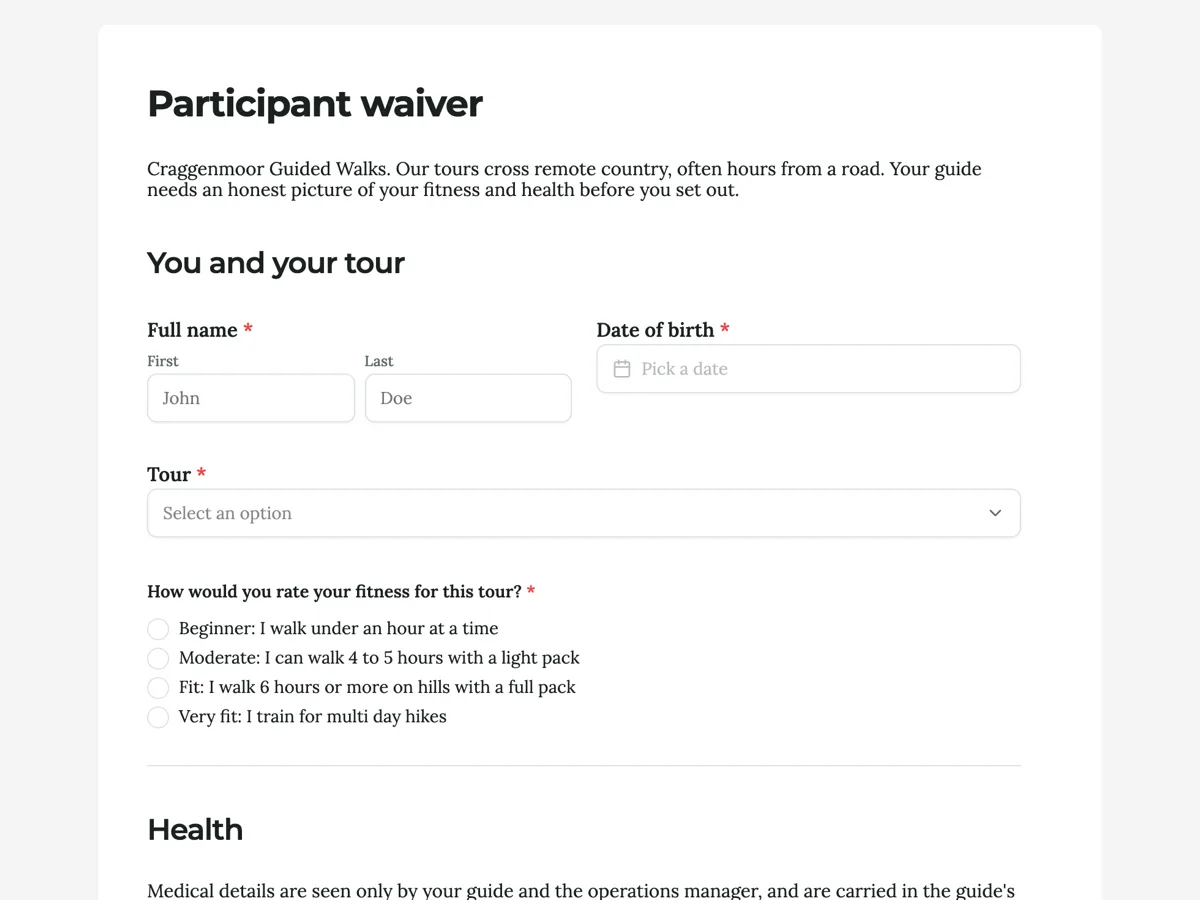
The form itself
A static copy of the finished form, exactly as it renders. Nothing here can be filled in or submitted, so read it as a reference and build your own from the button above.
Every field, and what it collects
The complete field list, in the order respondents meet it.
- Full nameNameRequired
- Date of birthDateRequired
- TourDropdownRequired
- Options: Ridgeline Traverse, 4 days, 62 km · Gorge and Waterfalls, 3 days, 38 km · Alpine Huts, 6 days, 88 km · Coastal Cliffs, 2 days, 27 km
- How would you rate your fitness for this tour?Single choiceRequired
- Options: Beginner: I walk under an hour at a time · Moderate: I can walk 4 to 5 hours with a light pack · Fit: I walk 6 hours or more on hills with a full pack · Very fit: I train for multi day hikes
- Do you have any of these?Multiple choiceRequired
- Options: Heart or lung condition · Asthma · Diabetes · Epilepsy · Severe allergy needing an adrenaline injector · Knee, hip or back problems · Fear of heights · None of these
- Medications you will carry, with dosesLong text
- Evacuation cost acknowledgementMultiple choiceRequired
- Options: I understand evacuation costs are my responsibility
- Do you have travel or ambulance insurance that covers evacuation?Single choiceRequired
- Options: Yes · No · Not sure
- Insurer and policy numberShort text
- Emergency contact name, relationship and phoneShort textRequired
- SignatureSignatureRequired
You and your tour
Health
Evacuation and insurance
What each field on this form collects
Full name sits beside date of birth, then the tour dropdown lists four walks with their days and distance. Fitness is a four level self rating described in hours of walking and pack weight. A privacy paragraph opens the health section, followed by a checkbox of seven conditions, including fear of heights, and "none of these", then an optional box for medications with doses. The evacuation paragraph sets out who pays, before a required acknowledgement. Insurance is a yes, no or not sure radio beside an optional insurer and policy number. An emergency contact and a final risks paragraph lead to the signature. Nine of the eleven fields are required.
Why fitness is described in hours, not adjectives
"Average fitness" means something different to a gym regular and to someone who walks the dog. Describing each level in walking hours and pack weight gives the guide a fact to compare with the tour: the Alpine Huts walk asks for six hour days with a pack, so a walker who picks "under an hour at a time" gets a phone call before departure, as the thank-you screen promises. Showing the distance and days in the tour dropdown does the same job from the other side, so the walker sees what they signed up for at the moment they rate themselves.
How to adapt this form
A sea kayak tour swaps the fitness levels for paddling experience and asks whether the guest can swim and has capsized before. A canyoning operator adds a question on comfort abseiling and a harness size. An overseas trekking company adds passport details and altitude history, and makes the insurance question require evacuation cover.
What makes this form work
Fitness in hours and pack weight
Four levels from "under an hour at a time" to "train for multi day hikes" give a measurable answer the guide can compare with each tour's daily distance.
Evacuation costs said out loud
A paragraph states that stretcher, vehicle or helicopter evacuation is the walker's cost, followed by its own required tick, separate from the general risks.
Insurance with an honest "not sure"
Many walkers do not know whether their cover includes evacuation, so the radio offers "not sure" beside an optional policy number for the guide to check.
Questions people ask
Who pays for a rescue on a guided tour?
In many places the walker pays, either directly or through insurance, and the cost of a helicopter evacuation can be very high. Ambulance cover differs between countries and states. This form states the walker's responsibility in a paragraph and asks for a separate acknowledgement, so no one discovers it for the first time after an injury.
Should an adventure tour require travel insurance?
Many operators require it for remote or overseas trips, and some only recommend it. This form asks yes, no or not sure and leaves the policy number optional, which suits a domestic tour. An operator that requires cover should make the policy field required and say so on the booking page.
Why ask about fear of heights?
Because a ridge line or exposed ladder can stop a walker in place, and a guide who knows in advance can plan for it: a different line, a slower pace, or a word at the briefing. It is not a reason to refuse a booking. It sits with health questions because it changes how the guide manages the group.
What should a guide do with a beginner fitness rating?
Call the walker before the tour, as the thank-you screen promises, and compare what they can do with the daily distance. Some will switch to a shorter walk; others will train in the weeks before. A beginner on a six day hike slows the group and risks injury, so the conversation is worth having early.
Is an adventure tour waiver enough to cover the operator?
No waiver replaces safe practice. Operators are expected to follow an adventure activity standard, carry suitable first aid and communication equipment, and employ qualified guides. The waiver records that the guest understood the inherent risks and gave honest information, which is evidence of informed participation, not a shield against poor guiding.
Why record medication doses on a walking tour?
If a walker collapses, the guide needs to know what they take and what they carry, such as an adrenaline injector or a reliever inhaler. The form keeps it optional and shows a placeholder with doses. The privacy paragraph says these details travel in the guide's first aid kit, where they are actually needed.
Build your own in about a minute
The button below opens the generator with this use case already described. Change the wording to match your own, generate, then edit anything you like.
Make one like thisOther form examples
Go kart waiver with licence class, height and safety briefing
A go kart waiver records that a driver understands the risks of racing, meets the height rules for their kart and has been briefed on track safety. This one adds licence class, a medical checklist, footwear and a photo for the timing screens, with a guardian for drivers under 16.
Trampoline park waiver with a jumper table and one guardian
A trampoline park waiver records that a parent or guardian accepts the risks of jumping for each child in the booking and has explained the park rules. This one lists up to four jumpers in a table, asks about the rules video, injuries and grip socks, and takes one guardian signature.
Massage consent form with draping, areas and the right to stop
A massage consent form records which treatment a client agrees to, which parts of the body may be massaged and that they can stop at any time. This one also explains draping in plain words, asks about pregnancy and health conditions, and takes the client's signature before the first appointment.
Want the steps in the builder? Read Form builder components, then Design your welcome and thank-you screens. For everything this generator can do, see the form maker.
Written and checked by the OneCraft team. Last checked .