Classic form
Campsite booking form that asks about the rig before the dates
A camping ground fits vehicles to sites, so the booking that matters is not the date but the length of what is being towed. This campsite booking form asks for the total rig length in metres, the power in amps and whether a generator is coming, then closes with the fire rules that apply on any day the district is under a total fire ban.
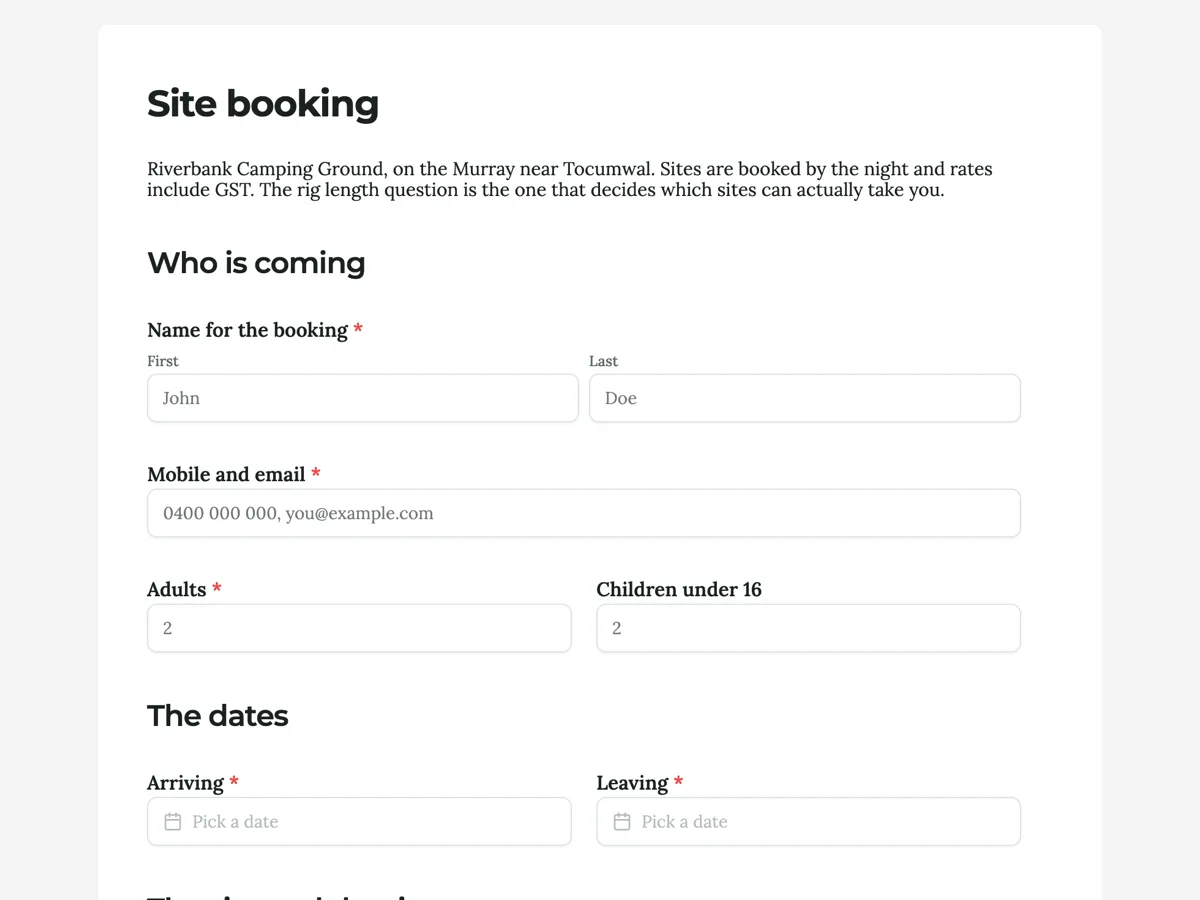
The form itself
A static copy of the finished form, exactly as it renders. Nothing here can be filled in or submitted, so read it as a reference and build your own from the button above.
Every field, and what it collects
The complete field list, in the order respondents meet it.
- Name for the bookingNameRequired
- Mobile and emailShort textRequired
- AdultsNumberRequired
- Children under 16Number
- ArrivingDateRequired
- LeavingDateRequired
- What sort of site?Single choiceRequired
- Options: Unpowered tent site, $38 a night · Powered tent site, $46 a night · Powered caravan site, drive through, $58 a night · Powered caravan site, back in, $52 a night · Large rig site, over 8 metres, $68 a night · Riverfront unpowered, no vehicle on the site, $44 a night
- What are you camping in?DropdownRequired
- Options: Tent · Swag · Rooftop tent · Camper trailer · Caravan · Pop top caravan · Fifth wheeler · Motorhome · Bus or converted van
- Total length in metres, including the tow vehicleNumberRequired
- What power do you need?Single choiceRequired
- Options: 15 amp, standard caravan lead · 10 amp, household style lead · No power, we run on solar and batteries · No power, but we would like it if a site has it
- Will you run a generator?Single choiceRequired
- Generators may run between eight in the morning and six in the evening, and never on the riverfront sites. Say so here and you will be placed away from tents.
- Options: No generator · Yes, a quiet inverter generator · Yes, a standard generator · Only if there is an outage
- Fire rulesMultiple choiceRequired
- Options: I understand fires are only permitted in the communal pits and never during a total fire ban · I will check the rating posted at the gate each day of my stay in the fire danger season
Who is coming
The dates
The site and the rig
Fire and total fire bans
What each field on this form collects
The first block takes the name for the booking, a mobile and email in one field, and adults beside children under sixteen, which is the split most grounds price on. The dates sit on one row. The site block is where the real work happens: a six option site type radio carrying a nightly rate on each line, a dropdown for what the party is camping in that runs from a swag to a converted bus, a paragraph explaining how to measure a rig properly, and a single number field for the total length in metres including the tow vehicle. Power is asked in amps rather than as a yes or no, with an option for a solar setup that would still like power if a site has it. The generator question names the hours generators may run. The last block is the fire rules paragraph with two acknowledgement ticks.
The Australian pieces on this form
Power is asked as fifteen amp or ten amp because that is how Australian caravan leads and camping ground posts are described, and a van wired for fifteen amp cannot be safely run from a household lead. Rates are quoted per night including GST, which is how a consumer price has to be displayed. Fire services declare a total fire ban by district, and on those days no solid fuel fire may be lit anywhere in the ground, including in a communal pit.
How to adapt this form
A ground with cabins adds the cabins to the site type radio with their own rates and a linen question, and hides the rig length behind the site choice by simply leaving it optional, since a cabin guest has no rig to measure. A national park campground replaces the power question with a walk in distance and adds a leave no trace acknowledgement, because the fire and rubbish rules are stricter and the vehicle question matters less. A ground that fills with seasonal fishing traffic adds a boat and trailer question, asking the trailer length separately and whether a ramp key is needed, which is the same measurement problem in a different shape.
What makes this form work
One number decides the site
Total length in metres including the tow vehicle, under a paragraph that explains how to measure it and why a metre matters. It is the answer that turns a booking request into a site allocation, and it is asked before anybody is promised a spot.
Every site option carries its nightly rate
Six site types from an unpowered tent site at thirty eight to a large rig site at sixty eight, with drive through and back in priced separately. The guest chooses with the trade off visible, and the walk in riverfront option states its constraint in the label.
The fire rules are acknowledged twice
One tick for the rule itself, that fires are only permitted in communal pits and never during a total fire ban, and a second for the habit of checking the rating posted at the gate each day. The second one is what makes the first survive a week of holiday.
Questions people ask
Why ask for the rig length in metres rather than the van model?
Because sites are cut to fixed lengths and a model number does not tell the office whether a bike rack and a spare wheel will fit. The paragraph explains how to measure, from the coupling to the rear bumper bar, including the tow vehicle if it has to sit on the site, which is the measurement that decides where the booking goes.
What does a total fire ban actually change for campers?
On a declared total fire ban day no solid fuel fire may be lit anywhere in the ground, including in the communal pits, and gas appliances may only be used under the conditions the fire service publishes for that day. The ground checks the district rating each morning in summer and posts it at the gate.
Why ask for power in amps?
Because fifteen amp and ten amp are different plugs, different leads and different loads. A van wired for fifteen amp should not be run from a household lead, and a ground that knows before arrival can allocate a site with the right post rather than lending out an adaptor that may not be safe.
Should the generator question be on a booking form?
Yes, because it changes where the site goes. Generators are noisy and camping disputes are mostly about noise. Asking up front lets the office place a generator away from tents and from the riverfront, and it puts the permitted hours in front of the guest before they arrive rather than after a complaint.
Is this a confirmed booking?
No. The thank you screen says the office confirms the site number, with the gate code and a drive in map, usually within a day. That order matters: the ground has to match the rig to an actual site before it can promise anything, which is exactly what the length and power answers make possible.
Why does the riverfront site say no vehicle on the site?
Because the riverfront sites are walk in, which protects the bank and keeps the frontage open. Saying it in the option label rather than in a terms page stops somebody booking it with a nine metre van, and it is the sort of constraint that belongs beside the price rather than three clicks away.
Build your own in about a minute
The button below opens the generator with this use case already described. Change the wording to match your own, generate, then edit anything you like.
Make one like thisOther form examples
Boat hire booking form with the licence and the weather policy on it
A boat hire booking turns on two answers that a date field cannot capture, which are what licence the person at the wheel holds and what happens when the bureau issues a wind warning. This booking form asks for both, prices each boat by its passenger limit, and takes a signature under a weather policy written in plain terms.
Holiday rental booking form with the house rules accepted up front
Two things ruin the end of a holiday rental stay: a bond deduction the guest did not expect, and a noise complaint from the house next door. This booking form puts both on the page before the dates are held, with the rules written out in full, a guest cap that is stated rather than implied, and a signature under the bond acknowledgement.
Car rental booking form with every driver named
A car rental booking is really two bookings, one for the car and one for the people allowed to drive it, and the second is where rentals go wrong. This booking form takes the vehicle class, the locations and the times in seven fields, then asks for every driver by name, licence number and expiry in a table.
Want the steps in the builder? Read Create a form with AI, then Every form field and when to use it. For everything this generator can do, see the form maker.
Written and checked by the OneCraft team. Last checked .