Classic form
Holiday rental booking form with the house rules accepted up front
Two things ruin the end of a holiday rental stay: a bond deduction the guest did not expect, and a noise complaint from the house next door. This booking form puts both on the page before the dates are held, with the rules written out in full, a guest cap that is stated rather than implied, and a signature under the bond acknowledgement.
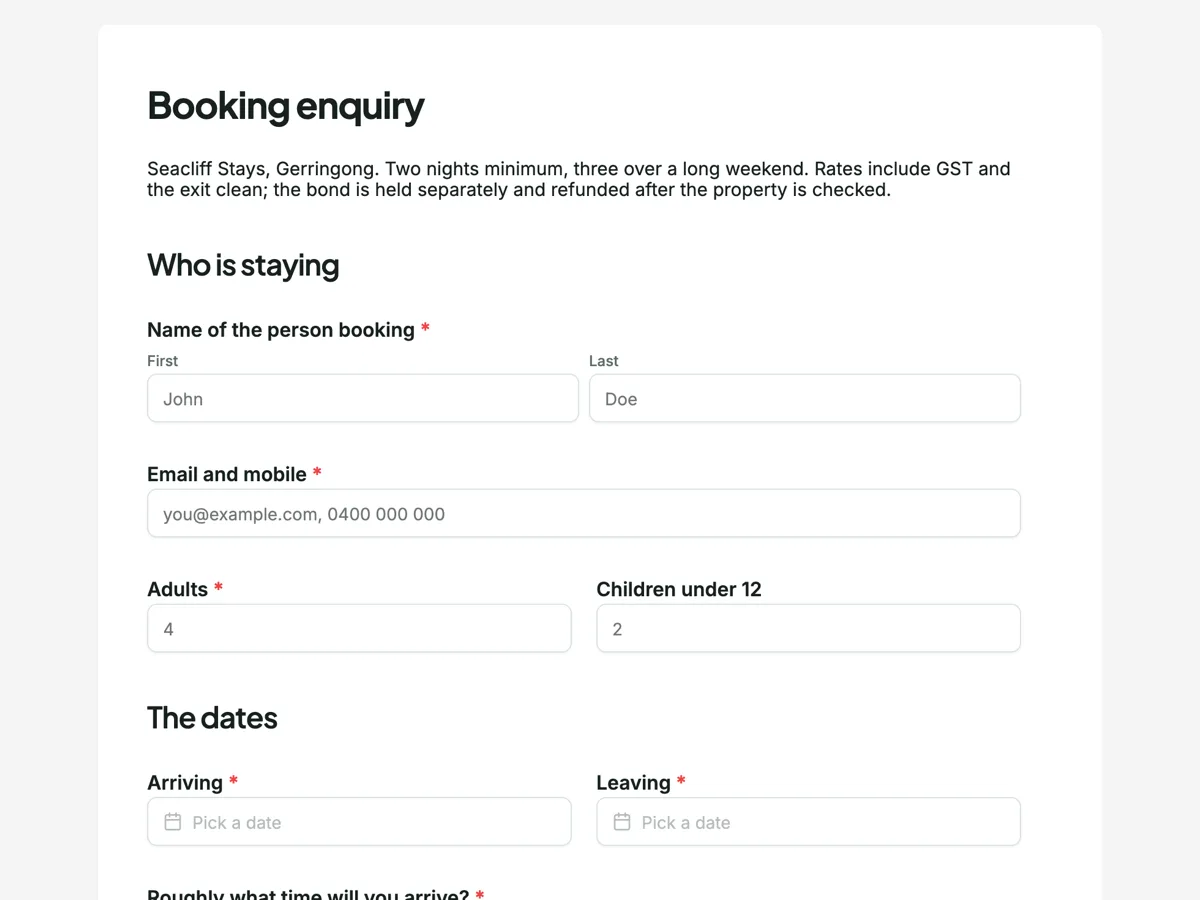
The form itself
A static copy of the finished form, exactly as it renders. Nothing here can be filled in or submitted, so read it as a reference and build your own from the button above.
Every field, and what it collects
The complete field list, in the order respondents meet it.
- Name of the person bookingNameRequired
- Email and mobileShort textRequired
- AdultsNumberRequired
- Children under 12Number
- ArrivingDateRequired
- LeavingDateRequired
- Roughly what time will you arrive?TimeRequired
- Check in is from three, and the lockbox opens from then. An early arrival is often possible when nobody stayed the night before.
- Are you bringing a dog?Single choiceRequired
- Options: No pets · One dog, stays outside and off the furniture · One dog, sleeps inside · Two dogs · A dog that is not house trained yet
- Linen pack?Single choiceRequired
- Options: Yes, beds made and towels out, $35 a bed · No, we will bring our own sheets and towels · Just the towels · Not sure yet, tell me the options
- House rulesMultiple choiceRequired
- Options: I have read the house rules and I will make sure everyone staying knows them · I understand the property is not available for a party or a function
- BondMultiple choiceRequired
- Options: I understand a bond is held and what it covers
- Signature of the person bookingSignatureRequired
Who is staying
The dates
The house
House rules and bond
What each field on this form collects
The first block takes the name of the person booking, their email and mobile in one field, and the party split as adults beside children under twelve, which is the number the guest cap is measured against. The dates block puts arrival and departure on one row and then asks roughly what time the guests will arrive. A classic form shows no note under a time field, so the owner states the three o'clock check in and any early arrival in the confirmation reply. The house block asks about dogs across five honest options and offers the linen pack with its per bed price. The last block is the two written policies: a paragraph setting out the house rules in full with two acknowledgement ticks, and a second paragraph explaining exactly what the bond covers with a tick of its own, closing with a signature from the person booking.
The Australian pieces on this form
Short term rental accommodation in New South Wales operates under a code of conduct that sets out what hosts and guests owe each other and what happens when a property generates repeated complaints, which is why the rules paragraph names quiet hours, the no party rule and the overnight guest cap in specific terms rather than asking guests to be considerate. Rates are described as including GST and the exit clean, which is how a consumer price has to read in Australia, and the bond is explained as a separate held amount rather than a fee, because a guest who thinks the bond is a cleaning charge treats the house differently.
How to adapt this form
A property with a pool adds a pool rules paragraph and its own acknowledgement tick, naming supervision of children and the gate, because that is the one clause an owner most needs evidence of. A rural or farm stay swaps the dog question for a livestock and gates question and adds a driving access note, since the arrival problem is the road rather than the time. An owner with several houses turns the first block into a property dropdown and keeps everything else, which works because the rules paragraph is the only part that changes between properties and it can be rewritten per form rather than per booking.
What makes this form work
The rules are a paragraph, not a link
Quiet hours, no parties, eight people overnight, smoking outside, dogs off the furniture, and the bin nights, all written above two ticks. The guest reads them in thirty seconds and the acknowledgement is dated and attached to their name.
The bond is explained before it is agreed to
A separate paragraph says what the five hundred covers, when it is taken, when it is returned and that it is not a cleaning fee, closing with the fact that most bonds come back in full. That last sentence is what turns a warning into an explanation.
Five honest options about the dog
Outside only, sleeps inside, two dogs, and one that is not house trained yet. Guests answer truthfully because the awkward answer is on the list, and an owner who knows can prepare the house instead of discovering it during the exit clean.
Questions people ask
Why write the house rules on the form instead of linking to them?
Because a linked page is read by almost nobody and a paragraph above a tick box is read by most people. The rules take thirty seconds to read here, and the acknowledgement is dated and attached to a named guest, which is worth far more than a link that was technically available.
Is a drawn signature enough for a booking?
For a booking enquiry, yes. It records that a named person read the rules and the bond terms and agreed to them, and it prints into the response PDF alongside their answers. A signing request with a certificate of completion is a separate e-signature process, which most holiday rentals do not need for a two night stay.
Why ask the arrival time on a self check in property?
Because it changes three things: whether an early arrival can be offered, whether the cleaner has time to finish, and whether the owner worries at nine in the evening when nobody has opened the lockbox. It is one field and it removes most of the day of arrival messaging.
What should the bond paragraph actually say?
What it covers, when it is taken, when it is returned, and that it is not a cleaning fee. This one names damage, missing items, extra cleaning beyond a normal exit clean and any fine passed on, and adds that most bonds are returned in full, which is true and stops the paragraph reading as a threat.
Why offer an option for a dog that is not house trained?
Because the honest answer is more useful than the polite one. An owner who knows can put down a mat, close a bedroom or decline the booking, all of which are better than finding out afterwards. Five specific options get a truthful answer where a yes or no question would not.
Does the guest cap need to be in the rules paragraph?
Yes, and it should be a number. Maximum eight people staying overnight is enforceable and checkable; do not exceed the capacity of the house is neither. It also gives the adults and children fields a purpose beyond the linen count, since the two numbers together are what the cap is read against.
Build your own in about a minute
The button below opens the generator with this use case already described. Change the wording to match your own, generate, then edit anything you like.
Make one like thisOther form examples
Boat hire booking form with the licence and the weather policy on it
A boat hire booking turns on two answers that a date field cannot capture, which are what licence the person at the wheel holds and what happens when the bureau issues a wind warning. This booking form asks for both, prices each boat by its passenger limit, and takes a signature under a weather policy written in plain terms.
Site inspection booking form for an electrician's quote
A site inspection booking form has to get a tradesperson to the right address, through the right door, with the right parts, at a time someone can let them in. This one asks the job type, access, a time window and parking, takes photos of the switchboard and the work area, and asks about pets before the gate opens.
Campsite booking form that asks about the rig before the dates
A camping ground fits vehicles to sites, so the booking that matters is not the date but the length of what is being towed. This campsite booking form asks for the total rig length in metres, the power in amps and whether a generator is coming, then closes with the fire rules that apply on any day the district is under a total fire ban.
Want the steps in the builder? Read Create a form with AI, then Every form field and when to use it. For everything this generator can do, see the form maker.
Written and checked by the OneCraft team. Last checked .