Classic form
Dental treatment consent form with item numbers and fees
A dental treatment consent form has to record the procedure, what it will cost, the other options the patient heard, the risks they read and how they will be sedated. This one asks for each in turn, with a four row table for the item numbers and fees from the treatment plan and a signature at the end.
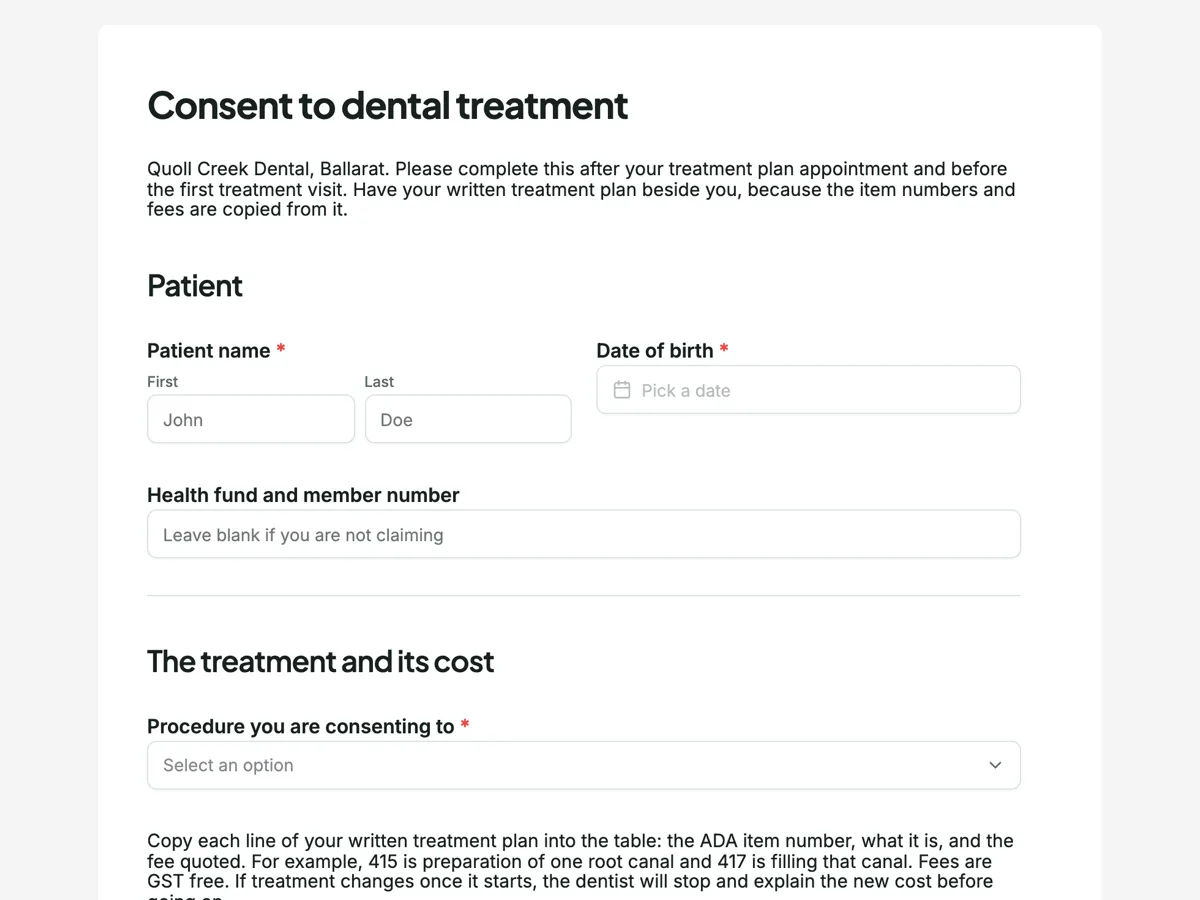
The form itself
A static copy of the finished form, exactly as it renders. Nothing here can be filled in or submitted, so read it as a reference and build your own from the button above.
Every field, and what it collects
The complete field list, in the order respondents meet it.
- Patient nameNameRequired
- Date of birthDateRequired
- Health fund and member numberShort text
- Procedure you are consenting toDropdownRequired
- Options: Root canal treatment, one canal · Root canal treatment, two or more canals · Removal of a tooth · Surgical removal of a wisdom tooth · Ceramic crown · Fillings on several teeth · Implant placement
- Item numbers and fees from your treatment planTableRequired
- Columns: Item number · What it is · Fee quoted
- Were the other options explained to you, including leaving the tooth untreated?Single choiceRequired
- Options: Yes, all the options were explained · Yes, but I would like them explained again · No
- I have read and understand these risksMultiple choiceRequired
- Options: Pain, swelling or bruising for a few days · Infection that needs further treatment · Numbness of the lip, chin or tongue, usually temporary · Damage to nearby teeth, fillings or crowns · The treatment may not succeed and the tooth may still need removal · Fees may change if the treatment changes, and I will be told first
- Sedation for this treatmentSingle choiceRequired
- Options: Local anaesthetic only · Nitrous oxide (happy gas) with local anaesthetic · IV sedation, with an adult to take me home
- Have all your questions been answered?Single choiceRequired
- Options: Yes, all my questions have been answered · No, I want to talk to the dentist before treatment starts
- Patient signature, or parent or guardian for a patient under 18SignatureRequired
Patient
The treatment and its cost
Risks and sedation
What each field on this form collects
Patient name and date of birth sit side by side, and the health fund number below them is optional for patients who are not claiming. The procedure dropdown lists seven common treatments, from one canal root canal treatment to implant placement. A paragraph explains how to copy the treatment plan, then the item numbers table takes four lines of item number, description and fee. A radio records whether the options were explained, with a second yes for a patient who wants to hear them again. After a privacy paragraph, the risks checklist lists six risks to tick. Sedation is a radio of three, questions answered is a yes or no radio, and the signature closes the form. Nine of the ten fields are required.
Why the cost sits inside the consent
Informed financial consent is part of consent in Australian dentistry. A patient who agreed to a root canal but did not know it would take four item numbers has not agreed to the bill. Putting the item numbers and fees in the same signed response as the risks means one record shows the patient saw both. The last risk on the list says fees may change if the treatment changes and that the patient will be told first. That turns a common complaint into something the patient read before treatment began.
The Australian terms this form follows
The item numbers come from the Australian Schedule of Dental Services and Glossary published by the Australian Dental Association, the same numbers health funds use to pay benefits. The Dental Board of Australia code of conduct expects informed consent to cover the treatment, the options, the risks and the costs. The Board also sets the endorsement rules for conscious sedation, which is why IV sedation is a separate choice. Dental services are GST free, so the fee column needs no tax line.
How to adapt this form
An orthodontic practice replaces the procedure dropdown with the appliance type and adds a payment plan radio, because treatment runs for months. A paediatric practice makes the signature label parent or guardian only and adds a question about the child being told what will happen. A practice that only offers local anaesthetic deletes the sedation radio and keeps everything else.
What makes this form work
Four lines of item numbers and fees
The table asks for the ADA item number, what it is and the fee quoted, copied from the written plan. The dentist sees exactly which steps and which costs the patient agreed to.
A second yes for unclear options
The options radio offers yes, but explain them again. A patient who is unsure can say so without saying no, and the dentist knows to talk before treating.
Six named risks, each ticked
Pain, infection, numbness, damage to nearby teeth, failure and fee changes are listed one per line. The required checklist shows the patient read every one.
Questions people ask
Does a patient need a separate consent form for each procedure?
For any treatment with real risk or real cost, yes. A general consent signed at the first visit covers the examination and x-rays, not a root canal or an extraction planned weeks later. This form is filled in after the treatment plan appointment, so it records consent to one planned course of treatment with its own item numbers.
Why copy the item numbers rather than just the total fee?
Item numbers are what the health fund pays against, and each one names a step. A patient who sees 415 and 417 knows the canal is prepared and then filled. The total alone hides that, and a patient who later disputes the bill has nothing to compare it with. The table keeps four lines, which covers most single tooth treatments.
What if the patient ticks that they want the options explained again?
Then the dentist calls them, or explains again at the start of the visit, before any treatment. The answer is not a refusal; it is a request. The thank-you screen tells the patient reception will book a short conversation, and the dentist reads that answer when the response arrives.
Can a parent sign for a teenager?
The signature label allows a parent or guardian to sign for a patient under 18. Some older teenagers can consent for themselves if the dentist judges they understand the treatment, which is a clinical call. A practice that wants both signatures can add a second signature field for the young patient.
Is a drawn signature on a form valid consent?
It records that the patient read and agreed to what the form says, with a date on the response. Consent itself is the conversation at the treatment plan appointment; the form is the written record of it. The signature is printed into the response PDF, so the practice can file it with the dental record.
Can the patient change their mind after signing?
Yes. The paragraph above the signature says consent can be withdrawn at any time before treatment starts, and the thank-you screen repeats it. A submitted response cannot be edited, so the practice records the withdrawal in the dental record instead and keeps the original form as it was.
Build your own in about a minute
The button below opens the generator with this use case already described. Change the wording to match your own, generate, then edit anything you like.
Make one like thisOther form examples
Gym waiver form with a health declaration, signed online at join
A gym waiver form records that a new member understands the risks of training, has declared any health conditions and accepts the club's terms before using the floor. This one is filled online at join for an Australian strength gym, with a six item health declaration, a clearance question and a signature.
Cosmetic treatment consent form with an eight item risks checklist
A cosmetic treatment consent form records that a client understood the treatment, its risks and the alternatives before agreeing to it. This one, for a skin clinic offering peels and microneedling, lists eight risks to tick, then asks about alternatives, aftercare and before and after photos before the client signs.
Vet surgery consent form with bloods, fluids and estimate
A vet surgery consent form has to record what the owner agreed to: the procedure, the optional anaesthetic extras, the estimated cost and what to do if something goes wrong. This one asks each of those as its own question, including resuscitation, and keeps a contact number for the day above the owner signature.
Want the steps in the builder? Read Form builder components, then View, export and manage your responses. For everything this generator can do, see the form maker.
Written and checked by the OneCraft team. Last checked .