Classic form
Emergency contact form
The emergency contact on file is usually the one somebody typed on their first day, three phone numbers ago. This form exists to be resent every year without asking anybody to confirm their bank details again, and it asks two questions most versions leave out: how much may be disclosed, and whether anybody must not be contacted. It is a classic form, because a first aider reading it needs the whole record on one page.
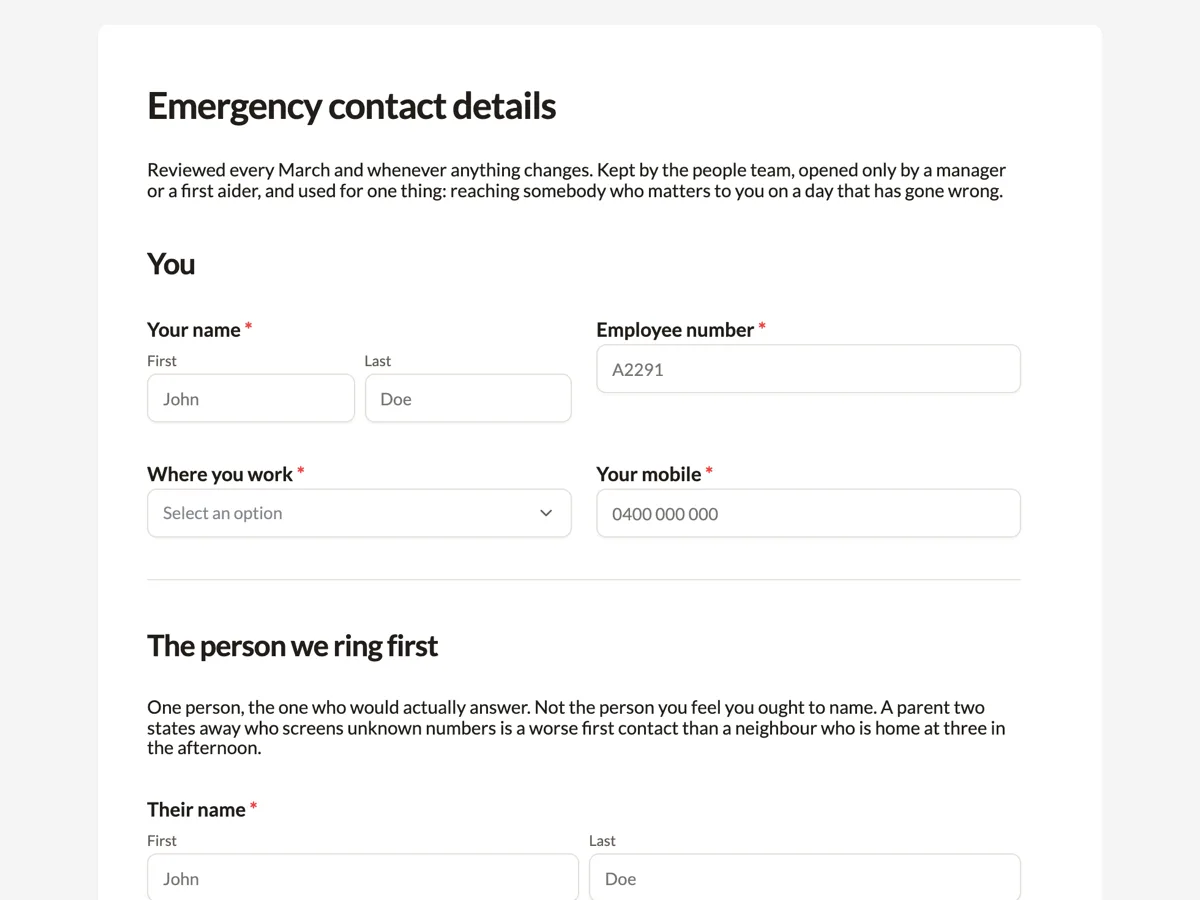
The form itself
A static copy of the finished form, exactly as it renders. Nothing here can be filled in or submitted, so read it as a reference and build your own from the button above.
Every field, and what it collects
The complete field list, in the order respondents meet it.
- Your nameNameRequired
- Employee numberShort textRequired
- Where you workDropdownRequired
- Options: Ardenway House · Bell Meadow · Community nursing, north · Community nursing, south · Head office
- Your mobileShort textRequired
- Their nameNameRequired
- Their relationship to youDropdownRequired
- Options: Partner or spouse · Parent · Adult child · Sibling · Friend · Neighbour · Housemate · Someone else
- Best number for themShort textRequired
- A second number for themShort text
- Do they know you have listed them?Single choiceRequired
- Options: Yes · Not yet, and I will tell them this week
- Do they live with you?Single choiceRequired
- Options: Yes · No, but they are nearby · No, they are more than an hour away
- Backup contactsTable
- Columns: Name · Relationship · Mobile · Do they know?
- What would help somebody helping youLong text
- If something happens at work, can we tell your contact what has happened and where you are?Single choiceRequired
- Options: Yes, tell them everything you know · Tell them I am unwell and where I am, and nothing more · Ring them but say only that they should come
- Is there anybody who must not be contacted about you?Single choiceRequired
- Options: No · Yes, and I have written their name below
- If yes, whoLong text
- I confirmMultiple choiceRequired
- Options: These numbers are current and I have checked at least the first one · I authorise my employer to contact the people named above in an emergency when I cannot be reached · I understand this replaces whatever emergency contact was on file for me · I will send this form again rather than telling one person, if any of it changes
You
The person we ring first
Two people we would try next
Anything a first aider should know
Two things people rarely get asked
Confirm
What makes this form work
It asks how much may be said, not just who to ring
Three options, from tell them everything to say only that they should come. It costs one field and it settles the hardest thirty seconds of an emergency call, which otherwise falls to whoever happens to be holding the phone.
The do not contact question is asked plainly and answered privately
A name is enough and no explanation is invited. The paragraph above it says who reads the answer and that it is not shared with a line manager. For a minority of staff this is the single most important line on any form their employer holds.
It says out loud that the first contact should be reachable
Naming the person who would actually answer, rather than the person you feel you ought to name, is the difference between a contact list and a working one. The prompt is one sentence and it changes what a surprising number of people write.
Questions people ask
Why keep the emergency contact on a form of its own?
Because it is the only staff detail that goes out of date quietly and the only one somebody needs at speed. A short form can be resent every March and answered in three minutes. Folded into a fifteen minute onboarding form it gets filled in once, by somebody who has not yet moved house, and never looked at again.
How many emergency contacts should you ask for?
One properly, then two in outline. The first contact is worth six fields because that is the call that gets made. Backups only need a name, a relationship and a mobile, which is why they sit in a small table rather than repeating the whole block twice.
Should a form ask about health conditions?
Only what changes what a first aider does, only optionally, and with the audience named at the field. This one says who reads it and who does not, and gives concrete examples so people write "EpiPen in my bag" instead of a diagnosis. It is not a medical record and the form says so rather than implying otherwise.
Who should be able to open these answers?
Not everybody with the link. A form holding home numbers and a do not contact name should be published with login required and an allow list, or behind a secret key sent to staff, both of which are access settings on the form rather than anything you build. Responses are visible to whoever can open the form in the builder.
Should the form ask whether the contact knows they are listed?
Yes, and this form asks it directly under the contact number. People name a parent or an ex partner without telling them, and the first that person hears of it is a call from a hospital. Asking prompts the conversation, and a no is useful information for whoever has to make that call.
Why ask whether there is somebody who must not be contacted?
Because for a small number of staff it is the most important answer on the form. This one asks it in its own section, with a follow up for the name. Family violence and estrangement are real, and a well meaning first aider ringing the wrong person can do serious harm.
Build your own in about a minute
The button below opens the generator with this use case already described. Change the wording to match your own, generate, then edit anything you like.
Make one like thisOther form examples
Leave request form
Most leave requests are refused or delayed for one of three reasons: the dates are ambiguous, nobody knows who is covering, or the evidence rule was never stated. This form closes all three in one page and puts the notice periods where the person is standing when they pick their dates. It is written for an Australian employer under the Fair Work rules, and it is a classic form because a manager reads a request as a whole, with the notice periods and the certificate rule beside the fields they govern.
Work from home request form
Most flexible work requests are refused on a hunch about whether the work will still get done, because the form never asked. This one asks which parts of the job travel and which do not, then spends its longest section on the home workspace, because an employer's safety duty follows the employee home and that is the part managers are actually nervous about. It is a classic form, so the safety self check and the photo of the space sit together on one page.
Internal transfer application form with the manager question handled properly
An internal move is a resignation from one team and a hire into another, and the question of who has been told first decides how well it goes. This ten field form asks it directly, offers two honest not yet answers, and says who can see the response.
Want the steps in the builder? Read Control who can fill in your form, then View, export and manage your responses. For everything this generator can do, see the form maker.
Written and checked by the OneCraft team. Last checked .