Classic form
Leave request form
Most leave requests are refused or delayed for one of three reasons: the dates are ambiguous, nobody knows who is covering, or the evidence rule was never stated. This form closes all three in one page and puts the notice periods where the person is standing when they pick their dates. It is written for an Australian employer under the Fair Work rules, and it is a classic form because a manager reads a request as a whole, with the notice periods and the certificate rule beside the fields they govern.
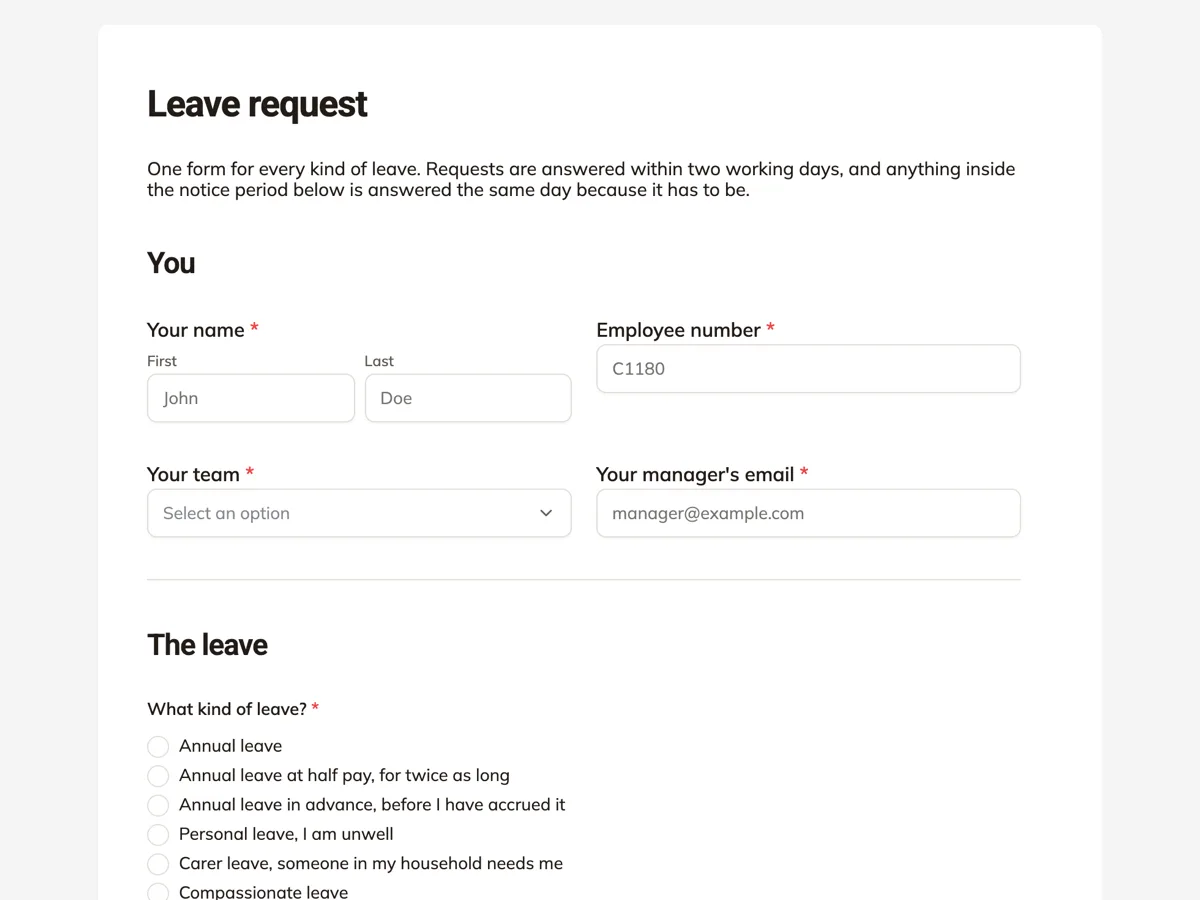
The form itself
A static copy of the finished form, exactly as it renders. Nothing here can be filled in or submitted, so read it as a reference and build your own from the button above.
Every field, and what it collects
The complete field list, in the order respondents meet it.
- Your nameNameRequired
- Employee numberShort textRequired
- Your teamDropdownRequired
- Options: Line haul drivers · Local delivery · Warehouse, day shift · Warehouse, night shift · Transport planning · Customer service · Workshop
- Your manager's emailShort textRequired
- What kind of leave?Single choiceRequired
- Options: Annual leave · Annual leave at half pay, for twice as long · Annual leave in advance, before I have accrued it · Personal leave, I am unwell · Carer leave, someone in my household needs me · Compassionate leave · Long service leave · Unpaid leave · Time in lieu I have already accrued
- First day awayDateRequired
- First day back at workDateRequired
- Working days you are asking forNumberRequired
- Is any of it a half day?Single choiceRequired
- Options: No · Yes, the first day · Yes, the last day
- Balance you believe you have, in daysNumber
- Your guess, not a payroll figure.
- Anything your manager should knowLong text
- Certificate or statutory declarationFile upload
- One PDF or a photo, under 10 MB. A phone photo of a paper certificate is fine as long as the date and the practitioner name are readable. Leave this empty for annual leave.
- Who is covering you?Short textRequired
- Have you spoken to them?Single choiceRequired
- Options: Yes, they have agreed · Not yet · Nothing needs covering
- What is in flight that somebody will need to pick upLong text
- Can you be contacted?Single choiceRequired
- Options: No, and please do not · Emergencies only · Yes, ring me if you need to
- Number while you are awayShort text
- I confirmMultiple choiceRequired
- Options: The dates above are the days I am rostered to work, not the calendar days I am away · If I am taking leave in advance, I understand any unaccrued portion can be recovered if I leave · I have not booked anything that depends on this being approved · If the leave is cancelled or changed I will send this form again rather than telling one person
You
The leave
Evidence, only when it is needed
While you are away
Before you send it
What makes this form work
The cover question is two fields, and the second one is the useful one
Naming a colleague is easy and means nothing. Asking whether you have actually spoken to them, with "not yet" as an honest option, is what turns a name into an arrangement and gives the manager the one thing they were going to ask anyway.
The notice periods are stated at the point of sending
Four weeks over five days, two weeks under. Written in the last block, next to the confirmations, where somebody is deciding whether to send. A notice period living in a handbook is a rule nobody breaks on purpose and everybody breaks by accident.
Contactability is asked instead of assumed
Three answers, including "no, and please do not". It takes a decision that is usually made by a manager on the day and hands it back to the person taking the leave, in writing, before the leave starts.
Questions people ask
Why ask for the first day back rather than the last day away?
Because it removes the argument. "Last day away" is read differently by people who count weekends and people who do not, and the two readings differ by exactly the days that get paid wrongly. First day away and first day back are unambiguous, and the working days count sits between them as a check.
When does a leave request need a medical certificate?
That is a policy choice, not a fixed rule. This employer asks for one after two consecutive days, and the form says so above the upload. It is worth knowing that an employer can reasonably ask for evidence for a single day, and that a statutory declaration is an accepted substitute when a doctor cannot be seen. Naming the threshold you use, rather than implying a universal one, is what makes it fair.
How does the manager find out?
Through the email alert add-on. Switch it on, give it one address, and every submission arrives as an email with the submitted values in the body. It is one address, not a routing rule, so a team with several managers usually sends to a shared inbox and lets the team field do the sorting.
Can the form approve or reject the leave?
No. A form collects a request; it has no approval state, no workflow and no way to send the answer back. The approval happens wherever your team already works, and the honest version of this form says so on the thank-you screen rather than leaving somebody to assume a submission is a yes.
Should a leave form ask who is covering the work?
Yes, and this one goes further by asking whether you have spoken to them. Naming a colleague without telling them is how cover falls over. The follow up question is uncomfortable enough to prompt the conversation, and it gives the approver something to check rather than a name typed to fill a required field.
Why ask whether the person can be contacted while away?
To set the expectation before they leave rather than during. This form asks it in the while you are away section, with an optional number. Most people answer no, which is the point. Making it an explicit question stops the assumption that silence means availability, and it gives the manager one place to look.
Build your own in about a minute
The button below opens the generator with this use case already described. Change the wording to match your own, generate, then edit anything you like.
Make one like thisOther form examples
Shift swap request form
A shift swap is agreed in a corridor and then forgotten by everyone except the person who did not turn up. This request writes the whole arrangement down in eleven taps: the exact shift, the exact colleague, whether they actually said yes, and what is coming back the other way. It is conversational, because it is answered on a phone between tables, and because every answer is a tap or a single line.
Staff availability form
A roster is only as good as the availability it was built from, and most availability arrives as text messages that contradict each other. This form turns the whole question into one grid of days against shift blocks, then asks the four things a grid cannot express. It is a classic form, because a seven by four grid and a table of dates away need the width of a page rather than a phone screen.
Performance review form
Most review forms fail in the same place: the objectives from last period are nowhere on the page, so the rating gets argued from memory. This one puts them in a table with the measure beside them, keeps the behaviour grid to six statements with a "not seen" column, allows exactly one rating, and gives the employee a box to disagree in writing. It is a classic form, because a manager writing it up needs the whole record visible at once.
Want the steps in the builder? Read Automate your form with add-ons, then Every form field and when to use it. For everything this generator can do, see the form maker.
Written and checked by the OneCraft team. Last checked .