Classic form
Internal transfer application form with the manager question handled properly
An internal move is a resignation from one team and a hire into another, and the question of who has been told first decides how well it goes. This ten field form asks it directly, offers two honest not yet answers, and says who can see the response.
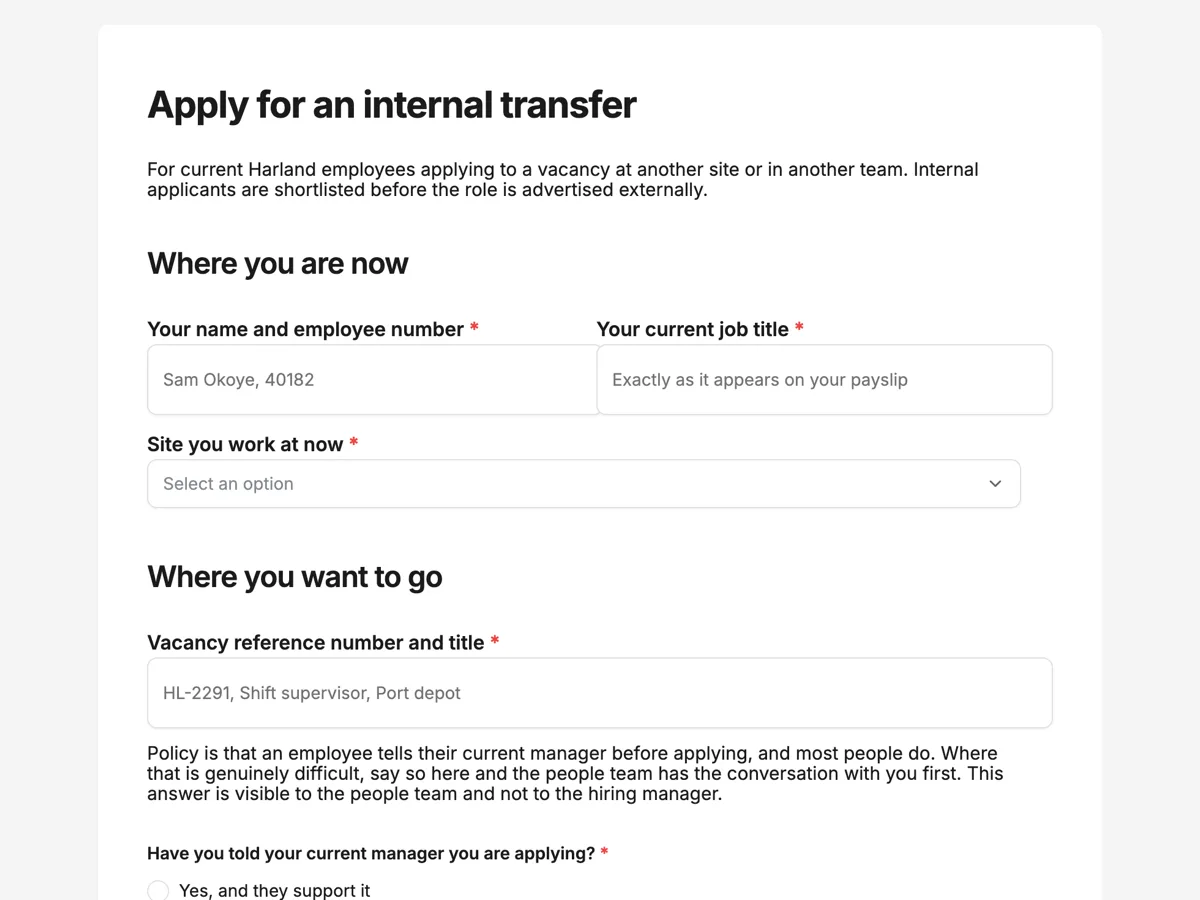
The form itself
A static copy of the finished form, exactly as it renders. Nothing here can be filled in or submitted, so read it as a reference and build your own from the button above.
Every field, and what it collects
The complete field list, in the order respondents meet it.
- Your name and employee numberShort textRequired
- Your current job titleShort textRequired
- Site you work at nowDropdownRequired
- Options: Northgate distribution centre · Southbank distribution centre · Port depot · Regional cross dock · Head office · Remote or field based
- Vacancy reference number and titleShort textRequired
- Have you told your current manager you are applying?Single choiceRequired
- Options: Yes, and they support it · Yes, and they have concerns · Not yet, I would like to tell them myself first · Not yet, and I would like to talk to the people team before they are told
- Earliest date you could start in the new roleDateRequired
- Why this role, and what you would bring to itLong textRequired
- Relevant training and tickets you already holdMultiple choiceRequired
- Options: Forklift licence · Dangerous goods handling · Warehouse management system, advanced · First aid · Fire warden · Leading a team, internal programme · Heavy rigid licence · None of these yet
- Your current CVFile upload
- Optional for internal applicants, and worth attaching if you have worked somewhere before Harland. One file, PDF or an image.
- Before you submitMultiple choiceRequired
- Options: I understand a transfer may change my shift pattern, site allowance or roster · I am happy for the hiring manager to see my last two performance reviews
Where you are now
Where you want to go
What each block of this form collects
The first block places the applicant in the organisation: name with employee number, the job title exactly as payroll has it, and the site as a dropdown of six real locations rather than free text, which is what lets a people team count movement between depots without cleaning up spelling. The second block is the move itself. The vacancy reference and title go in one field because employees copy both from the ad anyway. The manager question sits under a paragraph that states the policy and names who can see the answer. Then an earliest start date, a three hundred word answer about why, and a tick list of tickets already held that ends in none of these yet so the field can be required. The CV is optional and the two closing ticks cover the things people forget.
Why the manager question has two not yet answers
Every internal transfer policy says tell your manager first, and a form that offers only yes or no gets a dishonest yes from anyone whose situation is difficult. Two not yet options separate the ordinary case, I want to tell them myself before this goes anywhere, from the sensitive one, I want to talk to the people team before they are told at all. Those need completely different handling, and the difference is invisible on a yes or no. The paragraph above states who can see the answer, which is what makes the honest option safe to pick, and the thank you screen repeats the promise so nobody submits and then worries about it for two days.
How to adapt this form
An office based employer swaps the tickets list for a systems and certifications list and adds a question about working pattern, since the negotiable part of a desk move is hours rather than roster. An organisation with formal secondments adds a radio choosing between a permanent transfer and a fixed term secondment with an end date field, because the two have different approval paths. A large employer running continuous internal recruitment replaces the vacancy reference field with a dropdown fed from the open roles, and adds a second preference, which lets one application be considered for two vacancies without the employee applying twice.
What makes this form work
Two ways to say not yet
The manager question offers I would like to tell them myself first and I would like to talk to the people team before they are told. Those are different situations needing different handling, and a yes or no question would have collapsed both into a dishonest yes.
The paragraph says who can see the answer
Directly above the manager question it states the answer is visible to the people team and not to the hiring manager. That single sentence is what makes the honest option selectable, and the thank you screen repeats the promise rather than leaving it to be remembered.
The tickets list ends in none of these yet
Eight options from a forklift licence to an internal leadership programme, with an honest exit at the end. The field can then be required, so every application answers it, and a hiring manager can filter for a dangerous goods ticket without reading ten CVs.
Questions people ask
Should an internal application ask whether the manager has been told?
Yes, because the answer changes what happens next and guessing is worse for everyone. Asking it openly, with two honest not yet options and a paragraph saying who sees the response, gets a truthful answer. A policy that requires disclosure but never asks simply moves the awkward conversation to a worse moment.
Does choosing not yet weaken an application?
No, and the welcome screen says so before the first field. The people team handles the conversation and the hiring manager assesses the application on its merits. Treating a not yet as a mark against the candidate would guarantee that nobody ever selects it, which would make the question pointless.
Why ask for a CV from an existing employee?
It is optional here for exactly that reason. An internal hiring manager already has the employment record, so the CV only adds value where somebody worked elsewhere before joining. Making it required tells long serving employees to spend an evening documenting a history the company already holds.
Who should be able to open an internal transfer form?
Only employees, which is what the login required access setting is for: a respondent has to be signed in before the form loads. A public link works too, but it invites external applications into an internal process and makes the employee number field the only thing standing between the two.
Why ask about shift pattern and allowances in a tick?
Because a transfer between sites often changes a roster, a shift loading or a site allowance, and that is the single most common surprise after an internal move. One tick before submission sets the expectation while the employee is still deciding, rather than after they have accepted and the first payslip arrives.
How long should an internal application be?
Ten fields, and it should be visibly shorter than the external version. An employer already holds most of the record, so asking for it again signals that the internal process is an afterthought. The only long answer here is why this role, which is the part a hiring manager actually reads.
Build your own in about a minute
The button below opens the generator with this use case already described. Change the wording to match your own, generate, then edit anything you like.
Make my internal transfer application form with the manager question handled properlyOther form examples
Casual job application form built around an availability grid
Casual hiring turns on one thing, which is whether somebody is free when the roster has a hole. This twelve screen form puts a seven day by three shift grid at the centre, asks how many hours a week somebody actually wants, and treats the RSA, the work rights and the CV as things that change the roster rather than the decision.
Mentorship program application form for mentors and mentees
Running two separate forms for mentors and mentees means two sets of answers that cannot be compared, which is the hardest part of matching. This thirteen screen form asks both sides the same questions, including what they want out of it, and caps the expectations question at three ticks so a match has something specific to be built on.
Artist residency application form with a portfolio and work list
A residency panel looks at the images first and reads afterwards, so the portfolio instructions matter more than anything else on the form. This twelve field application caps the upload at ten images with a minimum resolution, pairs it with a numbered work list, and asks for a proposal that could only happen at this studio.
Want the steps in the builder? Read Control who can fill in your form, then Every form field and when to use it. For everything this generator can do, see the form maker.
Written and checked by the OneCraft team. Last checked .