Conversational form
Casual job application form built around an availability grid
Casual hiring turns on one thing, which is whether somebody is free when the roster has a hole. This twelve screen form puts a seven day by three shift grid at the centre, asks how many hours a week somebody actually wants, and treats the RSA, the work rights and the CV as things that change the roster rather than the decision.
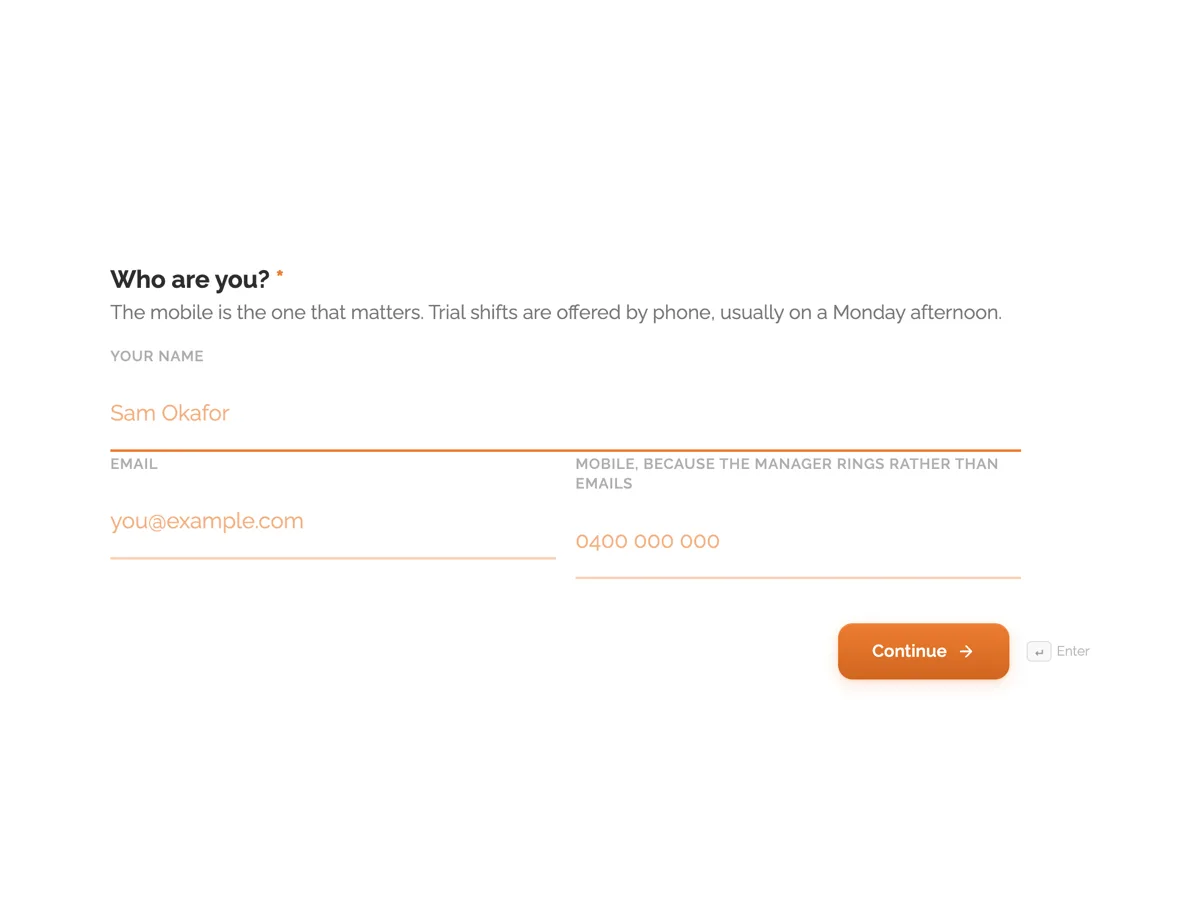
The form itself
The first screen of the form. A conversational form shows one question per screen, so the remaining screens are listed in the field table below. Nothing here can be filled in or submitted, so read it as a reference and build your own from the button above.
Every field, and what it collects
The complete field list, in the order respondents meet it.
- Who are you?ProfileRequired
- The mobile is the one that matters. Trial shifts are offered by phone, usually on a Monday afternoon.
- Which role are you after?Single choiceRequired
- Pick the one you want most. Everyone learns the floor regardless, and plenty of people move between them after a few months.
- Options: Barista, on the machine · Floor, taking orders and running food · Kitchen hand, prep and dish · Any of them, I just want the shifts
- When can you actually work?Rating gridRequired
- Tick every block you could reliably do every week. This is the single most important answer on the form. An overstated grid gets found out in the first fortnight and it is the usual reason a casual is dropped off the roster.
- Statements:
- Monday
- Tuesday
- Wednesday
- Thursday
- Friday
- Saturday
- Sunday
- How many hours a week are you hoping for?Single choiceRequired
- Casual hours move week to week. This answer tells the manager which end of the range to aim at when the roster is built.
- Options: Up to 10 hours · 10 to 20 hours · 20 to 30 hours · 30 hours or more, as close to full time as possible
- When could you start?DateRequired
- A date a few weeks out is fine and is not held against anybody. Notice periods and exam blocks are both normal here.
- Do you hold a current RSA?Single choiceRequired
- The cafe is licensed from 4pm, so a responsible service of alcohol certificate is needed for close shifts only. Not having one does not rule you out of open and middle shifts.
- Options: Yes, current and I can bring the certificate · Yes, but it is from another state · No, and I would do the course · No, and I would rather stick to daytime shifts
- Any food safety training?Single choice
- Optional. Nobody is expected to arrive with this and the induction covers what the kitchen needs.
- Options: Food Safety Supervisor certificate · A short food handling course · On the job training somewhere else · None yet
- Tell us about your hospitality experienceLong textRequired
- First hospitality jobs are filled here regularly, so an honest none yet with a sentence about other work is a real answer and not a disqualification.
- What coffee machines have you used?Dropdown
- Only relevant if you picked barista, and it changes the training plan rather than the decision. Answer anything if you did not.
- Options: A two group traditional machine, commercial · A three group traditional machine, commercial · A super automatic or bean to cup machine · Home machine only · None yet, I would learn · Not applying for barista
- What are your work rights in Australia?Single choiceRequired
- This is asked because a visa can carry an hours condition that the roster has to respect. It is not a filter, and student visa holders make up a good part of the team.
- Options: Australian citizen or permanent resident · New Zealand citizen · Student visa, with an hours condition · Working holiday visa · Another visa with work rights
- A CV, if you have oneFile upload
- Optional. PDF or a photo, one file, up to 10 MB. A phone photo of a printed CV is fine. If you do not have one, skip this screen, because the answers above are what the manager actually reads.
- One referee, and how to reach themShort textRequired
- A previous manager, a supervisor or a teacher. Not a family member. They are only called after a trial shift, so there is no rush to warn them today.
The grid is the application
A cafe manager building a fortnightly roster is solving a coverage problem, and everything else on a casual application is secondary to it. So the availability grid gets the third screen, seven days by three named shift blocks with real times on them, and it carries the bluntest description on the form: an overstated grid gets found out in the first fortnight and is the usual reason somebody is dropped off the roster. That sentence is there to buy an honest answer, because an honest grid that matches one gap beats a generous one that matches none.
The Australian pieces on this form
The RSA question exists because the cafe is licensed from 4pm, and the options include a certificate issued in another state, which is a real complication since RSA recognition differs between states. Work rights are asked as a five option radio including student visas with an hours condition and working holiday visas, and the description says plainly that it is not a filter. That matters, because a visa condition is a rostering constraint the employer has to respect rather than a reason not to hire, and asking it badly is how a form loses half its applicants.
How to adapt this form
A retail chain replaces the three shift blocks with store trading hours and adds a store preference dropdown, since the constraint is which location rather than which task. A pub keeps the RSA screen, makes it required, and adds a gaming licence question for venues with machines. A warehouse or events casual pool drops the coffee machine screen, adds a steel cap boots and safety footwear question, and turns the start date into a next available date because the work is called at short notice.
What makes this form work
Seven days by three named shift blocks
Open at 6am, middle at 11am, close at 3pm, ticked as checkboxes so several blocks per day are possible. The manager reads a roster rather than reconstructing one from a sentence about flexibility.
The grid carries the bluntest instruction on the form
An overstated grid gets found out in the first fortnight and is the usual reason a casual is dropped. Saying so is what turns the most gamed question on a casual application into a usable one.
Work rights are asked with five real options and no filter
Citizen, New Zealand citizen, student visa with an hours condition, working holiday, another visa. The description says student visa holders are a good part of the team, which is why people answer instead of leaving.
Questions people ask
Why use a conversational form for a casual job application?
Because most of these are filled in on a phone, often while someone is on a break. One question per screen suits a thumb, and every screen can carry its own description, which a classic form does not show on the published page. The twelve screens here run to about six minutes, which is shorter than the same questions on one long page.
How does the availability grid export?
As a single column, with each day paired to the shifts ticked for it, rather than twenty one separate columns. Read it as a block in the responses table or in the CSV. That format is closer to how a roster is read anyway, and it keeps the export usable when several applications are compared side by side.
Is asking about work rights appropriate on a form?
Asking about the right to work is normal and necessary, and the wording is what makes it fair. Five real options, including student and working holiday visas, and a description saying it is not a filter and that student visa holders make up a good part of the team. What would be wrong is a question about nationality, which is not asked here.
Should a CV be required for casual work?
No. Requiring one loses good applicants who have never made one, and the manager mostly reads the grid and the experience answer anyway. The upload here is optional, accepts a phone photo of a printed CV, and the instruction says to skip the screen if there is nothing, which removes the anxiety of an empty required field.
What makes the experience question work?
The description, which says first hospitality jobs are filled here regularly and that an honest none yet with a sentence about other work is a real answer. Free text collects nothing useful when people are guessing what is wanted. Telling them what a good answer looks like is the cheapest quality improvement available on any form.
Can the form limit hours for a visa with a condition?
No, and it does not claim to. A number field in a conversational form does not enforce a minimum or a maximum, and in any case the hours condition belongs in the rostering system rather than the application. What the form does is record the condition so that the person building the roster knows about it before offering a shift.
Build your own in about a minute
The button below opens the generator with this use case already described. Change the wording to match your own, generate, then edit anything you like.
Make my casual job application form built around an availability gridOther form examples
Internal transfer application form with the manager question handled properly
An internal move is a resignation from one team and a hire into another, and the question of who has been told first decides how well it goes. This ten field form asks it directly, offers two honest not yet answers, and says who can see the response.
Exchange program application form with host preferences and unit mapping
An exchange place is only useful if the units taken abroad come back as credit, and that mapping is the part most applications get wrong. This fifteen field form ranks three host universities, records the language of instruction honestly, and puts a four row unit mapping table at the centre of the decision.
Apprenticeship application form for a trade employer
An apprenticeship application is filled in by somebody who has never written one, so every question has to be answerable without a careers adviser in the room. This fifteen field form asks the year level, the maths, the licence and the way somebody would actually get to a job each morning, and gives the one written answer the space it deserves.
Want the steps in the builder? Read Build a conversational form with AI, then View, export and manage responses. For everything this generator can do, see the form maker.
Written and checked by the OneCraft team. Last checked .