Classic form
Exchange program application form with host preferences and unit mapping
An exchange place is only useful if the units taken abroad come back as credit, and that mapping is the part most applications get wrong. This fifteen field form ranks three host universities, records the language of instruction honestly, and puts a four row unit mapping table at the centre of the decision.
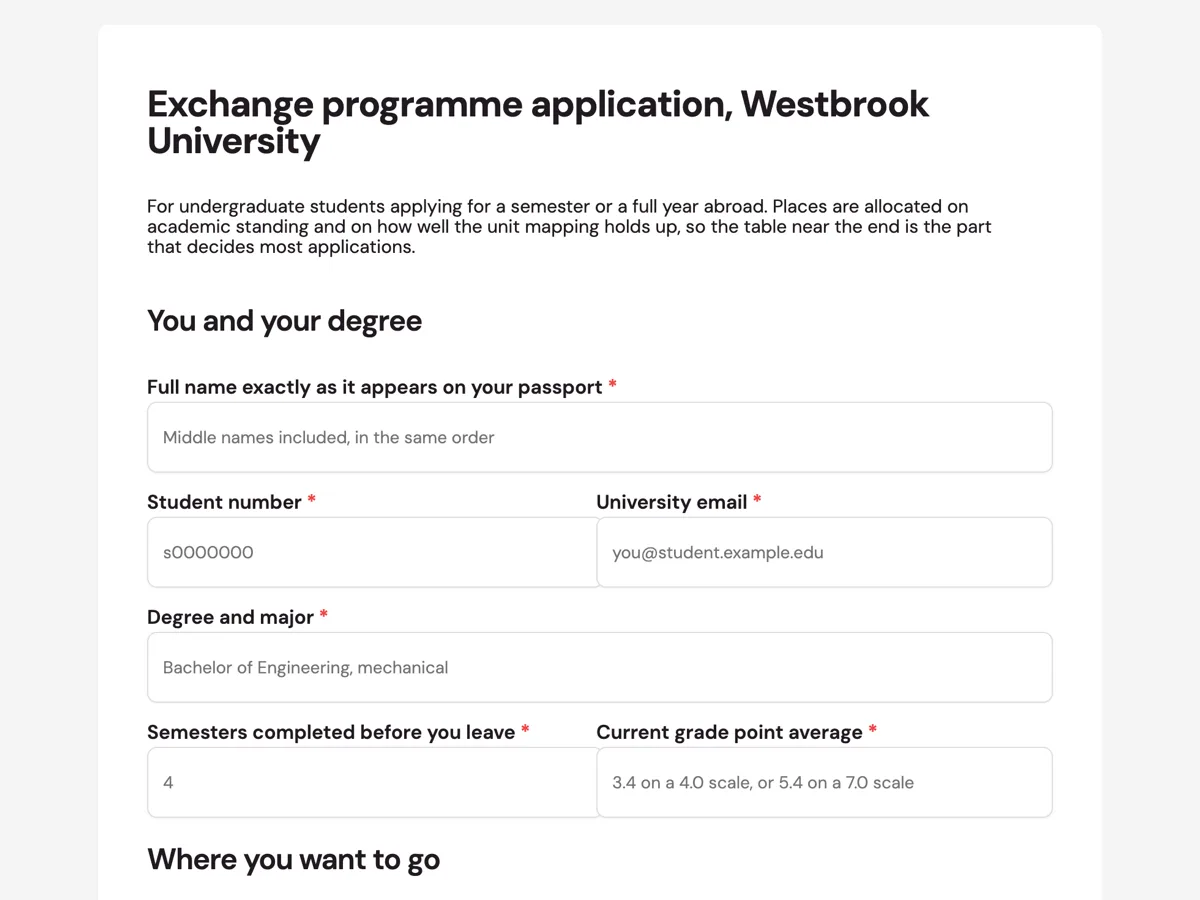
The form itself
A static copy of the finished form, exactly as it renders. Nothing here can be filled in or submitted, so read it as a reference and build your own from the button above.
Every field, and what it collects
The complete field list, in the order respondents meet it.
- Full name exactly as it appears on your passportShort textRequired
- Student numberShort textRequired
- University emailShort textRequired
- Degree and majorShort textRequired
- Semesters completed before you leaveNumberRequired
- Current grade point averageNumberRequired
- Exchange period you are applying forDropdownRequired
- Options: Semester 1 next year · Semester 2 next year · Full year, starting semester 1 · Full year, starting semester 2 · Short winter term only
- Host university preferencesTableRequired
- Columns: Host university · City and country · Term offered there · Why this one
- Language level in the language of instruction at your first preferenceSingle choiceRequired
- Options: It is taught in English and English is my first language · It is taught in English and I have met the English requirement · Beginner in the local language, studying now · Intermediate, I can follow a lecture with effort · Advanced or native in the local language
- Unit mappingTableRequired
- Columns: Host unit code and title · Credit points there · Westbrook unit it replaces · Core or elective
- Statement of purposeLong textRequired
- Academic referenceFile uploadRequired
- One reference from an academic who has taught you, on faculty letterhead, dated within the last six months. PDF preferred.
- Passport expiry dateDateRequired
- Emergency contact, name and phone with country codeShort textRequired
- Before you submitMultiple choiceRequired
- Options: I understand a place is conditional on my faculty approving the unit mapping · I understand I remain enrolled and liable for fees at Westbrook during the exchange · I will arrange my own visa, insurance and accommodation unless the host arranges them
You and your degree
Where you want to go
How the credit comes back
Documents and practicalities
What each block of this application collects
The identity block asks for the name exactly as the passport prints it, because every later document from the offer letter to the visa has to match, and a preferred name here creates months of correction. Semesters completed and the grade point average are two numbers with real ranges on them, one to twelve and zero to ten, which is what a classic number field can enforce, and the average carries its scale in the placeholder so a four point and a seven point transcript both fit. The preference block ranks three partners with the term offered there and a short reason, so an allocator comparing two students for one place has something to compare.
Why the mapping is a table and not an attachment
Faculties assess mapping row by row, and an attached spreadsheet arrives in a different shape from every applicant. Four fixed rows with named columns means an assessor reads twenty applications in the same order, and it means the core or elective column is always answered, which is the field that decides whether a mapping needs faculty sign off or can be approved by the exchange office alone. It also makes the gap visible: a student who maps three units for a four unit semester has an obvious hole in row four rather than a buried omission in a document. Credit points are asked in the host institution own units, because converting them is the office job and not the student one.
How to adapt this form
A postgraduate exchange replaces the semesters completed number with a research stage radio and swaps the unit mapping for a supervision plan, since coursework credit is rarely the point. A programme that sends students on placements rather than to partner universities turns the preference table into an employer preference table with an industry column and drops the language question to a single yes or no. A university running an internal scholarship alongside the exchange adds a household income band and a costs table after the statement, which keeps the academic assessment and the financial one in the same submission without mixing the two decisions.
What makes this form work
The mapping table has a core or elective column
Four rows of host unit, credit points, the unit replaced and whether it is core. That last column routes the application: a mapping that touches a core unit needs faculty sign off, and one that only replaces electives does not, so the form sorts its own queue.
Preferences carry a reason and a term
Each of the three preference rows asks for the term offered at that host and one line on why this one. An allocator choosing between two students for the same place has something better than rank order, and the term column catches the student who has ranked a partner that does not run their semester.
Two numbers carry real ranges
Semesters completed is capped between one and twelve and the grade point average between zero and ten, wide enough for a four point or a seven point transcript. On a classic form both limits are passed to the input, so a typed 54 instead of 5.4 is caught at the keyboard rather than by an assessor reading a spreadsheet in the allocation round.
Questions people ask
Why does the form ask for the name exactly as it appears on the passport?
Because the offer letter, the host enrolment, the visa application and the insurance all have to match that name character for character. A preferred first name entered here creates a correction chain that can take months and occasionally costs a student the visa appointment.
What is unit mapping and why does it matter so much?
It is the list of units a student will take at the host university and the home units each one replaces. Without it an exchange is a semester of travel that does not count. The table asks for credit points and whether the replaced unit is core, which together decide whether the faculty must sign off or the exchange office can approve it.
How many host universities should a student rank?
Three, and the table is fixed at three rows for that reason. One preference means an applicant who misses out gets nothing in a round that allocates places against each other. More than three tends to produce filler choices that nobody would accept, which makes the allocation worse rather than better.
Does the language question need a certificate?
No. The five options describe what a student can do, from an English taught programme through to advanced local language, and the middle option says I can follow a lecture with effort, which is the honest answer for most intermediate students. Where a host institution requires a formal certificate, the exchange office asks for it after a place is offered.
Why is a place conditional even after it is offered?
Because the faculty, not the exchange office, owns the credit decision, and the mapping has to survive that review. The first acknowledgement tick states it plainly so that no student books a flight on an unconditional reading of an offer letter. In practice most mappings are approved, and the ones sent back are usually missing a core unit.
Should the passport expiry be asked this early?
Yes, because renewal takes weeks and most study visas cannot be lodged until a place is confirmed. Asking for the date in the application means the office can flag a passport that expires inside six months of the exchange end while there is still time, rather than discovering it in the week visas are due.
Build your own in about a minute
The button below opens the generator with this use case already described. Change the wording to match your own, generate, then edit anything you like.
Make my exchange program application form with host preferences and unit mappingOther form examples
Brand ambassador application form that reads the content before the reach
Ambassador programmes drown in applications from accounts that bought their audience, and a follower count cannot tell those apart from the creators worth signing. This thirteen screen form asks for a sample post, a sixty second unscripted video and what an audience actually comes for, then asks about reach in bands.
Financial hardship application form with a fortnightly budget on it
A hardship application is filled in by somebody having a bad year, often on a phone, and every extra field costs an applicant who needed the help. This sixteen field form asks what changed, what comes in and goes out each fortnight, and what the customer can genuinely pay, then says plainly that nothing is disconnected while it is read.
Apprenticeship application form for a trade employer
An apprenticeship application is filled in by somebody who has never written one, so every question has to be answerable without a careers adviser in the room. This fifteen field form asks the year level, the maths, the licence and the way somebody would actually get to a job each morning, and gives the one written answer the space it deserves.
Want the steps in the builder? Read Every form field and when to use it, then View, export and manage your responses. For everything this generator can do, see the form maker.
Written and checked by the OneCraft team. Last checked .