Classic form
Research funding application form with a justified budget table
An internal seed fund is judged by a cross disciplinary panel that reads the lay summary aloud and argues about the budget, so those two parts of the form need the most structure. This fifteen field application asks for a 300 word lay summary, six budget lines each with a written justification, and an ethics status that includes not sure yet.
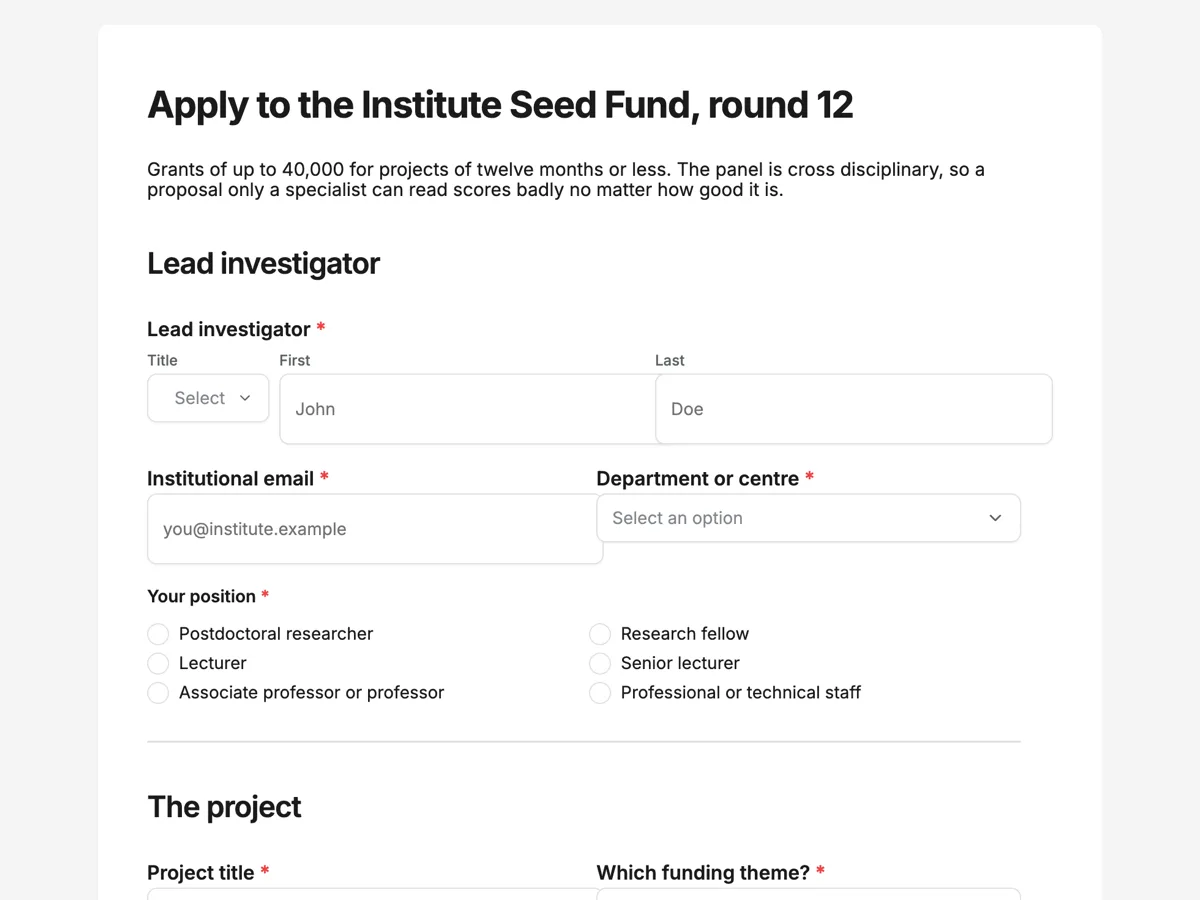
The form itself
A static copy of the finished form, exactly as it renders. Nothing here can be filled in or submitted, so read it as a reference and build your own from the button above.
Every field, and what it collects
The complete field list, in the order respondents meet it.
- Lead investigatorNameRequired
- Institutional emailShort textRequired
- Department or centreDropdownRequired
- Options: School of Biological Sciences · School of Chemistry · School of Physics and Astronomy · School of Engineering · School of Computing and Information Systems · School of Population Health · School of Social and Political Sciences · Centre for Climate and Coastal Systems · Centre for Health Services Research
- Your positionSingle choiceRequired
- Options: Postdoctoral researcher · Research fellow · Lecturer · Senior lecturer · Associate professor or professor · Professional or technical staff
- Project titleShort textRequired
- Which funding theme?DropdownRequired
- Options: Climate adaptation and coastal systems · Health services and equity · Digital methods and data infrastructure · Materials and manufacturing · Communities, policy and governance · Open theme, none of the above
- Lay summaryLong textRequired
- Aims and research questionsLong textRequired
- Methods and why this is feasible in twelve monthsLong textRequired
- Project duration in monthsNumberRequired
- Co investigatorsTable
- Columns: Name · Institution or department · What they contribute
- BudgetTableRequired
- Columns: Item · Cost · Justification
- Total requested, in dollarsNumberRequired
- Ethics approval statusSingle choiceRequired
- Options: Not required, no human or animal participants and no identifiable data · Approved, and I can supply the approval number · Submitted and under review · Not yet submitted, and I understand funds are held until approval is granted · I am not sure and would like advice from the research office
- Supporting documentsFile upload
- Optional. PDF, up to three files, 15 MB each. A letter of support from a partner organisation, a preliminary data figure or a quote for equipment. Do not attach a full manuscript or a previous grant application, because neither is read.
Lead investigator
The project
People and money
Approvals and attachments
The budget table carries its own justification column
Most funding forms ask for a budget and then, separately, for a justification paragraph, which produces a table nobody can check against prose nobody finishes. Here the justification is the third column of the same six row table, so each figure sits beside the sentence that supports it. The paragraph above says what happens without one, which is that an unsupported figure is removed rather than queried. It also lists what is eligible and names two things that are not, teaching relief and conference attendance, which saves the panel from removing them one application at a time.
Writing for a panel that is not in your field
A cross disciplinary panel means the lay summary is the only section every member reads, and this form says so directly. The instruction is specific rather than encouraging: around 300 words, no undefined acronyms, no citations, no sentence that needs a specialist, write it last, and show it to somebody outside the discipline first. That is five concrete rules in place of the usual request for accessible language, and it is the difference between a summary a panel can argue about and one they skip on the way to the budget.
How to adapt this form
A travel or conference fund cuts the whole methods block, adds the event name, dates and a destination, and turns the budget into airfare, accommodation and registration with the same justification column. A philanthropic grant to community organisations replaces the department dropdown with an organisation name and charity number, and the ethics radio with a safeguarding policy question. A large scheme with a two stage process keeps only the title, theme, lay summary and total for the expression of interest, and holds the budget table back for stage two.
What makes this form work
Justification is a column, not a separate section
Six budget lines, each with item, cost and the sentence that supports it. The note above says an unsupported figure is removed rather than queried, which is what gets the third column filled in.
The lay summary instruction has five concrete rules
Around 300 words, no undefined acronyms, no citations, no specialist sentences, written last and read by somebody outside the field. That is more useful than asking for accessible language.
Ethics status includes not sure yet
Five options covering not required, approved, under review, not yet submitted with funds held, and an explicit request for advice. The last one routes a confused applicant to the research office instead of to a guess.
Questions people ask
How many rows should a budget table have?
Six here, and the count is fixed because a table renders exactly the rows it is configured with and cannot grow while somebody fills it in. Six lines fits a seed grant of this size comfortably. A scheme funding larger projects needs a bigger table set up front, or a spreadsheet upload alongside a summary total.
Why ask about ethics before the project is funded?
Because the answer changes when money can be released, not whether an application is competitive. The five options include approved, under review, not yet submitted with an acknowledgement that funds are held, and not sure and would like advice. That last option routes an applicant to the research office instead of leaving them guessing, which is the point of asking early.
Should co investigators be named on the form?
Yes, with what they contribute, and the paragraph above says the panel contacts one at random on about a third of applications. That sentence is the whole mechanism. It makes people ask permission first, which is both the right thing to do and the fastest way to stop a courtesy co investigator appearing on three unrelated proposals.
Why cap the project title at 120 characters?
Because the title is reused in the panel agenda, the outcome letter and the annual report, and a title that wraps across three lines in all of them is a small recurring cost. The field enforces the limit with a maximum length, and the placeholder adds the more important instruction, which is that it should be readable outside the applicant field.
What should not be attached to a funding application?
A full manuscript or a previous grant application, both named in the upload instructions as documents that are not read. Saying so keeps the attachment set to three short PDFs: a letter of support, a preliminary figure, or an equipment quote. An open ended upload on a research form reliably produces a sixty page bundle that delays the panel.
Can the form total the budget automatically?
No. The budget is a table and the total is a separate number field capped at the scheme maximum, so the applicant enters both. That is worth knowing before designing around it. The check happens when the research office reads the response, where the table exports as a JSON array of its filled rows beside the total column.
Build your own in about a minute
The button below opens the generator with this use case already described. Change the wording to match your own, generate, then edit anything you like.
Make my research funding application form with a justified budget tableOther form examples
Travel grant application form for a conference, with itemised costs
A travel grant panel is deciding between twenty applicants who all want to go somewhere useful, and the difference between them is almost always the costings. This twelve field form takes the accepted abstract, the acceptance letter and a six row cost table that asks how each figure was estimated.
Board member application form with a skills matrix on it
A nominations committee is filling gaps, not collecting resumes, so a board application has to produce something comparable across twenty candidates. This fourteen field form puts a six row skills matrix at the centre, asks for directorships as dated rows, and makes the conflicts declaration a required box that will not accept silence.
Exchange program application form with host preferences and unit mapping
An exchange place is only useful if the units taken abroad come back as credit, and that mapping is the part most applications get wrong. This fifteen field form ranks three host universities, records the language of instruction honestly, and puts a four row unit mapping table at the centre of the decision.
Want the steps in the builder? Read Every form field and when to use it, then View, export and manage responses. For everything this generator can do, see the form maker.
Sources
Written and checked by the OneCraft team. Last checked .