Classic form
Board member application form with a skills matrix on it
A nominations committee is filling gaps, not collecting resumes, so a board application has to produce something comparable across twenty candidates. This fourteen field form puts a six row skills matrix at the centre, asks for directorships as dated rows, and makes the conflicts declaration a required box that will not accept silence.
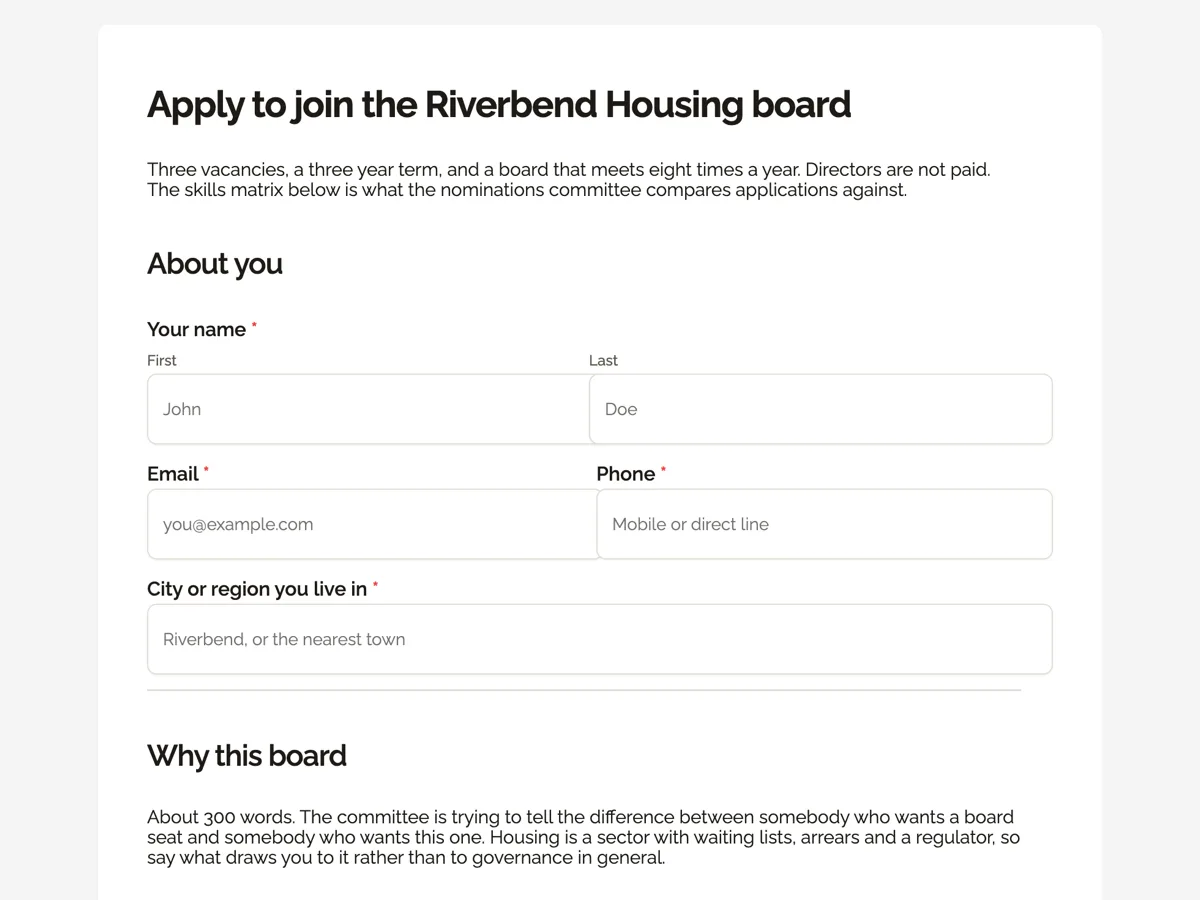
The form itself
A static copy of the finished form, exactly as it renders. Nothing here can be filled in or submitted, so read it as a reference and build your own from the button above.
Every field, and what it collects
The complete field list, in the order respondents meet it.
- Your nameNameRequired
- EmailShort textRequired
- PhoneShort textRequired
- City or region you live inShort textRequired
- Why do you want to join this board?Long textRequired
- Your professional background, in shortLong textRequired
- Where do you sit on each of these?Rating gridRequired
- Statements:
- Financial oversight, budgets and audit
- Property development and asset management
- Social housing, tenancy and support services
- Legal, regulatory compliance and risk
- Fundraising, philanthropy and government relations
- Digital, data and cyber security
- Boards and committees you have served onTable
- Columns: Organisation · Role · From · To
- Governance trainingSingle choiceRequired
- Options: A formal company directors course · A not for profit governance short course · In house induction and training at a previous board · None yet, and I would do the induction course
- The time commitmentSingle choiceRequired
- Options: I can do the eight meetings and one subcommittee · I can do the eight meetings but not a subcommittee · I could chair a subcommittee as well · I would need to discuss the load before committing
- Lived experience of social or affordable housingSingle choiceRequired
- Options: Yes, I have been a social or affordable housing tenant · Yes, through a close family member · I have worked in the sector but not lived in it · No · I would rather not answer
- Conflicts of interest to declareLong textRequired
- One referee, and how to reach themShort textRequired
- SignatureSignatureRequired
About you
Why this board
Skills
Governance experience
Conflicts and declaration
A skills matrix is what a nominations committee actually uses
Boards recruit against gaps. A committee that already has three accountants is looking for a development or a cyber person, and no amount of resume reading produces that answer as quickly as six rows rated on the same four point scale. The scale matters as much as the rows: no experience, working knowledge, practised, led it. The paragraph above it does the real work, saying that a board of six people who all claim to have led finance is worse off than one that knows its gaps, which is the sentence that makes people answer truthfully.
Conflicts and lived experience, asked properly
Two questions here are easy to ask badly. The conflicts box is required and its paragraph lists the specific things that count: a contract with the organisation, a role at a funder, a competing provider, a development interest, a close relationship with a director. It also asks for the word none rather than an empty box, so silence never has to be interpreted. The lived experience question offers a prefer not to answer option, because a provider that wants tenant voices on its board has to make it safe to say yes and safe to say nothing.
How to adapt this form
A sports club or association swaps the six skill rows for coaching, competition administration, facilities, sponsorship, member engagement and child safety, and keeps the same four point scale. A school council adds a parent or community category and a conflict question about enrolment. A larger charity with a paid board adds a remuneration disclosure and a directorship cap question, since an overcommitted director is the risk that a dated table of boards is really designed to surface.
What makes this form work
Six skill rows on a four point scale
Financial oversight through to digital and cyber, rated no experience, working knowledge, practised or led it. A committee reads twenty applications on one scale instead of twenty resumes in twenty formats.
The conflicts box is required and names what counts
A contract, a funder role, a competing provider, a development interest, a close relationship with a director. It asks for the word none rather than a blank, so an empty answer never has to be interpreted.
Board history is four dated rows, not a paragraph
Organisation, role, from and to. Dates show whether somebody has served a full term and how many seats they currently hold, which is the capacity question a nominations committee most needs answered.
Questions people ask
Why rate skills instead of asking for a resume?
Because resumes are not comparable. Twenty documents in twenty formats tell a committee very little about where the gaps are, while six rows on one scale can be read across every application at once. The matrix exports as a single column pairing each skill with its rating, which is enough to sort a shortlist before anybody opens a background answer.
Should a board application ask about lived experience?
A provider that serves a community usually wants that community represented, so the question is worth asking. What makes it safe is the option set: a tenant, a close family member, worked in the sector, no, and prefer not to answer. Offering the last two means the question invites a contribution rather than forcing a disclosure.
How should conflicts of interest be collected?
As a required free text box with a paragraph naming the specific conflicts that count, and a request to write none rather than leave it blank. Making it required is the point. An optional conflicts field is answered by the people who have nothing to declare and skipped by the ones who do, which is exactly backwards.
Why a table for previous board roles?
Because dates are the useful part. Organisation, role, from and to, in four rows, shows a committee whether somebody has served a full term anywhere and how many seats they hold right now. A paragraph of prose hides both. The note above says fewer than four is fine and that two current directors started with none.
What does the declaration signature cover?
Three things named in the paragraph above it: that the applicant is not disqualified from managing a corporation, that they would consent to a police check and a bankruptcy search, and that the application is true. Those are the standard director eligibility questions, and having them signed at application saves a difficult conversation after a shortlist.
Is fourteen fields too long for a volunteer board role?
It is the right length for a three year fiduciary appointment. Every field changes a decision: the matrix decides fit, the table decides capacity, the conflicts box decides eligibility, and the two written answers decide motivation. The welcome screen warns it takes about twenty minutes, which sets the expectation before anybody starts.
Build your own in about a minute
The button below opens the generator with this use case already described. Change the wording to match your own, generate, then edit anything you like.
Make my board member application form with a skills matrix on itOther form examples
Research funding application form with a justified budget table
An internal seed fund is judged by a cross disciplinary panel that reads the lay summary aloud and argues about the budget, so those two parts of the form need the most structure. This fifteen field application asks for a 300 word lay summary, six budget lines each with a written justification, and an ethics status that includes not sure yet.
Beta tester application form that sorts testers into the right cohort
A beta cohort fails when it fills up with people who applied out of curiosity and never opened the build. This eleven screen application asks what platform someone will really test on, what they use today, and how many hours a week they can honestly give.
Art exhibition proposal form with a works list and install needs
A gallery programming committee is deciding whether a show fits a specific room, which is a question about dimensions as much as about ideas. This eleven field proposal form publishes the wall length, the ceiling height and the doorway width, then asks for a works list with sizes so the answer is checkable before the meeting.
Want the steps in the builder? Read Every form field and when to use it, then Design your welcome and thank you screens. For everything this generator can do, see the form maker.
Sources
Written and checked by the OneCraft team. Last checked .