Conversational form
Mentorship program application form for mentors and mentees
Running two separate forms for mentors and mentees means two sets of answers that cannot be compared, which is the hardest part of matching. This thirteen screen form asks both sides the same questions, including what they want out of it, and caps the expectations question at three ticks so a match has something specific to be built on.
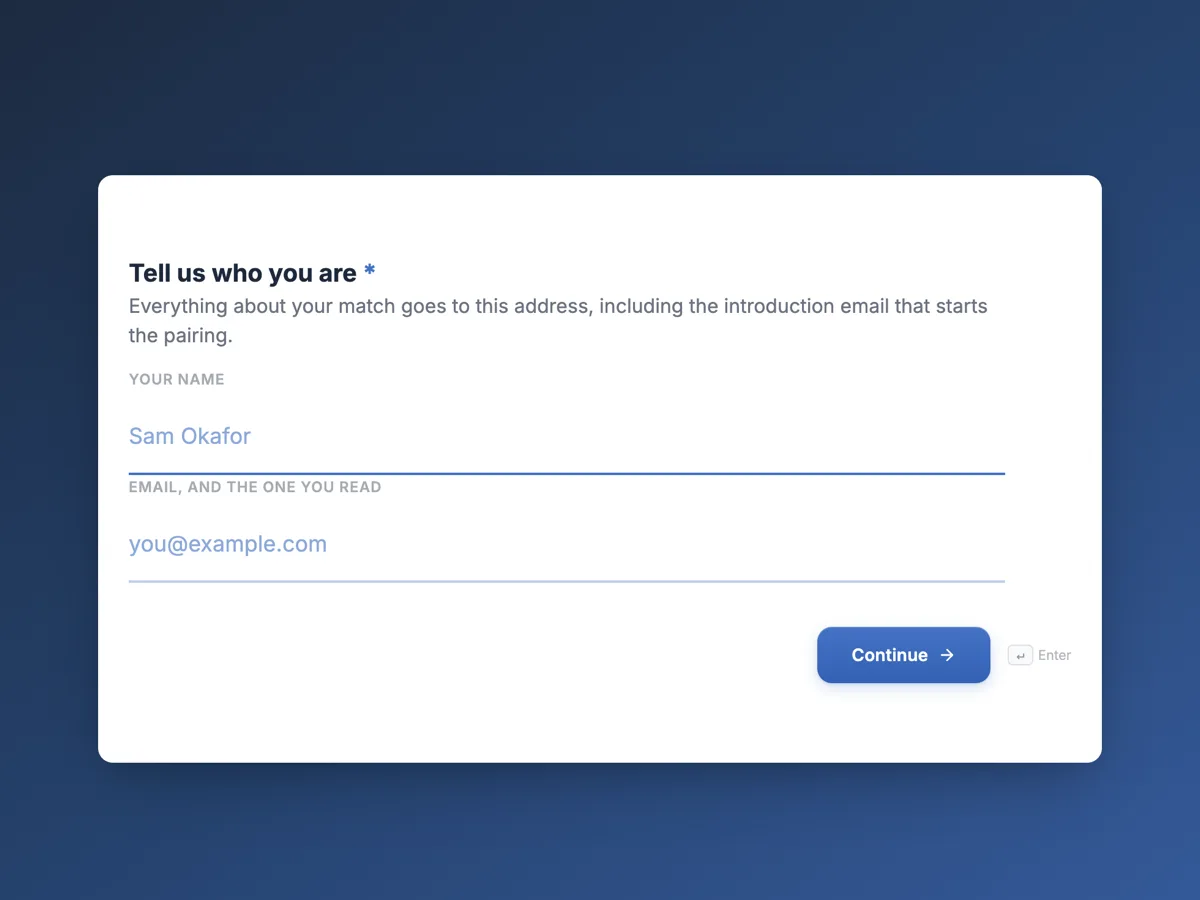
The form itself
The first screen of the form. A conversational form shows one question per screen, so the remaining screens are listed in the field table below. Nothing here can be filled in or submitted, so read it as a reference and build your own from the button above.
Every field, and what it collects
The complete field list, in the order respondents meet it.
- Tell us who you areProfileRequired
- Everything about your match goes to this address, including the introduction email that starts the pairing.
- Are you applying as a mentor or a mentee?Single choiceRequired
- Both sides answer the same thirteen screens, which is deliberate. A mentor who cannot say what they want out of it is the pairing that fades after two sessions.
- Options: Mentee, I am looking for a mentor · Mentor, I am offering my time · Either, and I would do both if the match worked
- Which industry do you work in?DropdownRequired
- Matching does not always stay inside an industry. A cross industry pairing is often the better one when the goal is a career change or a first management role.
- Options: Technology and software · Financial services · Healthcare and life sciences · Education and research · Government and public sector · Not for profit and community · Manufacturing and engineering · Retail, hospitality and consumer · Media, marketing and creative · Construction and property · Professional services and consulting · Something else
- What is your current role?Short textRequired
- A title plus a bit of context beats a title on its own. The size of the organisation is usually the most useful detail.
- How long have you been in this field?Single choiceRequired
- This is not a seniority filter. Some of the best pairings here are six years apart rather than twenty, because the mentor still remembers the problem.
- Options: Less than two years · Two to five years · Five to ten years · Ten to twenty years · More than twenty years
- What do you want to get out of this?Long textRequired
- This is the answer the matching team reads first and the one that decides most pairings. Two specific paragraphs beat a page of general ambition. Name the actual problem if you can.
- What should a good match give you?Multiple choiceRequired
- Pick up to three. Choosing everything tells the matching team nothing, and a pairing built on three shared expectations lasts longer than one built on nine.
- Options: Someone who has done the specific job I am aiming at · Honest feedback on how I come across · Help thinking through a decision I am facing · An introduction to a different industry or function · Accountability, someone who asks whether I did the thing · Technical depth in my own field · Someone who has navigated the same barriers I have · A sounding board with no agenda
- How many hours a month can you commit?Single choiceRequired
- The programme expects at least one hour a month for six months. Answering honestly at the low end is far better than dropping out in month three.
- Options: One hour, one session · Two hours, usually two sessions · Three to four hours · More than four hours
- How would you like to meet?Multiple choiceRequired
- Tick everything you would accept. A video only answer narrows the pool considerably in smaller cities, and most pairings settle into a mix anyway.
- Options: Video call · Phone call · In person, coffee or a walk · Asynchronous messages between calls
- Which time zone are you in?DropdownRequired
- Pairings across more than four hours of difference are possible but they need a fixed early or late slot, so the matching team checks this before proposing one.
- Options: UTC minus 8 to minus 5, the Americas west and central · UTC minus 5 to minus 3, the Americas east · UTC minus 1 to plus 1, western Europe and west Africa · UTC plus 1 to plus 3, central Europe, east Africa and the Middle East · UTC plus 4 to plus 6, south and central Asia · UTC plus 7 to plus 9, southeast and east Asia · UTC plus 10 to plus 13, Australia, New Zealand and the Pacific
- A profile link, if you have oneShort text
- Optional. It is used to write the short profile that goes to your proposed match, and nothing else. Applications are not judged on it.
- Have you been in a mentoring relationship before?Single choiceRequired
- First timers on either side are sent a one page guide on how to run the first session, which is where most pairings either start well or drift.
- Options: No, this would be my first · Yes, informally, without a programme · Yes, through a structured programme · Yes, and it did not work, which is why I am being careful this time
- The programme agreementMultiple choiceRequired
- Four commitments, each ticked separately. They are the ones that pairings break, in roughly that order.
- Options: I will commit to six months and tell the programme early if I cannot continue · I will treat what my match tells me as confidential · I understand this is not a recruitment or business development channel · I have read the code of conduct and agree to it
One form for both sides, on purpose
The usual design is a mentor form and a mentee form, which produces two sets of answers in two shapes and leaves the matching team comparing prose to prose. Here both sides answer the same thirteen screens and the mentor or mentee question is just the second one. The description on that screen explains why: a mentor who cannot say what they want out of it is the pairing that fades after two sessions. Asking a mentor about their goals is not a courtesy, it is the thing that makes the match survive month three.
Capping the expectations question at three
The eight options on the what should a match give you screen are the real reasons pairings work: somebody who has done the job, honest feedback, help with a decision, an introduction, accountability, technical depth, shared barriers, a sounding board with no agenda. The description caps the answer at three and says why, which is that a pairing built on three shared expectations lasts longer than one built on nine. A checkbox cannot enforce a cap, so the instruction has to carry it, and saying what the limit is for makes people respect it.
How to adapt this form
A university alumni programme adds a graduation year and a faculty dropdown, and replaces the time zone bands with campus and city, because proximity matters more than hours of difference. A women in leadership or first generation programme keeps the shared barriers option and adds an optional demographic question with a prefer not to say answer. A reverse mentoring programme inverts the years in the field screen entirely and asks what the junior participant can teach, since that is the exchange being organised rather than an accident of it.
What makes this form work
Mentors answer the goals question too
The same thirteen screens for both sides, and the mentor or mentee question is only the second. A mentor who cannot say what they want from the pairing is the one that fades after two sessions.
Eight real expectations, capped at three
Somebody who has done the job, honest feedback, help with a decision, an introduction, accountability, technical depth, shared barriers, a sounding board. Three ticks give a match something to be built on.
The previous experience question has a fourth option
Yes, and it did not work, which is why I am being careful. That answer tells a matching team more about what to avoid than the other three put together, and it only appears if you offer it.
Questions people ask
Should mentors and mentees fill in the same form?
Yes, if you want to match them. Two different forms produce answers in two different shapes and a matching team ends up reading prose against prose. Here the second screen asks which side somebody is on and everything after it is common, so the goals, the expectations and the availability are directly comparable across the whole cohort.
Why is the goals question free text rather than a list?
Because the specific problem is the thing that matches people, and a list flattens it. The description asks a mentee for the decision in front of them and a mentor for what they want to practise, then says two specific paragraphs beat a page of general ambition. That instruction is what turns the answer from a mission statement into something usable.
Can a form limit how many checkboxes someone ticks?
Not by itself, so the limit is stated in the description instead: pick up to three, because choosing everything tells the matching team nothing. Explaining the reason works better than a hard rule would, and a handful of applications with four ticks is a much smaller problem than a form that blocks people mid answer.
Why ask about a previous mentoring relationship?
Because first timers on either side need a different start, and the description says they are sent a one page guide on running the first session. The fourth option, that it did not work last time, is the most useful answer on the screen. Somebody being careful is telling you exactly what to avoid in their next pairing.
What does the programme agreement prevent?
Four specific failures, ticked separately: dropping out silently, breaking confidence, using the pairing to recruit or sell, and ignoring the code of conduct. The description says they are the ones pairings break in roughly that order. Naming the sales one explicitly matters, because it is the complaint most programmes receive and the least often stated up front.
Is thirteen screens too many for a volunteer programme?
It runs to about seven minutes on a phone, one question at a time, and the welcome screen says so. A conversational form carries this comfortably because each screen holds its own description, which a classic form does not render on the published page. Most of the screens are a single tap; only one asks for writing.
Build your own in about a minute
The button below opens the generator with this use case already described. Change the wording to match your own, generate, then edit anything you like.
Make my mentorship program application form for mentors and menteesOther form examples
Accelerator application form with traction numbers and a deck
An accelerator reads a hundred applications to shortlist twenty, so the form has to produce numbers that sort and answers that are hard to fake. This sixteen screen form asks for stage, last month revenue, active users, capital raised and a founder table, then a 90 second video pitch recorded in the browser.
Board member application form with a skills matrix on it
A nominations committee is filling gaps, not collecting resumes, so a board application has to produce something comparable across twenty candidates. This fourteen field form puts a six row skills matrix at the centre, asks for directorships as dated rows, and makes the conflicts declaration a required box that will not accept silence.
Pet adoption application form with the home check questions built in
A rescue is matching an animal that already has a history to a home it cannot see, and the decision turns on fencing, hours alone and whether the landlord has actually said yes. This fifteen screen application asks those in the first half and spends the second half on the animals already in the house.
Want the steps in the builder? Read Build a conversational form with AI, then Design your welcome and thank you screens. For everything this generator can do, see the form maker.
Sources
Written and checked by the OneCraft team. Last checked .