Conversational form
Accelerator application form with traction numbers and a deck
An accelerator reads a hundred applications to shortlist twenty, so the form has to produce numbers that sort and answers that are hard to fake. This sixteen screen form asks for stage, last month revenue, active users, capital raised and a founder table, then a 90 second video pitch recorded in the browser.
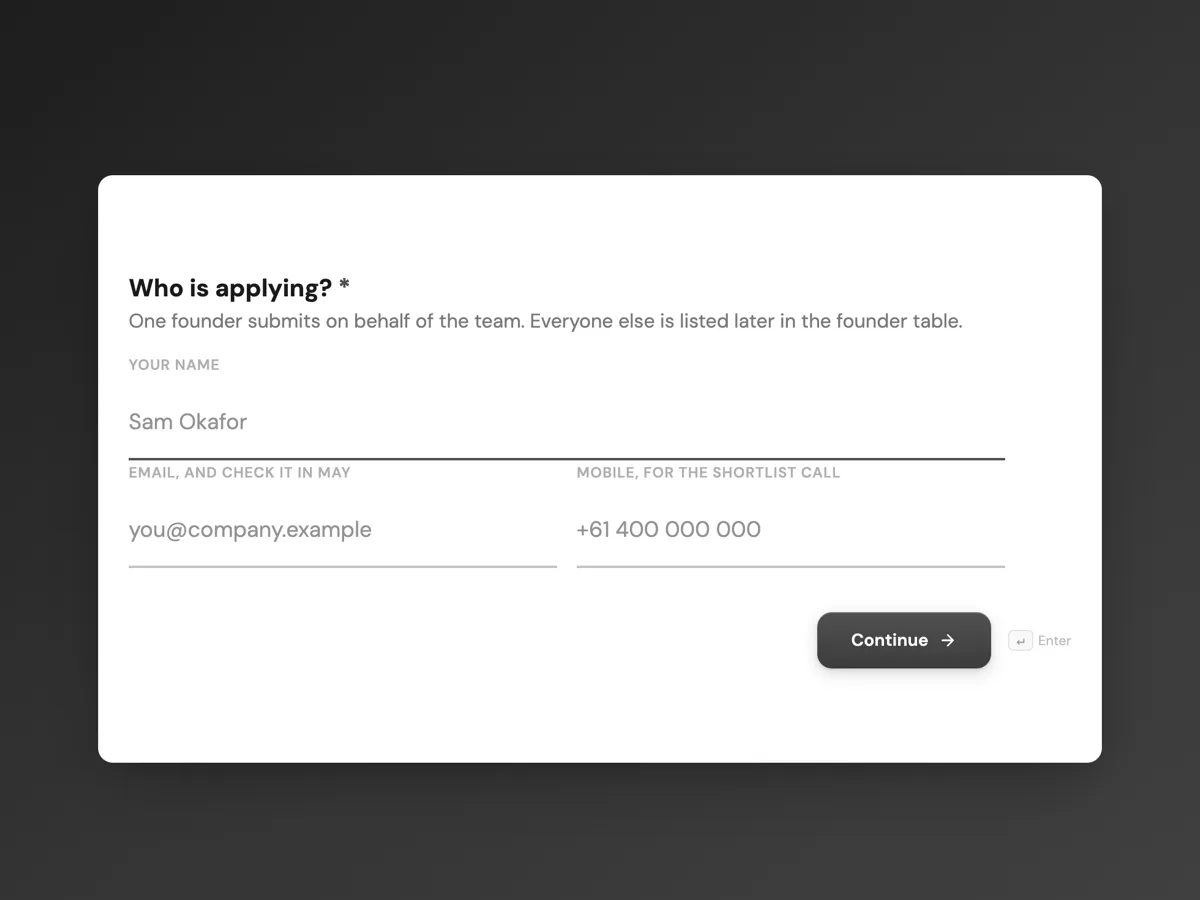
The form itself
The first screen of the form. A conversational form shows one question per screen, so the remaining screens are listed in the field table below. Nothing here can be filled in or submitted, so read it as a reference and build your own from the button above.
Every field, and what it collects
The complete field list, in the order respondents meet it.
- Who is applying?ProfileRequired
- One founder submits on behalf of the team. Everyone else is listed later in the founder table.
- What is the company called?Short textRequired
- A working name is fine. Several cohort companies changed their name during the programme.
- Describe it in one sentenceShort textRequired
- Plain language, no category words. If a reader has to already know the industry to understand the sentence, it is not the right sentence yet.
- Website or product linkShort text
- Optional, and an empty answer is not held against a team building something that is not public yet.
- What stage are you at?Single choiceRequired
- Answer for where you are this week, not where you expect to be in May. Two thirds of every cohort applies with either an idea or a prototype.
- Options: An idea, nothing built yet · A prototype, not in anybody hands · Live with early users, no revenue · Live with revenue, under 10,000 a month · Live with revenue, over 10,000 a month
- What are you building, and why this?Long textRequired
- About 300 words. The part that carries the most weight is how you came to the problem, because founders who lived it tend to keep going when the first version fails.
- Who is the customer, and how do you know?Long textRequired
- Name a specific person or business you have spoken to, and what they said. An answer built out of a market size figure is the most common reason a strong idea gets passed on here.
- Monthly revenue, in dollarsNumberRequired
- Last full month, gross, before costs. Enter 0 if there is none, which is true of most applicants and is not a problem. This figure is checked at the shortlist call, so put the real one.
- How many people used the product last month?NumberRequired
- Active users, however you define active, and you will be asked how you defined it. Enter 0 if nothing is live yet.
- How has that moved over the last three months?Single choiceRequired
- Flat and honest reads better than a number nobody can reproduce. Early companies are expected to be lumpy.
- Options: Growing month on month · Growing, but unevenly · Flat · Down · Too early to say, nothing is live
- How much have you raised to date, in dollars?NumberRequired
- Everything from outside the founders, including grants, an accelerator cheque, friends and family, and any convertible note. Enter 0 if the answer is nothing.
- Who is on the founding team?TableRequired
- Up to four founders including you. Leave rows blank if there are fewer. Part time is a normal answer at this stage and it is asked because it changes what the programme can expect in week one.
- Columns: Name · What they do · Full time or part time · Equity, roughly
- How long has the team worked together?Single choiceRequired
- Teams that met at a startup weekend are accepted every cohort. The question is here because co founder breakups are the most common reason a company leaves the programme early.
- Options: More than three years · One to three years · Six to twelve months · Less than six months · I am a solo founder
- Your deckFile uploadRequired
- PDF only, one file, up to 25 MB. Ten slides is plenty and nobody is reading past fifteen. If you do not have a deck, a one page PDF that answers the two written questions above is genuinely enough.
- Record a 90 second pitchRecording
- Recorded here in the browser, with a timer running. Unscripted is better than polished and a single take is fine. Say what you are building, who it is for, and what you would do with fourteen weeks.
- Why this programme, and what would you want from it?Long textRequired
- About 150 words. A precise answer, such as needing an introduction to three regional logistics operators, is worth more than an answer about wanting mentorship and networks.
Making zero a safe answer
The three number screens are the ones applicants lie on, and they lie because zero feels disqualifying. So each description says the opposite in plain words: enter 0 if there is none, which is true of most applicants and is not a problem, and this figure is checked at the shortlist call. The stage radio does the same job from the other direction by saying two thirds of every cohort applies with an idea or a prototype. Telling people the honest answer is normal is cheaper and more effective than any validation rule.
The video pitch, and why it is recorded on the form
A recording field captures audio or video in the browser with a timer running and a duration cap, set here to 90 seconds. It changes what gets submitted. A link to a polished video invites a week of editing, while a recording made in the moment produces the unscripted version a partner actually wants, and the description says unscripted beats polished and one take is fine. It is also the only screen where the whole team dynamic shows up, which is what the founder table and the years together question are circling.
How to adapt this form
A grant or non dilutive funding programme drops the equity column from the founder table and adds a use of funds breakdown, since the decision is about spend rather than ownership. A corporate innovation challenge replaces the customer evidence question with a named business unit and a pilot proposal. A university incubator taking student teams drops revenue entirely, adds a study commitment question and a supervisor name, and keeps the video pitch, which is usually the only part of the application the selection panel remembers.
What makes this form work
Every number screen says that zero is normal
Revenue, users and capital raised each carry a description telling applicants to enter 0 honestly and warning that the figure is checked at the shortlist call. That pairing is what produces usable numbers.
The pitch is recorded in the browser with a 90 second cap
A recording field with a running timer collects the unscripted version instead of a link to something edited for a week. The description says one take is fine, which is what makes people press record.
The customer question rejects market size answers
It asks for a specific person or business the team has spoken to and what they said, and states that an answer built from a market size figure is the most common reason a strong idea is passed on.
Questions people ask
Does a number field stop someone entering a silly figure?
Not in a conversational form. The input is rendered without a minimum or maximum, so nothing is blocked while somebody types and the range is only checked when the form is submitted. That is why each description here states the rule in words and says the figure is checked at the shortlist call, which is the control that actually works.
How long should a pitch recording be?
Ninety seconds here, and the cap is enforced by the field with a visible timer. Long enough to say what you build, who it is for and what you would do with the programme, short enough that a partner watches all of them. The maximum a recording field allows is set per field, so a programme wanting two minutes can have it.
Why ask for equity in the founder table?
Because an uneven or undecided split is one of the strongest predictors of a team not finishing a programme, and the question is easier to answer on a form than in a call. The column asks for roughly, which signals that an approximate answer is fine and stops people leaving it blank because the cap table is not tidy yet.
Is a deck necessary if the form asks the same questions?
It is required here, but the instruction lowers the bar considerably: ten slides is plenty, nobody reads past fifteen, and a one page PDF answering the two written questions is genuinely enough. That framing keeps a team without a deck from abandoning the application, which is the usual cost of a required upload on an early stage form.
Why ask how the founders know each other?
Because co founder breakups end more accelerator companies than product failure does. The options include teams that met at a startup weekend and solo founders, and the description says both are accepted every cohort. Asking without judgement gets an honest answer, which is what a programme needs before putting two strangers through fourteen intense weeks.
How do these responses get reviewed?
Through the responses table, where each application is one row and the numbers sort directly. The CSV export gives one column per question, with the founder table exported as a JSON array of its filled rows and the recording marked as uploaded rather than inlined. Partners typically sort by stage and revenue, then watch the recordings in that order.
Build your own in about a minute
The button below opens the generator with this use case already described. Change the wording to match your own, generate, then edit anything you like.
Make my accelerator application form with traction numbers and a deckOther form examples
Art exhibition proposal form with a works list and install needs
A gallery programming committee is deciding whether a show fits a specific room, which is a question about dimensions as much as about ideas. This eleven field proposal form publishes the wall length, the ceiling height and the doorway width, then asks for a works list with sizes so the answer is checkable before the meeting.
Franchise application form that asks about capital before it asks about coffee
A franchise group can only assess three things from a first application: where the applicant wants to trade, what they can fund without borrowing, and whether they intend to stand in the store. This form asks those three in its first three screens and spends the other eleven on history, partners and timing.
Brand ambassador application form that reads the content before the reach
Ambassador programmes drown in applications from accounts that bought their audience, and a follower count cannot tell those apart from the creators worth signing. This thirteen screen form asks for a sample post, a sixty second unscripted video and what an audience actually comes for, then asks about reach in bands.
Want the steps in the builder? Read Build a conversational form with AI, then View, export and manage responses. For everything this generator can do, see the form maker.
Written and checked by the OneCraft team. Last checked .