Conversational form
Pet adoption application form with the home check questions built in
A rescue is matching an animal that already has a history to a home it cannot see, and the decision turns on fencing, hours alone and whether the landlord has actually said yes. This fifteen screen application asks those in the first half and spends the second half on the animals already in the house.
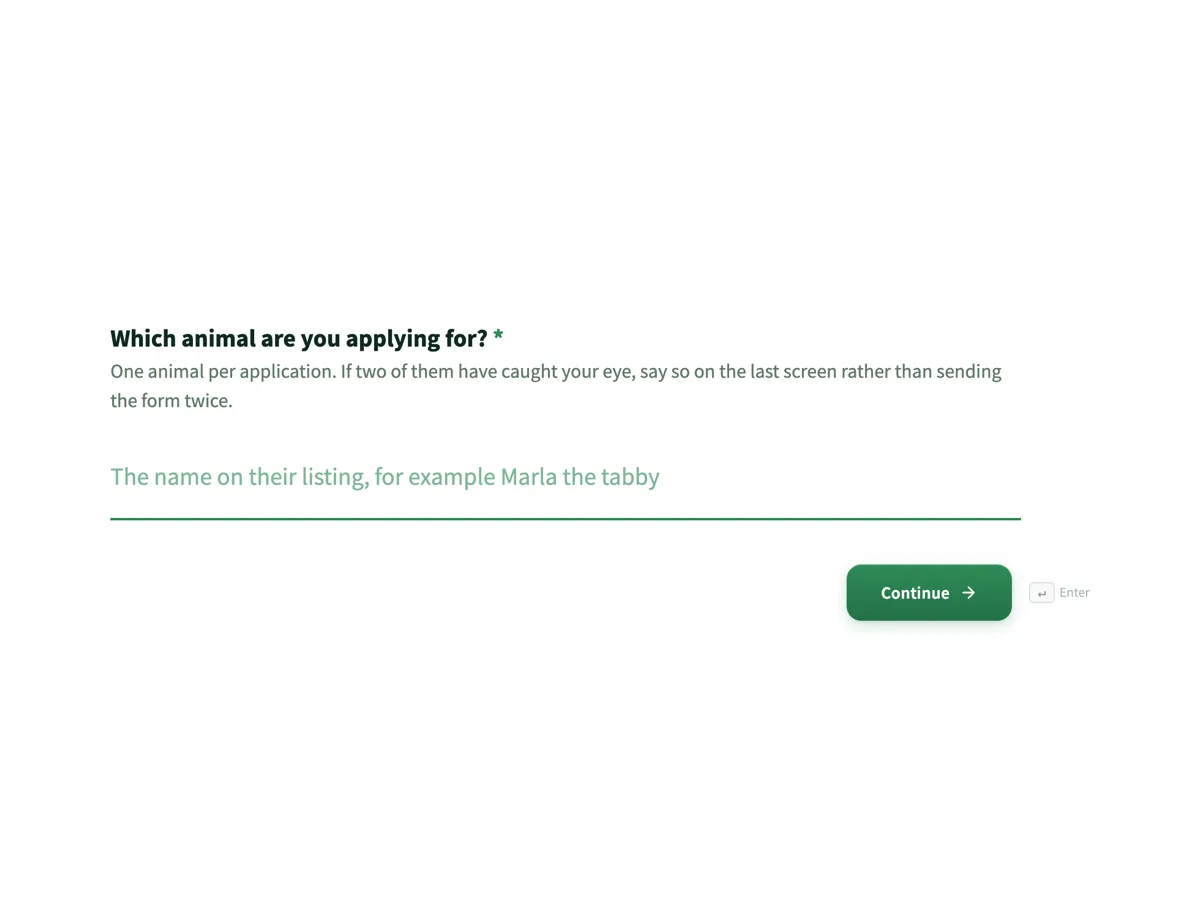
The form itself
The first screen of the form. A conversational form shows one question per screen, so the remaining screens are listed in the field table below. Nothing here can be filled in or submitted, so read it as a reference and build your own from the button above.
Every field, and what it collects
The complete field list, in the order respondents meet it.
- Which animal are you applying for?Short textRequired
- One animal per application. If two of them have caught your eye, say so on the last screen rather than sending the form twice.
- Have you met this animal yet?Single choiceRequired
- Meeting first is not required, and it changes nothing about how this application is read. It only decides whether the next step is a meet or a call.
- Options: Yes, at an adoption day · Yes, at the foster carer home · No, I have only seen the listing · No, but I have adopted from this rescue before
- What kind of home do you live in?Single choiceRequired
- Options: House with a yard · House with a courtyard only · Townhouse with a small yard · Apartment with a balcony · Apartment with no outdoor space · Rural property
- Do you own or rent?Single choiceRequired
- Options: I own it · I rent it · I live with family or friends who own it · Other arrangement
- If you rent, does your landlord or body corporate allow pets?Single choiceRequired
- This question ends more adoptions than any other, so it is asked early. Written permission is not needed now, only an honest answer about what has been agreed.
- Options: Yes, in writing · Yes, agreed verbally · Not yet asked · No, but I am moving before the adoption · I do not rent
- How is your outdoor space fenced?Single choiceRequired
- Cats and small dogs escape different gaps from large dogs, so the height and the state of the fence both matter more than the size of the yard.
- Options: Fully fenced, over 1.5 metres, no gaps · Fully fenced, under 1.5 metres · Fenced but it needs repair before an animal arrives · Partly fenced · Not fenced · No outdoor space, the animal will be indoors only
- On a normal weekday, how long would the animal be alone?Single choiceRequired
- Options: Never, someone is home · Under 4 hours · 4 to 6 hours · 6 to 9 hours · More than 9 hours · It varies week to week
- Who else lives in the home?Multiple choiceRequired
- Options: Adults only · Children under 5 · Children 5 to 12 · Teenagers · A person with limited mobility · Someone with an animal allergy · Visitors with children, regularly
- Animals living with you nowTable
- Leave the rows blank if this would be your first. The last column is the one the foster carer reads hardest.
- Columns: Species and breed · Age · Desexed · How they are with other animals
- Have you had a pet before, and what happened to them?Single choiceRequired
- Every honest answer here is acceptable. Rehoming an animal is not a disqualification, and hiding it is the only version that is.
- Options: Yes, and they are still with me · Yes, and they died of old age or illness · Yes, and I rehomed them · Yes, and they were lost or did not come home · No, this would be my first
- Your vet clinic, if you have oneShort text
- The rescue calls to ask one question: were the animals in your care kept up to date. Leave it blank if this is your first animal.
- What would you do if the animal chewed, sprayed or cried at night for the first month?Long textRequired
- There is no correct answer. A plan that includes asking for help reads better than a plan that does not.
- How much exercise and activity can you offer?Single choiceRequired
- Options: A short walk or play session daily · An hour or more of walking daily · Two long walks and weekend activity · Indoor play only · Off leash running on acreage
- The adoption termsMultiple choiceRequired
- Options: I will keep the microchip registered to me and update it when I move · I will return the animal to the rescue rather than rehome them myself · I understand the animal is desexed and vaccinated before adoption and that the fee covers part of that cost · I agree to a home visit or a video walkthrough before the adoption is confirmed
- How can the foster carer reach you?ProfileRequired
What each screen of this application collects
The first two screens name the animal and say whether the applicant has met them, which decides whether the next step is a phone call or a meet. The housing block is the screening core: home type, own or rent, landlord permission and fencing, in that order, because permission and fencing are the two answers that most often end an application and asking them early respects the applicant time. Hours alone is asked as a band rather than a number so that nobody rounds down. The household tick list separates children under five from children five to twelve, since that is a real difference in how a nervous dog is placed. The animals table takes four rows with a column for how each existing animal is with others, which the foster carer reads hardest.
Why the awkward answers are offered as options
Three screens deliberately name the answer an applicant would rather not give. Landlord permission offers not yet asked and no, but I am moving. The previous pet question offers rehomed them and lost or did not come home. The fencing question offers fenced but it needs repair. None of those is a rejection on its own, and every one of them is a conversation the rescue would rather have now than after a failed placement. A form that only lists the good answers does not stop people applying, it just makes the application useless, because the foster carer ends up relying on a phone call to find out what the form was supposed to establish.
How to adapt this form
A cat only rescue drops the fencing screen entirely and replaces it with an indoor or outdoor question plus a screened balcony check, because containment for cats is vertical rather than horizontal. A greyhound adoption program adds a muzzle and small animal screen and turns the activity question into a question about lead strength and recall training. A large shelter taking hundreds of applications keeps this shape and adds a webhook so each submission lands in the matching spreadsheet, since the value of a conversational form at that volume is that the fields arrive structured rather than as a paragraph in an inbox.
What makes this form work
Permission and fencing are asked before the sentimental questions
Landlord permission is screen five and fencing is screen six, ahead of anything about lifestyle or love of animals. Both are the answers that end placements, so an applicant who cannot pass them finds out in ninety seconds rather than after writing two paragraphs about their childhood dog.
Hours alone is a band, including it varies
Six options from never to more than nine hours, with it varies week to week at the end, so a shift worker has something true to pick. A free text answer here produces roughly eight hours, which is the number people believe rather than the number the animal experiences.
The terms are four ticks the adopter will be held to
Microchip kept registered and updated on a move, return to the rescue rather than rehome, desexing already done and included in the fee, and a home visit or video walkthrough. Each is a sentence the adopter reads on its own, and each is a condition the rescue actually enforces.
Questions people ask
Why does an adoption form ask about fencing in that much detail?
Because a yard is either secure for this animal or it is not, and the size of the yard says almost nothing about that. The options name fence height at one and a half metres, gaps, partial fencing and fencing that needs repair, so a foster carer can match an escape artist to a home rather than discovering the gap in week one.
Does saying I rehomed a previous pet end the application?
No, and that is why the option is on the list. People rehome animals for illness, a move overseas, a relationship ending or a bite history, and a rescue would much rather read that than find it later. The answer that ends applications is the one that turns out to be untrue when the vet is called.
Why ask for a vet clinic rather than a written reference?
Because a phone call answers the question in thirty seconds and a written reference takes two weeks. The rescue asks one thing: were the animals in this person care kept up to date. First time adopters leave the field blank, which is expected, and the question then falls to the household and behaviour screens instead.
Can a conversational form collect the adoption fee?
No. This form takes an application and records agreement to the terms. The fee is arranged after the match is confirmed, which is the right order anyway, since taking money before a foster carer has approved the placement creates a refund every time an application is declined.
Why is there a table of current animals instead of a yes or no question?
Because a home with a fourteen year old cat and a home with two young dogs are different placements, and one yes cannot carry that. Four rows with species, age, desexed status and how each animal is with others give the foster carer the shape of the household, and an applicant with no animals simply leaves the rows empty.
How long should an adoption application be?
Fifteen screens is about six minutes and sits near the upper limit for a form that anyone can start on a phone from a listing page. Longer applications collect better information from the people who finish and lose the ones who were going to be good homes.
Build your own in about a minute
The button below opens the generator with this use case already described. Change the wording to match your own, generate, then edit anything you like.
Make my pet adoption application form with the home check questions built inOther form examples
Board member application form with a skills matrix on it
A nominations committee is filling gaps, not collecting resumes, so a board application has to produce something comparable across twenty candidates. This fourteen field form puts a six row skills matrix at the centre, asks for directorships as dated rows, and makes the conflicts declaration a required box that will not accept silence.
Beta tester application form that sorts testers into the right cohort
A beta cohort fails when it fills up with people who applied out of curiosity and never opened the build. This eleven screen application asks what platform someone will really test on, what they use today, and how many hours a week they can honestly give.
Franchise application form that asks about capital before it asks about coffee
A franchise group can only assess three things from a first application: where the applicant wants to trade, what they can fund without borrowing, and whether they intend to stand in the store. This form asks those three in its first three screens and spends the other eleven on history, partners and timing.
Want the steps in the builder? Read Create a conversational form with AI, then Classic or conversational, and when to use each. For everything this generator can do, see the form maker.
Written and checked by the OneCraft team. Last checked .