Classic form
Equipment hire booking form with the items as a table
A hire yard prices a booking from three columns, which are the item, how many and for how many days, and everything else on a hire form is about getting the gear to a site and back. This booking form takes those three as a table, asks what the truck will find when it arrives, and closes with the waiver and the terms signed.
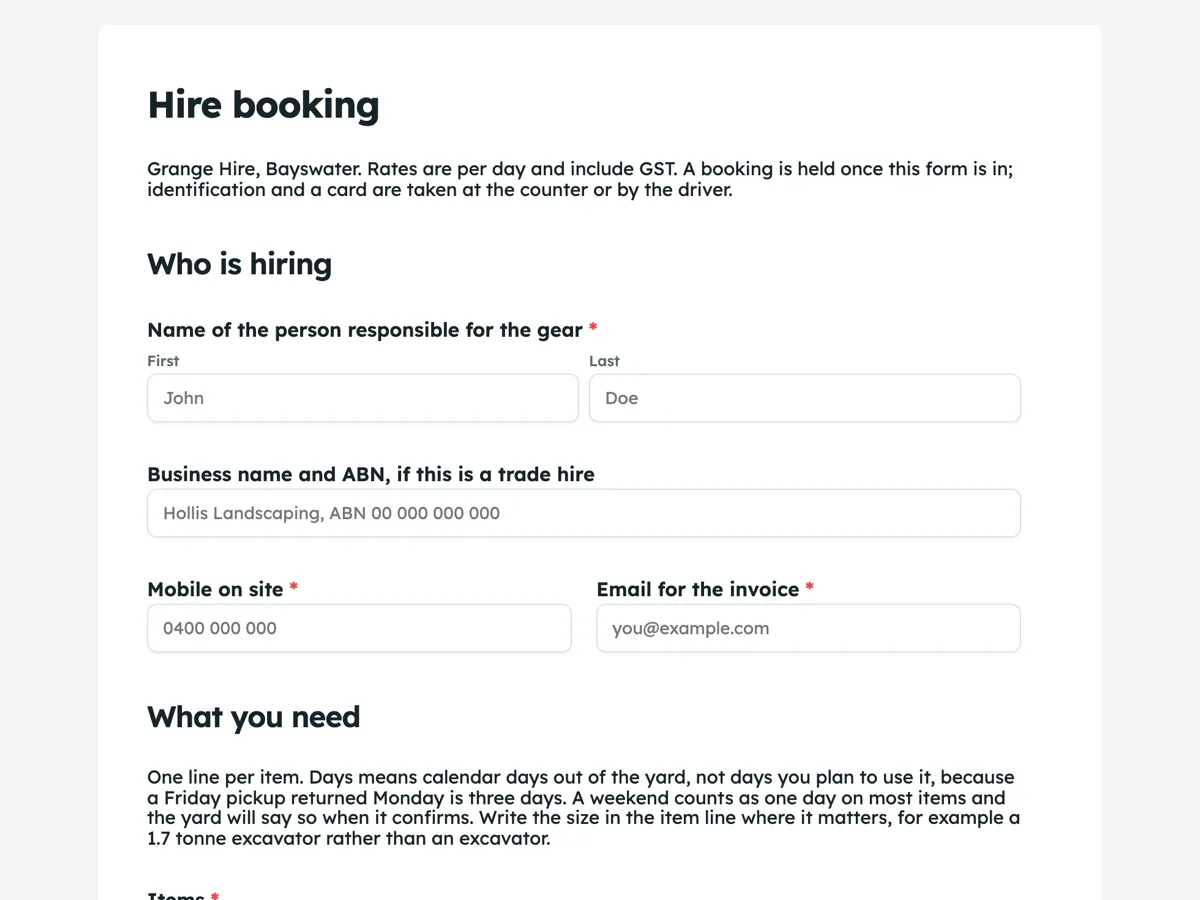
The form itself
A static copy of the finished form, exactly as it renders. Nothing here can be filled in or submitted, so read it as a reference and build your own from the button above.
Every field, and what it collects
The complete field list, in the order respondents meet it.
- Name of the person responsible for the gearNameRequired
- Business name and ABN, if this is a trade hireShort text
- Mobile on siteShort textRequired
- Email for the invoiceShort textRequired
- ItemsTableRequired
- Columns: Item and size · Quantity · Days
- First day you need itDateRequired
- Pickup or delivery?Single choiceRequired
- Options: I will collect from the yard and return it myself · Deliver and collect, metropolitan · Deliver and collect, outside the metropolitan area · Deliver only, I will return it · Collect only, it is already on site from a previous hire
- Site addressShort textRequired
- Site access: gates, driveway, where the truck can get toShort textRequired
- High risk work licence or operator ticket, where one is requiredFile upload
- Needed for a scissor lift, a boom lift, a forklift or anything else on the high risk work licence list. Photograph the front and back of the card. Leave this blank for hand tools, compactors, mixers and small excavators, which need no ticket. Images or PDF, up to 4 files, 10 MB each.
- Damage waiverSingle choiceRequired
- Options: Yes, add the waiver at 12 per cent of the hire rate · No, I accept full responsibility for loss and damage · My business insurance covers hired plant, I will send the certificate · Tell me what it would cost for this booking
- Hire termsMultiple choiceRequired
- Options: I have read the hire terms and I accept responsibility for the equipment while it is out · I will hold a current licence for any item on the form that requires one · Where I am digging, I will request underground service plans before I start
- Signature of the hirerSignatureRequired
Who is hiring
What you need
Licences, waiver and terms
What each field on this form collects
The first block names the person responsible for the gear rather than the person paying, takes an optional business name and ABN for trade hires, and puts a site mobile beside an invoice email. The items block opens with a paragraph defining what a day means and asking for sizes in the item line, then a five row table with three columns: item and size, quantity, and days. The first day needed sits under it. The logistics block is three fields: a five option pickup or delivery radio that prices metropolitan and outer deliveries separately, the site address, and a required site access field asking about gates, driveways and where a truck can reach. The compliance block is the licence upload, the damage waiver radio, the hire terms paragraph, three acknowledgement ticks and the signature of the hirer.
The Australian pieces on this form
Two of these fields exist because of Australian work health and safety rules. High risk work licences are a national scheme covering classes of plant such as forklifts and elevating work platforms, so the upload asks for the ticket where one is required and the field description lists the common items that need none, which is most of what a domestic hirer takes home. The third acknowledgement tick covers underground services: before digging, an operator can request plans for buried cables and pipes through the free national referral service, and hitting one is the hirer problem and an expensive one. The terms paragraph says both plainly.
How to adapt this form
A yard that hires mostly to builders replaces the five row table with ten rows and adds a purchase order field and a site supervisor name, since the person booking and the person receiving are rarely the same on a commercial site. A party and event hire business keeps the table and the delivery block, drops the licence upload entirely, and adds a bump in and bump out time pair, because marquees and furniture are delivered against a schedule rather than a date. A yard with a large scaffolding or access equipment share should split the licence upload into two fields, one for the ticket and one for a safe work method statement, which is the document a principal contractor asks for before plant comes on site.
What makes this form work
Three columns are the whole quote
Item and size, quantity, days. The yard reads a price off the table without a phone call, and the paragraph above defines a day as calendar days out of the yard, which is the definition every hire invoice argument comes back to.
Site access is asked before the truck is loaded
A required line about gates, driveways and where the truck can get to, sitting right under the site address. It is the detail only the hirer knows and the one that decides whether a six in the morning delivery succeeds or comes back to the yard.
Three ticks cover the three real obligations
Responsibility for the gear while it is out, holding a licence for anything that needs one, and requesting underground service plans before digging. Each is specific enough to mean something on its own.
Questions people ask
Why does the items table have five rows and no way to add more?
Because a table on this form renders exactly the rows it is configured with and cannot grow. Five covers almost every domestic and small trade booking. A hirer with more items either books twice or calls the yard, and a yard that finds five rows regularly filled has good evidence for raising the number.
What does days mean on a hire booking?
Calendar days out of the yard, not days of use. The paragraph above the table says so, and it adds that a Friday pickup returned Monday is three days while most items charge a weekend as one. Defining it before the table is filled in prevents the most common invoice dispute in equipment hire.
Which items need a high risk work licence?
Classes named in the national high risk work licence scheme, including forklifts and elevating work platforms such as scissor and boom lifts. The upload description says that and then lists what does not need one, hand tools, compactors, mixers and small excavators, so a weekend hirer is not put off by a field that does not apply to them.
Is the damage waiver insurance?
No, and the option wording avoids calling it that. It is a charge that limits what the hirer pays for damage, offered here at twelve per cent of the hire rate, with an alternative for a business whose own policy covers hired plant. The fourth option lets somebody ask what it would cost for their specific booking.
Why is site access a required field?
Because a truck that cannot reach the drop point turns a delivery into a return trip, and the hirer is the only person who knows about the single gate, the low branch or the neighbour car. One required line describing gates, driveways and reach saves more delivery failures than any other question on the form.
What is the underground services tick actually asking for?
That the hirer requests plans of buried cables and pipes through the free national referral service before digging. It takes minutes, the plans arrive by email, and striking a service is the hirer responsibility. Putting it as its own acknowledgement rather than a clause in the terms makes it something a person actually reads.
Build your own in about a minute
The button below opens the generator with this use case already described. Change the wording to match your own, generate, then edit anything you like.
Make one like thisOther form examples
Venue hire form for a community hall
A community hall committee is a handful of volunteers approving bookings between other jobs, so the hire form has to arrive complete or it costs somebody three emails. This one asks for the access and vacate times rather than the event time, names the five ways alcohol can appear at a function, and asks for a current certificate of public liability insurance, which the hall checks before it confirms a booking.
Site inspection booking form for an electrician's quote
A site inspection booking form has to get a tradesperson to the right address, through the right door, with the right parts, at a time someone can let them in. This one asks the job type, access, a time window and parking, takes photos of the switchboard and the work area, and asks about pets before the gate opens.
Holiday rental booking form with the house rules accepted up front
Two things ruin the end of a holiday rental stay: a bond deduction the guest did not expect, and a noise complaint from the house next door. This booking form puts both on the page before the dates are held, with the rules written out in full, a guest cap that is stated rather than implied, and a signature under the bond acknowledgement.
Want the steps in the builder? Read Every form field and when to use it, then View, export and manage your responses. For everything this generator can do, see the form maker.
Written and checked by the OneCraft team. Last checked .