Classic form
Workplace grievance form
A grievance form that only asks "describe your complaint" produces a page of frustration nobody can act on. This one asks for the account and then a dated table of incidents beside it, keeps witnesses separate, and finishes with the question that decides what happens next: what would a good outcome look like. It is written for an Australian workplace, and it is a classic form, because somebody writing something difficult needs to see the whole shape of it before they start.
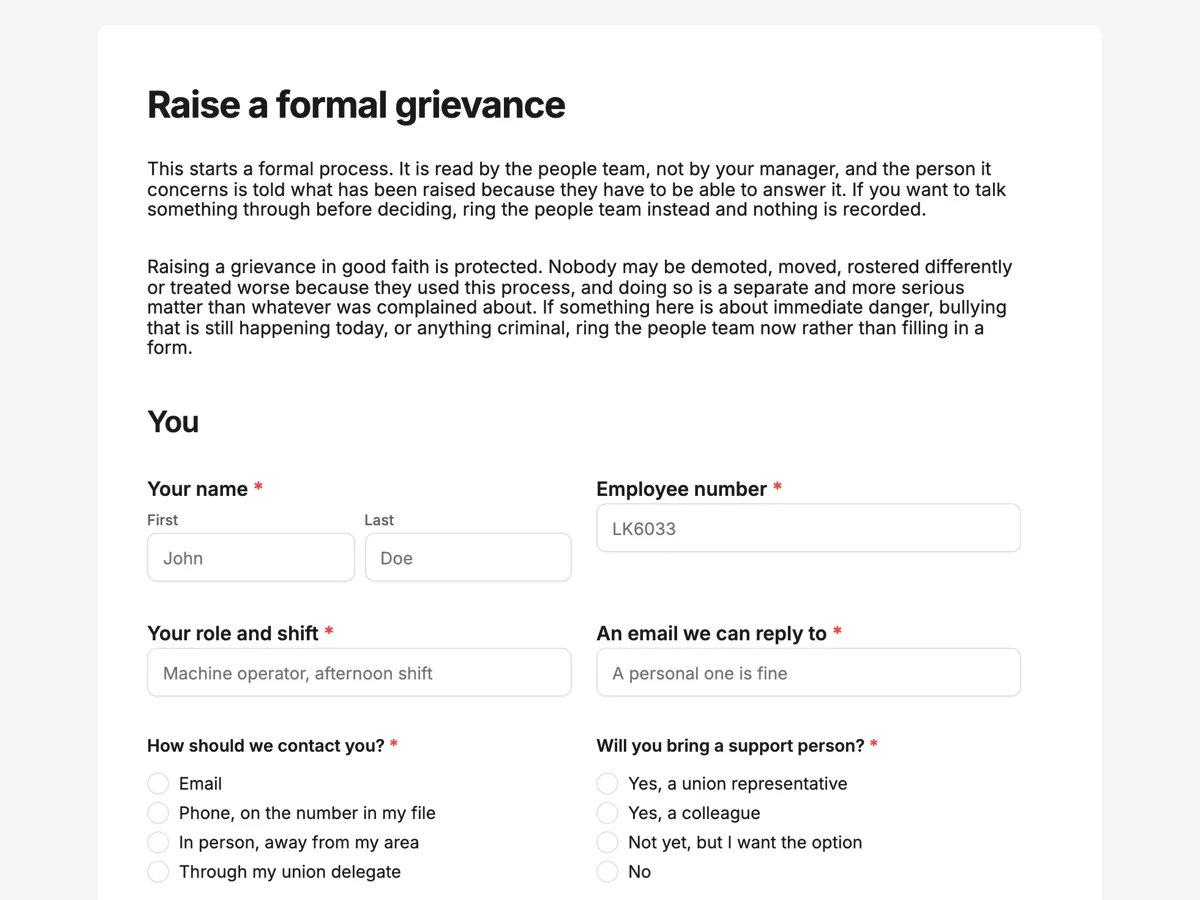
The form itself
A static copy of the finished form, exactly as it renders. Nothing here can be filled in or submitted, so read it as a reference and build your own from the button above.
Every field, and what it collects
The complete field list, in the order respondents meet it.
- Your nameNameRequired
- Employee numberShort textRequired
- Your role and shiftShort textRequired
- An email we can reply toShort textRequired
- How should we contact you?Single choiceRequired
- Options: Email · Phone, on the number in my file · In person, away from my area · Through my union delegate
- Will you bring a support person?Single choiceRequired
- Options: Yes, a union representative · Yes, a colleague · Not yet, but I want the option · No
- Your account, in your own wordsLong textRequired
- The incidents, in orderTable
- Columns: Date · Where · What happened · Who was present
- When did this start?DateRequired
- Is it still happening?Single choiceRequired
- Options: Yes, in the last week · Yes, but less often · No, it stopped · I have been avoiding the situation
- Who is this about?Short textRequired
- How would you describe it?DropdownRequired
- Options: Bullying or repeated unreasonable behaviour · Discrimination or harassment · Sexual harassment · A safety issue that has not been fixed · How a decision about me was made · Pay, hours or roster · Something else, described in my account
- People who saw or heard some of itTable
- Columns: Name · Role · Which part they saw
- Anything that supports your accountFile upload
- Up to eight files, PDF or photo, 10 MB each. Emails, messages, rosters, photographs, a note you wrote on the day. Screenshots are more useful with the date and the sender visible in the frame, and a photograph of a screen is fine if that is what you have.
- Has any of this been raised before?Single choiceRequired
- Options: No, this is the first time · I raised it with the person directly · I raised it with my supervisor · I raised it with someone in the people team · I have raised it more than once and nothing changed · I did not feel safe raising it
- What happened when you did?Long text
- What would a good outcome look like?Multiple choiceRequired
- Options: The behaviour stops · An apology · A formal investigation · A change to my roster, area or reporting line · A decision about me reviewed · A conversation facilitated by somebody neutral · Training or a reminder given to a team · I want it recorded, and nothing else for now
- In your own words, what do you want to happen?Long text
You
What happened
Witnesses and anything you have kept
What you have already tried
What you are asking for
What makes this form work
The protection is stated before anything is asked
The first paragraph says that nobody may be demoted, moved or rostered differently for using the process, and that doing so is more serious than the original complaint. The fear of consequences is why grievances go unraised, so the answer to it belongs at the top of the page rather than in a policy appendix.
It separates what somebody saw from what they were told
The instruction above the account asks for that split explicitly, because a reader who cannot tell first hand from second hand discounts the whole document. It costs one sentence and it materially changes how usable the account is two months later.
It asks what a good outcome would look like
Eight options, from the behaviour stopping to an investigation to simply having it recorded. Plenty of complaints do not want a formal process and are resolved by a roster change, and a form that never asks pushes every one of them down the same expensive path.
Questions people ask
Should a grievance form allow anonymous complaints?
This one does not, and it says why. A complaint that cannot be put to the person it concerns cannot be investigated fairly, and a process that accepts anonymous reports and then does nothing with them damages trust more than not accepting them. What the form does instead is state the protection against being treated badly for raising something, which is the real fear behind the request to be anonymous.
Why put the incidents in a table as well as a written account?
They do different jobs. The account carries the meaning and the sequence; the table carries the dates, places and who was present in a form somebody can check against a roster. Asking for both takes a few extra minutes at lodgement and saves the two follow up meetings that otherwise exist only to establish when things happened.
Who should be able to see the responses?
As few people as possible. Responses are visible to the account that owns the form, so a grievance form should live in the people team's account and not in a shared operational one. Turn on the email alert only if the address it points at is a restricted inbox, because the alert contains every answer in the body of the message.
What if somebody needs help right now?
The form says at the top to ring instead. A form is the wrong tool for immediate danger, for bullying happening today, or for anything criminal, and putting that line first is the difference between a considered process and a delay. Everything after it assumes the situation can wait three working days for a reply.
Should the form ask what a good outcome looks like?
Yes, and this one asks twice, once as a set of options and once in the person own words. Most people want something smaller than an investigation, often a schedule change or an apology. Asking early stops a process escalating past what the complainant wanted, and it gives the reviewer something concrete to test any resolution against.
Why ask whether the person will bring a support person?
Because they usually may, and almost nobody knows it. This form asks in the first section, beside how you would like to be contacted. Asking at the start signals that the process is not adversarial, and it gives whoever schedules the meeting the room booking and the timing they will actually need.
Build your own in about a minute
The button below opens the generator with this use case already described. Change the wording to match your own, generate, then edit anything you like.
Make one like thisOther form examples
Emergency contact form
The emergency contact on file is usually the one somebody typed on their first day, three phone numbers ago. This form exists to be resent every year without asking anybody to confirm their bank details again, and it asks two questions most versions leave out: how much may be disclosed, and whether anybody must not be contacted. It is a classic form, because a first aider reading it needs the whole record on one page.
Work from home request form
Most flexible work requests are refused on a hunch about whether the work will still get done, because the form never asked. This one asks which parts of the job travel and which do not, then spends its longest section on the home workspace, because an employer's safety duty follows the employee home and that is the part managers are actually nervous about. It is a classic form, so the safety self check and the photo of the space sit together on one page.
Performance review form
Most review forms fail in the same place: the objectives from last period are nowhere on the page, so the rating gets argued from memory. This one puts them in a table with the measure beside them, keeps the behaviour grid to six statements with a "not seen" column, allows exactly one rating, and gives the employee a box to disagree in writing. It is a classic form, because a manager writing it up needs the whole record visible at once.
Want the steps in the builder? Read Control who can fill in your form, then View, export and manage your responses. For everything this generator can do, see the form maker.
Written and checked by the OneCraft team. Last checked .