Classic form
Freedom of information request form for a council
A freedom of information request form has to describe the documents clearly enough for an agency to find them, say who is asking and how they want access, and deal with the application fee. This one does that for a Victorian council, with a date range to narrow the search, a hardship waiver option and the four forms of access.
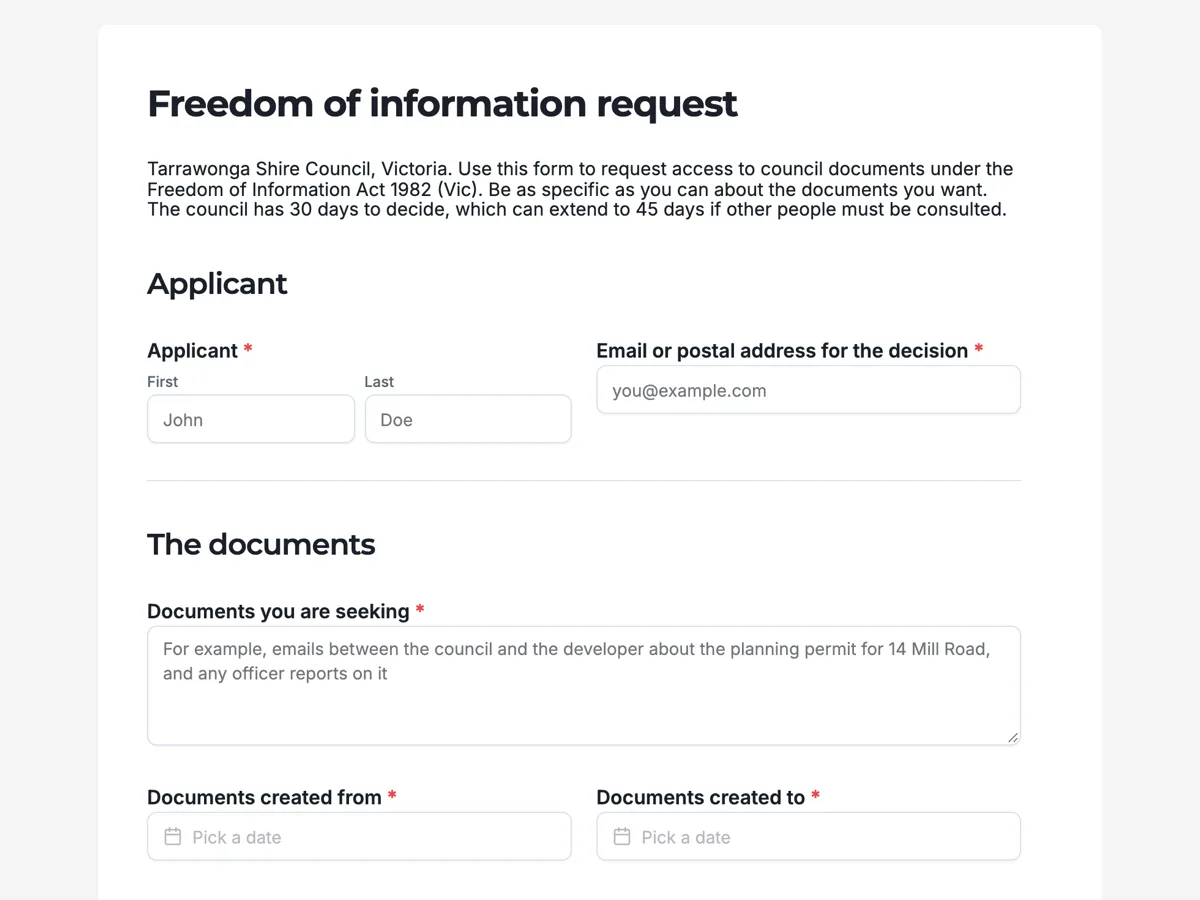
The form itself
A static copy of the finished form, exactly as it renders. Nothing here can be filled in or submitted, so read it as a reference and build your own from the button above.
Every field, and what it collects
The complete field list, in the order respondents meet it.
- ApplicantNameRequired
- Email or postal address for the decisionShort textRequired
- Documents you are seekingLong textRequired
- Documents created fromDateRequired
- Documents created toDateRequired
- Are the documents about you?Single choiceRequired
- Options: Yes, my own personal information · No, other information held by the council · Both
- Fee waiverSingle choiceRequired
- Options: I will pay the application fee · I ask for a waiver because of hardship, and will send evidence
- How would you like access?Single choiceRequired
- Options: Electronic copies · Paper copies by post · Inspect at the council office · A written transcript of a recording
- Proof of identityFile upload
- Needed if the documents are about you. Driver licence or passport, image or PDF, one file.
- Applicant signatureSignatureRequired
Applicant
The documents
Fee and access
What each field on this form collects
Applicant name sits beside an email or postal address for the decision. Documents sought is a long text with a worked example in the placeholder. A from and to date pair narrows the search. Are the documents about you is a radio of three. A paragraph explains the fee and charges, then the fee waiver radio offers payment or a hardship waiver. Form of access is a two column radio of four. Proof of identity is an optional upload, needed when the documents are personal, and the applicant signs. Nine of the ten fields are required.
Why the date range matters
An FOI officer searches emails, files and systems for the documents described. A request for everything about the Mill Road permit could cover ten years; the same request with a date range covers the two that matter. Narrower requests are decided faster and cost less, because search time can be charged. The placeholder shows a specific request, naming the parties, the subject and the kind of document, which is what Victoria's Information Commissioner advises applicants to include.
The Victorian FOI rules this form follows
The Freedom of Information Act 1982 (Vic) gives people the right to request documents from Victorian agencies, including councils. The Office of the Victorian Information Commissioner says requests must be in writing and as specific as possible, that the application fee was $34.50 and rises each 1 July, that hardship can justify a waiver, that agencies have 30 to 45 days to decide, and that applicants are contacted if charges will exceed $70. Proof of identity is needed for requests for personal information.
How to adapt this form
A New South Wales council renames it an access application under the GIPA Act and changes the fee and time paragraph. A Commonwealth agency uses the federal FOI Act, which has no application fee for most requests. A university FOI office adds the faculty or unit most likely to hold the documents.
What makes this form work
A worked example in the placeholder
The documents placeholder names the parties, the subject and the type of document. Applicants copy the shape and write requests an officer can search.
Fees explained before the choice
The paragraph gives the fee, the 1 July rise, the hardship waiver and the $70 charges notice. The waiver radio comes after the facts.
The four forms of access
Electronic copies, paper by post, inspection and a transcript come from the Act. Applicants choose the one that suits the documents.
Questions people ask
Does a freedom of information request have to use a form?
No. In Victoria a request can be made by email, letter or an agency form, as long as it is in writing and describes the documents. A form helps because it asks for everything a valid request needs at once, including the fee choice and the form of access, so the request is not sent back.
Why is the identity upload optional?
Identity is needed when the documents are about the applicant, so the council does not release personal information to the wrong person. For other council information, anyone can apply without proving who they are. The upload description says when it is needed, and the FOI officer asks for it if a personal request arrives without one.
What does a hardship waiver require?
Evidence that paying the fee would cause hardship, such as a concession or health care card, a bank statement or a statutory declaration. The second fee option says the applicant will send evidence. The council decides whether to waive or reduce the fee, and the request is not valid until that is settled.
Can the council refuse a request?
It can refuse access to documents that fall under an exemption in the Act, such as cabinet documents or material that would unreasonably disclose another person's personal affairs, and it must give reasons. The applicant can ask the Information Commissioner to review the decision. Many decisions release documents with parts removed rather than refusing outright.
How is the decision sent?
To the email or postal address given in the first row, which is required for that reason. The form itself does not send anything to the applicant. The council's FOI officer writes to the applicant about the fee, any charges and the decision, and provides access in the form chosen where possible.
What does inspect at the council office mean?
The applicant views the documents in person instead of receiving copies. It suits large files or plans that are hard to copy, and it can avoid copying charges. The Act lists inspection, copies, hearing or viewing a recording, and a written transcript as forms of access, which is where the four options come from.
Build your own in about a minute
The button below opens the generator with this use case already described. Change the wording to match your own, generate, then edit anything you like.
Make one like thisOther form examples
Document request form for a school office
A document request form tells an office which record someone needs, who it is about, why and how to send it, with proof that the person asking is allowed to have it. This one does that for an Australian secondary school, with five documents to choose from, an identity upload and a standard or urgent turnaround.
Data access request form for an app
A data access request form lets a person ask an organisation for the personal data it holds about them, and gives the organisation enough to confirm who is asking. This one handles access, correction and deletion in one form for a hiking app, with an optional date range, an identity upload and a choice of delivery.
Overtime request form with an hours table by day
An overtime request form records the extra hours an employee worked, why, who approved them and how they will be paid. This one does that for an Australian civil construction crew, with a five row hours table, the employee's classification under the Building and Construction General On-site Award and a signature confirming the hours.
Want the steps in the builder? Read Form builder components, then View, export and manage your responses. For everything this generator can do, see the form maker.
Written and checked by the OneCraft team. Last checked .