Classic form
Surf lesson waiver on swimming ability and ocean conditions
A surf lesson waiver confirms that a surfer can swim, has declared anything that matters in the water and accepts the risks of the ocean before a lesson. This one asks an Australian surf school's students whether they can swim 50 metres unaided, then covers health, experience, conditions, wetsuit size and a guardian for under 18s.
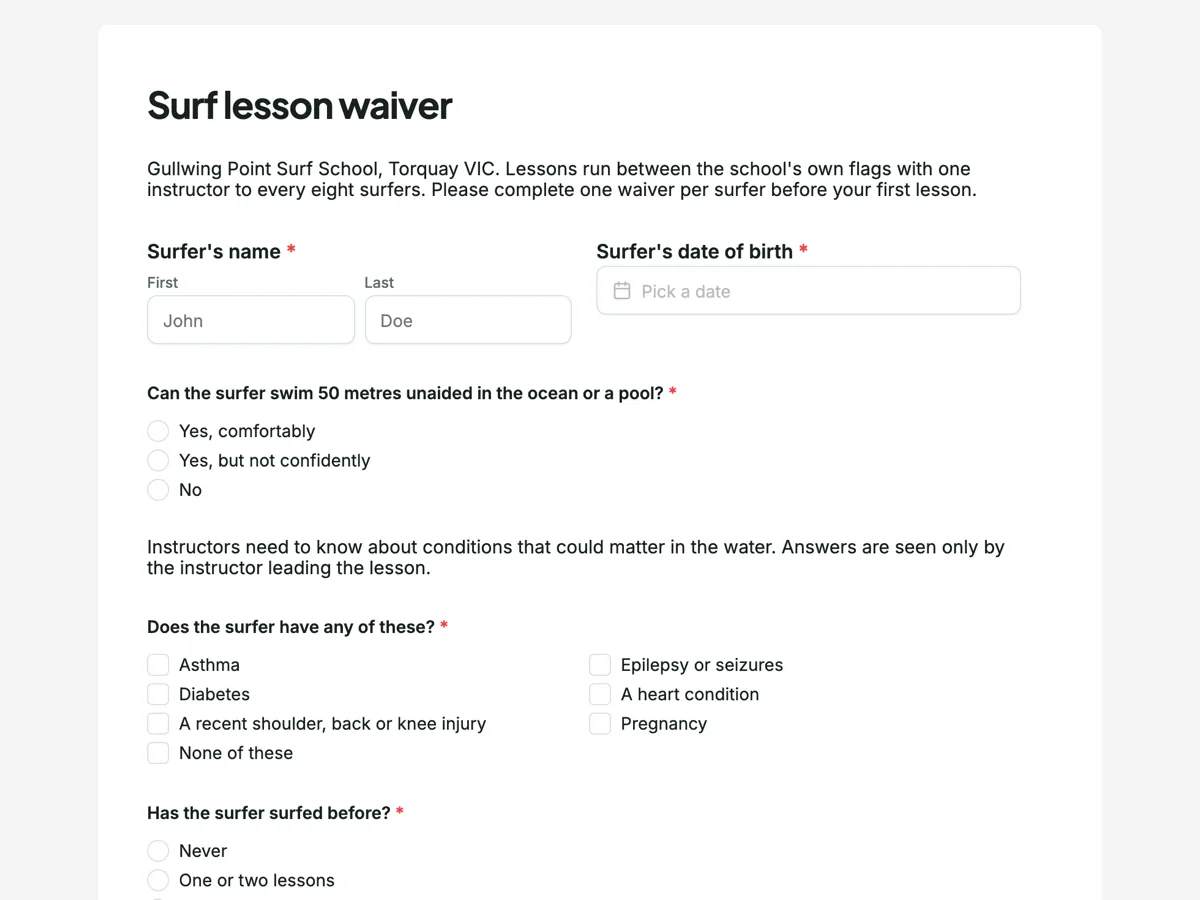
The form itself
A static copy of the finished form, exactly as it renders. Nothing here can be filled in or submitted, so read it as a reference and build your own from the button above.
Every field, and what it collects
The complete field list, in the order respondents meet it.
- Surfer's nameNameRequired
- Surfer's date of birthDateRequired
- Can the surfer swim 50 metres unaided in the ocean or a pool?Single choiceRequired
- Options: Yes, comfortably · Yes, but not confidently · No
- Does the surfer have any of these?Multiple choiceRequired
- Options: Asthma · Epilepsy or seizures · Diabetes · A heart condition · A recent shoulder, back or knee injury · Pregnancy · None of these
- Has the surfer surfed before?Single choiceRequired
- Options: Never · One or two lessons · Can catch white water and stand · Can catch unbroken waves
- Conditions acknowledgementMultiple choiceRequired
- Options: I understand the ocean risks above and will follow the instructor's directions in the water
- Wetsuit sizeDropdownRequired
- Options: Kids 8 · Kids 10 · Kids 12 · Kids 14 · Adult XS · Adult S · Adult M · Adult L · Adult XL · Bringing my own
- Parent or guardian (under 18s only)Name
- Signature of the surfer, or the guardian for under 18sSignatureRequired
What each field on this form collects
The surfer's name sits beside their date of birth. The swimming question offers three honest answers, including "yes, but not confidently". A privacy paragraph introduces a checkbox of six conditions and "none of these". Experience has four levels, from never to catching unbroken waves. The conditions paragraph lists rips, swell, cold water, stingers, rocks and board collisions before a single acknowledgement tick. Wetsuit size runs from kids 8 to adult XL, plus bringing your own. A paragraph explains the guardian field, which is optional because adults leave it blank, and the last field is the signature. Eight of the nine fields are required.
Why the 50 metre swim comes first
Every surf school asks it, and for good reason: a beginner who falls off in waist deep water and gets pulled into a gutter needs to swim to the board or the sand. Asking it as the first question after the name puts it before anything else the instructor reads. The middle answer matters. People who can swim but not confidently are common, and they are better placed close to the instructor in the shallowest part of the lesson area than turned away. A "no" is a conversation before the lesson, not an automatic refusal.
The Australian setting
Lessons run on public beaches, often between the school's own flags, and conditions change by the hour. Surf Life Saving Australia's Beachsafe site gives beach by beach hazard ratings and patrol times, and Surfing Australia accredits surf schools and coaches. Marine stingers are named in the risk paragraph because they matter on northern beaches for part of the year. The health answers are sensitive information under the Australian Privacy Principles, which is why the form says who reads them.
How to adapt this form
A stand up paddle school swaps the wetsuit sizes for buoyancy vest sizes and adds a question on flat water versus ocean experience. A school camp booking raises the guardian field to required. A surf camp of several days adds dietary needs and a second emergency contact.
What makes this form work
Three honest swim answers
"Yes, comfortably", "yes, but not confidently" and "no" let the instructor place a nervous swimmer in the shallowest water instead of guessing from a yes or no.
Ocean risks named one by one
Rips, changing swell, cold water, marine stingers, rocks and board collisions are listed above the acknowledgement, so the surfer knows exactly what they accept.
Wetsuits sorted before arrival
Ten sizes from kids 8 to adult XL, plus "bringing my own", mean suits are bagged by name before the lesson instead of tried on at the trailer.
Questions people ask
Do you need to be able to swim to take a surf lesson?
Yes. Most schools expect students to swim at least 50 metres unaided, because a fall in moving water can carry a beginner out of their depth. This form asks it first and offers a "not confidently" answer, so the instructor can keep less confident swimmers close and in the shallowest water.
Who signs a surf lesson waiver for a child?
A parent or guardian, for any surfer under 18. The form shows a paragraph explaining this above an optional guardian name field, then one signature box labelled for the surfer or the guardian. A school that teaches many children can make the guardian field required on a separate kids' version of the form.
What happens if the surf is too big on lesson day?
The school moves the lesson to a sheltered beach, delays it or reschedules, and the thank-you screen warns that lessons may move. Instructors check conditions before every session. The waiver covers the risks that remain on a suitable day; it is never a reason to run a lesson in unsafe surf.
Why does the form ask about asthma and epilepsy?
Both can become an emergency in the water. An instructor who knows a student has asthma checks the reliever is on the sand, and one who knows about epilepsy keeps the student close and in shallow water. "None of these" lets everyone else answer quickly, so the question can stay required.
How are wetsuit sizes chosen?
From the size the surfer picks on the form, matched to the school's stock before the lesson, so nobody waits at the trailer while suits are tried on. Children's sizes go by age, adult sizes by usual clothing size. Bringing your own is an option, which helps the school plan stock on busy days.
Does one waiver cover a whole course of lessons?
Usually, yes. A waiver signed before the first lesson covers a booked course, provided nothing changes. If the surfer's health changes, such as a new injury or pregnancy, they should tell the instructor and update the form. Many schools ask for a fresh waiver each season.
Build your own in about a minute
The button below opens the generator with this use case already described. Change the wording to match your own, generate, then edit anything you like.
Make one like thisOther form examples
Gym waiver form with a health declaration, signed online at join
A gym waiver form records that a new member understands the risks of training, has declared any health conditions and accepts the club's terms before using the floor. This one is filled online at join for an Australian strength gym, with a six item health declaration, a clearance question and a signature.
Parental consent form for a whole club season
A parental consent form for a sports club has to say which activities the child may join, who may drive them, what happens if they are hurt and whether they can be photographed. This one covers a whole junior football season at once, with a medications table for the coach and a guardian signature.
Dental treatment consent form with item numbers and fees
A dental treatment consent form has to record the procedure, what it will cost, the other options the patient heard, the risks they read and how they will be sedated. This one asks for each in turn, with a four row table for the item numbers and fees from the treatment plan and a signature at the end.
Want the steps in the builder? Read Form builder components, then Design your welcome and thank-you screens. For everything this generator can do, see the form maker.
Written and checked by the OneCraft team. Last checked .