sw-KE · Kenyan Swahili
Swahili AI voiceover
Swahili maps to sw-KE, the Kenyan locale, and it arrives with the complete cast of eight premium voices, a stronger tier than several European languages get. Captions are plain Latin, rendering natively in every look on the shelf.
The Swahili voices, with samples
Each sample reads the same line so you can compare them fairly.
Puck
energetic · maleHivi ndivyo ninavyosikika ninaposoma hati yako kwa mwendo wa kawaida, bila muziki nyuma yangu.
Laomedeia
energetic · femaleHivi ndivyo ninavyosikika ninaposoma hati yako kwa mwendo wa kawaida, bila muziki nyuma yangu.
Charon
instructional · maleHivi ndivyo ninavyosikika ninaposoma hati yako kwa mwendo wa kawaida, bila muziki nyuma yangu.
Erinome
instructional · femaleHivi ndivyo ninavyosikika ninaposoma hati yako kwa mwendo wa kawaida, bila muziki nyuma yangu.
Umbriel
warm · maleHivi ndivyo ninavyosikika ninaposoma hati yako kwa mwendo wa kawaida, bila muziki nyuma yangu.
Sulafat
warm · femaleHivi ndivyo ninavyosikika ninaposoma hati yako kwa mwendo wa kawaida, bila muziki nyuma yangu.
Iapetus
neutral · maleHivi ndivyo ninavyosikika ninaposoma hati yako kwa mwendo wa kawaida, bila muziki nyuma yangu.
Aoede
neutral · femaleHivi ndivyo ninavyosikika ninaposoma hati yako kwa mwendo wa kawaida, bila muziki nyuma yangu.
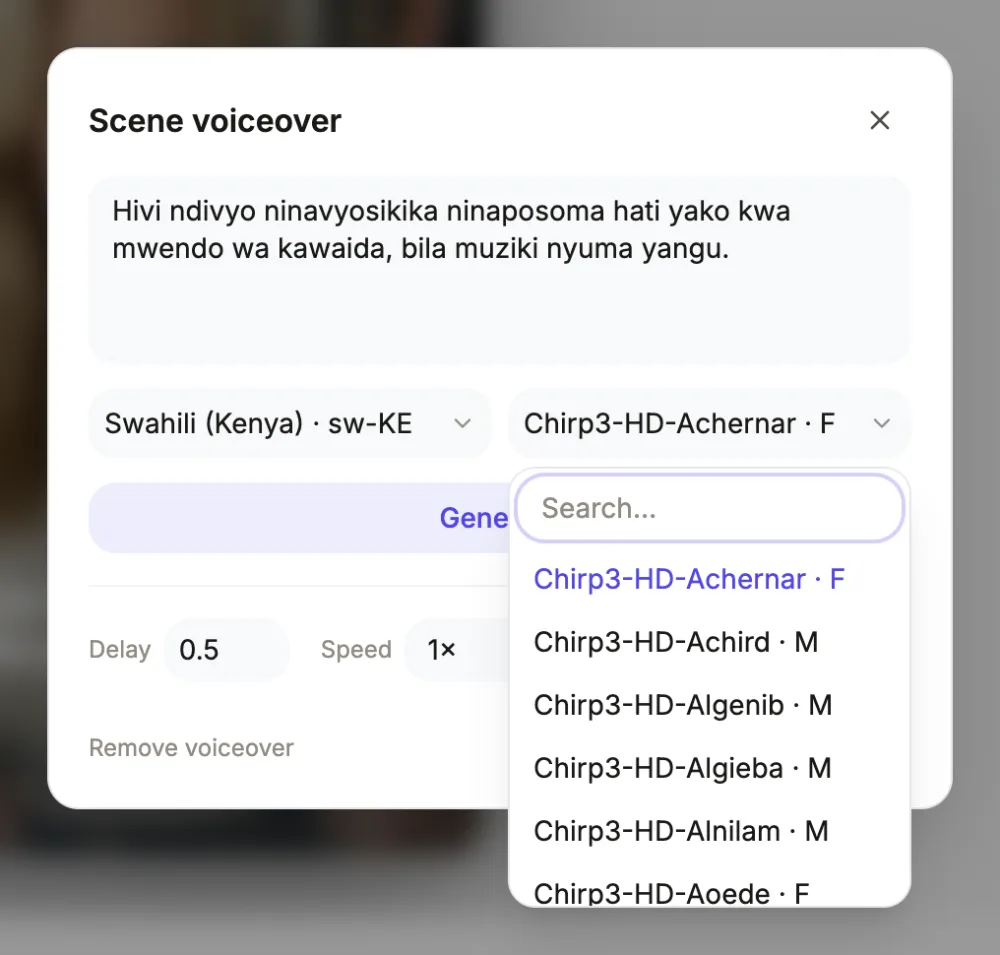
A full premium cast on sw-KE
The mapped locale is sw-KE, so the accent is Kenyan; Tanzanian listeners will understand every word, with the coastal standard differing mainly in flavour. All eight premium characters exist here, which is worth underlining because it puts Swahili's voice tier above languages like Russian, Malay or Filipino in this same product. Puck and Laomedeia carry energetic retail spots, Charon and Erinome the instructional lane with tutorials locked to them, Umbriel and Sulafat the warm register, and Iapetus and Aoede the neutral one.
From brief facts to a Swahili script
The Language field set to Swahili is the whole instruction: the director writes narration and on-screen copy in Swahili natively, taking only the facts from a brief in any language. Noun-class agreement, the machinery that breaks word-for-word translation, comes out correct because the text is composed rather than converted. Sheng or an English-mixed register can be requested in the brief for a Nairobi youth audience, and exact phrases you quote, a cooperative's motto say, pass through untouched.
Scene timing and the automatic mix
Swahili's open syllables read steadily, and lines usually sit within their scenes; when one runs long the scene stretches to hold the clip, and dynamic pace resolves the overrun across the following cut. Each scene provides a delay in seconds before the voice enters and speed steps at 0.85x, 0.9x, 1x, 1.1x and 1.25x. The music bed needs no attention, dipping to 22 percent whenever narration plays and recovering between passages, with short ramps at both edges.
Text details that improve the read
Write amounts as words when the phrasing matters, shilingi mia tano rather than KSh 500, since digits leave the engine choosing a form. Foreign names respell phonetically in the narration box, about half a credit per regenerated clip, and Swahili's near-perfect letter-to-sound mapping makes the first respelling almost always the last. Sentence punctuation cuts the caption cues, so short sentences keep the pill in rhythm with the voice. Generated narration carries no em dashes by rule; commas serve the connecting work in your own edits too.
Captions in this script
Swahili's unaccented Latin alphabet is the easiest case the caption system has: every catalogue font covers it, so all 21 looks render captions in their own typeface with no fallback anywhere. Words highlight one at a time on timings measured from the clip. Swahili's agglutinated verbs produce occasional long words, ninavyosikika and kin, but sentence lengths stay moderate and the 48 character split into a second cue triggers rarely in conversational writing.
Questions people ask
Which Swahili voices are available?
All eight premium characters in sw-KE: Puck, Laomedeia, Charon, Erinome, Umbriel, Sulafat, Iapetus and Aoede, four styles in male and female versions. The per-scene voice dialog searches the entire Google catalogue beyond them, where other Swahili options appear.
Kenyan or Tanzanian Swahili?
The locale is sw-KE, so the voices carry Kenyan pronunciation. The written standard the director produces is broadly shared across East Africa, and phrasing preferences can be set in the brief. For a different regional voice, the scene-level catalogue search is the place to look.
Can my brief be in English?
Yes, and most are. With Swahili selected in the Language field, everything spoken and shown is written in Swahili natively from your brief's facts, with grammatical agreement intact because nothing is translated word for word. Quote any Swahili wording that must appear exactly.
How reliable are the captions?
Very. The Latin alphabet renders in every look's own font, no fallback ever, and the word-by-word highlight is timed against the actual clip. Captions default on per scene and switch off in the voice dialog where on-screen text already carries the message.
What does narration cost?
Narration is billed by length, about half a credit for a typical clip, roughly one clip per speaking scene, and edits between generations are free. Export bills its render time, usually a small amount; longer videos or pending narration need at least 1 credit left to start.
Narrate a video in Swahili
The button opens the video generator with the language already set in the brief. Pick a voice after the scenes are planned.
Make a videoRelated pages
Vietnamese AI voiceover
Vietnamese narration has the full eight vi-VN voices behind it, with the director writing every line in Vietnamese. The caption question is tone marks: most look fonts ship the Vietnamese subset, but three families do not, and this page names them.
Turkish AI voiceover
Turkish narration draws on eight tr-TR voices, cast by style and gender from your brief while the director writes the whole script in Turkish. Vowel harmony, the dotless ı and suffix chains all behave; here is what to know before generating.
Portuguese AI voiceover
Choosing Portuguese gives you a Brazilian voice, one of eight pt-BR characters spanning energetic, instructional, warm and neutral reads. A team in Lisbon should know that up front: European Portuguese exists only through the per-scene catalogue search, not as the default.
Every locale is listed onthe voiceover languages page.