ur-IN · Indian Urdu
Urdu AI voiceover
Urdu maps to ur-IN, so the accent is Indian Urdu rather than Pakistani, with all eight premium voices present. The script is right to left, which the captions honour, though the Perso-Arabic glyphs come from a fallback font rather than the look's own.
The Urdu voices, with samples
Each sample reads the same line so you can compare them fairly.
Puck
energetic · maleآپ کا اسکرپٹ عام رفتار سے، پیچھے کسی موسیقی کے بغیر پڑھتے ہوئے میری آواز ایسی لگتی ہے۔
Laomedeia
energetic · femaleآپ کا اسکرپٹ عام رفتار سے، پیچھے کسی موسیقی کے بغیر پڑھتے ہوئے میری آواز ایسی لگتی ہے۔
Charon
instructional · maleآپ کا اسکرپٹ عام رفتار سے، پیچھے کسی موسیقی کے بغیر پڑھتے ہوئے میری آواز ایسی لگتی ہے۔
Erinome
instructional · femaleآپ کا اسکرپٹ عام رفتار سے، پیچھے کسی موسیقی کے بغیر پڑھتے ہوئے میری آواز ایسی لگتی ہے۔
Umbriel
warm · maleآپ کا اسکرپٹ عام رفتار سے، پیچھے کسی موسیقی کے بغیر پڑھتے ہوئے میری آواز ایسی لگتی ہے۔
Sulafat
warm · femaleآپ کا اسکرپٹ عام رفتار سے، پیچھے کسی موسیقی کے بغیر پڑھتے ہوئے میری آواز ایسی لگتی ہے۔
Iapetus
neutral · maleآپ کا اسکرپٹ عام رفتار سے، پیچھے کسی موسیقی کے بغیر پڑھتے ہوئے میری آواز ایسی لگتی ہے۔
Aoede
neutral · femaleآپ کا اسکرپٹ عام رفتار سے، پیچھے کسی موسیقی کے بغیر پڑھتے ہوئے میری آواز ایسی لگتی ہے۔
ur-IN, and what that accent means
The voice map sends Urdu to ur-IN, the Indian Urdu locale, and all eight premium characters are present there. For Lucknow, Hyderabad or Delhi audiences this is the natural accent; a Karachi viewer will still understand every word, though the locale is worth knowing before you promise a Pakistani client a local voice. The director writes the script in Urdu once the Language field says so, composing from your brief's facts in any language. Wording that must stay put, a couplet or a registered tagline, belongs in the brief in Urdu script.
Casting eight voices across four moods
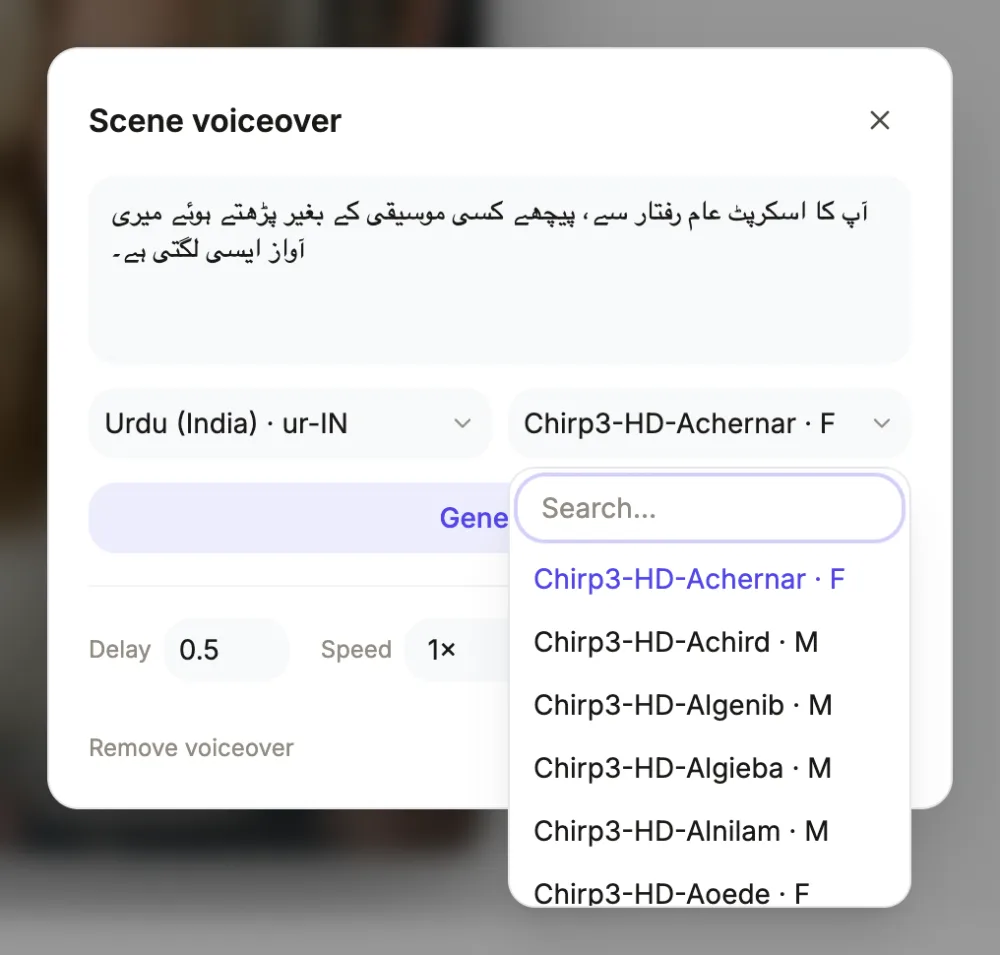
Puck and Laomedeia take the energetic register for promos and offer spots. Charon and Erinome hold the instructional lane, and tutorials are fixed to them by code, so a walkthrough cannot inherit an ad read. Umbriel and Sulafat give the warm delivery a perfumery or wedding service wants. Iapetus and Aoede stay level for announcements. The gender axis doubles the choice, the director picks from the brief, and each scene's voice dialog can override locally while searching the full Google catalogue behind the defaults.
Right to left on screen, correctly and honestly
Detecting Urdu text, the composition mirrors alignments and lays the caption right to left, first spoken word at the right edge, highlight moving leftward with the voice. The compromise is typographic: the fallback font shapes the letters in a plain Naskh manner, not the hanging Nastaliq of Urdu print. On-screen headlines have the same trait. Where typography matters most, lean on the voice and keep on-screen Urdu short, or place key phrases inside uploaded imagery you control. Mixed-direction lines holding numbers or Latin names deserve one look at a render before shipping.
The working controls, scene by scene
Each scene carries a delay in seconds before its voice enters, a speed setting stepped from 0.85x to 1.25x, and its own narration box, where respelling is the pronunciation control; a foreign word rewritten in Urdu letters reads as intended after a regeneration of about half a credit. Scenes stretch to fit their clips, and dynamic pace lets a long sentence finish over the following cut. Music ducks to 22 percent under speech automatically. Numbers do best written as words when their spoken form matters, and generated narration never contains an em dash by prompt rule.
Captions in this script
Urdu's Perso-Arabic script switches the render into right-to-left mode: the caption pill takes an RTL direction so words order correctly from the right, the highlight tracks the voice from the first spoken word, and slot alignments mirror across the frame. No catalogue font carries the script, so the fallback font draws it, and that fallback is usually a Naskh-style face rather than the Nastaliq Urdu readers prefer; legible, but visibly not calligraphic. Lines mixing Urdu with digits or Latin brand names can misorder inside the centred pill, so give those scenes a render check or disable their captions.
Questions people ask
Which Urdu voices are available?
Eight in ur-IN: Puck, Laomedeia, Charon, Erinome, Umbriel, Sulafat, Iapetus and Aoede, four style pairs across both genders. The automatic casting picks by your brief's tone; the per-scene voice dialog searches the entire live Google catalogue when you want alternatives.
Is the accent Indian or Pakistani?
Indian: the mapped locale is ur-IN. The written Urdu is standard and fully mutually intelligible, but the read carries the Indian Urdu accent. If a different regional voice is essential, look for it through the scene-level catalogue search rather than the Language field.
How do right to left captions behave?
The pill switches to RTL direction, so word order reads correctly from the right and the highlight follows the spoken word. The script is drawn by a fallback font in a Naskh style rather than Nastaliq, since no catalogue font ships Perso-Arabic glyphs. Captions toggle per scene in the voice dialog.
Can my brief be in English?
Yes. Selecting Urdu as the Language makes the director write all narration and on-screen text in Urdu, regardless of the brief's language. It composes natively rather than translating. Provide any exact Urdu phrases in the brief as quotes and they are used untouched.
What is the credit price?
Narration is billed by length, about half a credit for a typical clip, roughly one per speaking scene, and edits between generations cost nothing. Export bills its render time, usually a small amount; longer videos, or exports with narration still to generate, need at least 1 credit left.
Narrate a video in Urdu
The button opens the video generator with the language already set in the brief. Pick a voice after the scenes are planned.
Make a videoRelated pages
Arabic AI voiceover
Arabic resolves to ar-XA, the multi-region locale, so the eight voices speak Modern Standard Arabic rather than an Egyptian or Gulf dialect. Captions run right to left with mirrored layout, and the whole script is written in Arabic by the director.
Hebrew AI voiceover
Hebrew narration runs on eight he-IL voices with the director writing the entire script in Hebrew. The render mirrors itself for right-to-left text, and one font in the catalogue, Open Sans, actually ships Hebrew glyphs, a detail worth using.
Bengali AI voiceover
Bengali resolves to bn-IN, the Indian Bengali locale, with the full eight premium voices and a director that scripts the whole video in Bengali. Captions time word by word; the Bengali script itself is drawn by a fallback font, covered honestly below.
Every locale is listed onthe voiceover languages page.