ar-XA · Multi-region Arabic
Arabic AI voiceover
Arabic resolves to ar-XA, the multi-region locale, so the eight voices speak Modern Standard Arabic rather than an Egyptian or Gulf dialect. Captions run right to left with mirrored layout, and the whole script is written in Arabic by the director.
The Arabic voices, with samples
Each sample reads the same line so you can compare them fairly.
Puck
energetic · maleهكذا يبدو صوتي عندما أقرأ النص بوتيرة عادية، من دون موسيقى في الخلفية.
Laomedeia
energetic · femaleهكذا يبدو صوتي عندما أقرأ النص بوتيرة عادية، من دون موسيقى في الخلفية.
Charon
instructional · maleهكذا يبدو صوتي عندما أقرأ النص بوتيرة عادية، من دون موسيقى في الخلفية.
Erinome
instructional · femaleهكذا يبدو صوتي عندما أقرأ النص بوتيرة عادية، من دون موسيقى في الخلفية.
Umbriel
warm · maleهكذا يبدو صوتي عندما أقرأ النص بوتيرة عادية، من دون موسيقى في الخلفية.
Sulafat
warm · femaleهكذا يبدو صوتي عندما أقرأ النص بوتيرة عادية، من دون موسيقى في الخلفية.
Iapetus
neutral · maleهكذا يبدو صوتي عندما أقرأ النص بوتيرة عادية، من دون موسيقى في الخلفية.
Aoede
neutral · femaleهكذا يبدو صوتي عندما أقرأ النص بوتيرة عادية، من دون موسيقى في الخلفية.
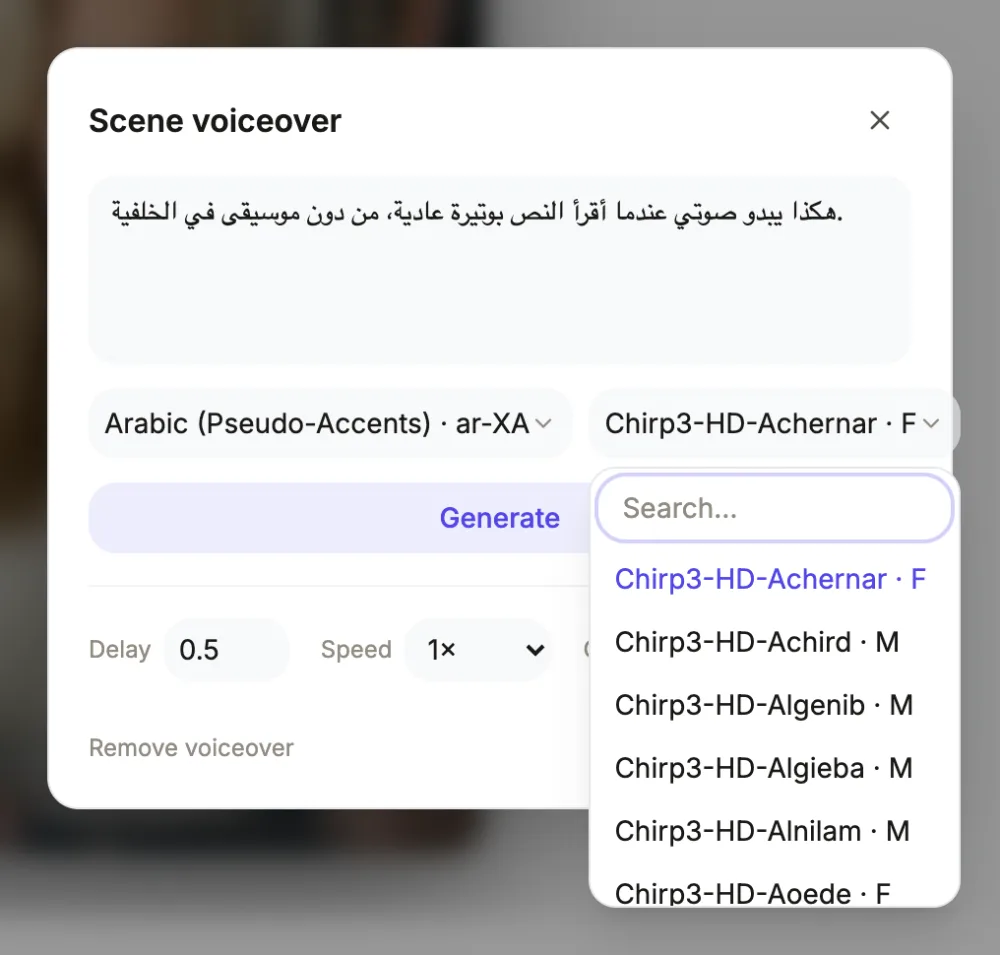
ar-XA means Standard Arabic, deliberately
The mapped locale is the multi-region ar-XA rather than ar-EG or ar-SA, and the trade-off is clear: every voice reads Modern Standard Arabic that any Arabic-speaking market understands, and none of them performs a dialect. For a pan-regional product video that is the right call. If a country-specific voice matters to you, the per-scene voice dialog searches the full Google catalogue, though the director's script will still be written in MSA unless your brief asks for dialect phrasing, which the voices will then read as written.
The same eight characters, reading right to left
All eight premium characters exist in ar-XA: Puck and Laomedeia for the energetic ad read, Charon and Erinome for instruction, with tutorials pinned to that pair mechanically, Umbriel and Sulafat for warmth, Iapetus and Aoede for the neutral register. The director casts one by style and gender from your brief, and any scene can override it. Because a premium voice name embeds its locale, the Arabic cast never leaks into another language's scenes if you build a bilingual video by hand; each scene's clip is generated by its own voice.
What right-to-left changes on screen
The moment the script is written in Arabic, the composition detects the right-to-left text and mirrors itself: authored left alignments become right alignments, and the caption pill lays its words right to left with the first spoken word at the right edge. Numerals and Latin trademarks embedded in an Arabic sentence are the residual risk, since a mixed-direction line can order unexpectedly inside a centred pill; keeping such tokens at the start or end of the sentence, or turning captions off for that scene in the voice dialog, both work. Verify with one render rather than assuming.
Pacing, credits and script hygiene
MSA reads measured and slightly formal, so lines run longer than conversational English; scenes stretch to their clips automatically and a long line finishes over the next cut under dynamic pace. Per scene you control a start delay in seconds and speed steps from 0.85x to 1.25x, and the music bed ducks itself to 22 percent under speech. Narration is billed by length, about 1 credit per 330 characters. Write numbers as words when their spoken form matters, respell foreign names in Arabic letters to steer pronunciation, and know that generated narration never carries an em dash by rule.
Captions in this script
When the script is Arabic the render flips into right-to-left mode: the caption pill sets an RTL text direction, so words sit in correct reading order, and slot text alignment across scenes mirrors left for right. Word-by-word highlighting still tracks the voice, beginning from the rightmost, first-spoken word. What no look provides is an Arabic typeface; none of the catalogue fonts ship Arabic glyphs, so the render host's fallback font draws the letters, connected and correct but not matched to the design. A line mixing Arabic with Latin brand names or digits can still order oddly inside the pill, so render such scenes once and check before shipping.
Questions people ask
Which Arabic voices are available?
Eight voices in the multi-region ar-XA locale: Puck, Laomedeia, Charon, Erinome, Umbriel, Sulafat, Iapetus and Aoede, covering energetic, instructional, warm and neutral styles in both genders. They read Modern Standard Arabic. The scene-level search opens the whole Google catalogue beyond them.
Will the voice speak my dialect?
The automatic voices read MSA, and the director writes MSA, which travels across every Arabic market. If you write dialect phrasing into a scene's narration yourself the voice reads it as written with MSA phonetics. Country-specific voices exist in the wider catalogue via the per-scene search.
Do captions work right to left?
Yes. The pill switches to RTL direction for Arabic script, so reading order is correct and the word highlight starts from the right. No look font includes Arabic, so a fallback font draws the glyphs. Lines mixing digits or Latin names deserve one render check, and captions can be disabled per scene.
Can the brief be in English?
Yes, and most are. The Language field set to Arabic makes the director compose all narration and on-screen text in Arabic natively. Anything that must appear exactly, a brand name in Arabic script or a legal phrase, should be quoted in the brief so it passes through untouched.
What does Arabic narration cost?
Narration is billed by length at the same rate for every language, about 1 credit per 330 characters, with a minimum of half a credit per clip. Edits between generations are free, including caption toggles, delays and speed changes. Export bills its render time, usually a small amount, and needs at least 1 credit left above 30 seconds or while narration remains to generate.
Narrate a video in Arabic
The button opens the video generator with the language already set in the brief. Pick a voice after the scenes are planned.
Make a videoRelated pages
Hebrew AI voiceover
Hebrew narration runs on eight he-IL voices with the director writing the entire script in Hebrew. The render mirrors itself for right-to-left text, and one font in the catalogue, Open Sans, actually ships Hebrew glyphs, a detail worth using.
Urdu AI voiceover
Urdu maps to ur-IN, so the accent is Indian Urdu rather than Pakistani, with all eight premium voices present. The script is right to left, which the captions honour, though the Perso-Arabic glyphs come from a fallback font rather than the look's own.
Japanese AI voiceover
Japanese narration draws on the full eight ja-JP voices, with the director writing the script in Japanese natively. Spaceless text is segmented into dictionary words for the captions, and katakana respelling is your pronunciation control.
Every locale is listed onthe voiceover languages page.