E-signatures
How secure is e signing
Most of the security in a signing product is invisible, which makes it easy to claim and hard to check. Here is what is actually enforced, in the order a request meets it, and then what it does not cover.
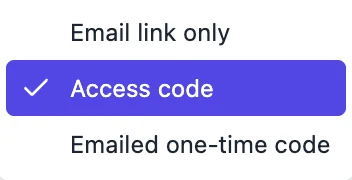
Three credentials that do different jobs
Owner routes, everything to do with creating, preparing and tracking envelopes, require the account holder's own signed in session. The recipient token in a signing link identifies which row a request concerns but authorises nothing on its own. Past the identity check, a separate short lived session is issued, bound to that one recipient, and it is what the document, submit and decline routes actually require. Mixing those three up is how a product like this becomes insecure, so they are kept apart.
The link on its own reveals almost nothing
Somebody holding a signing link, before passing whichever check applies, can learn the document title, the name and address of the recipient it was issued to, and which check is required. Not the pages, not a preview, not the other parties, not the file. That is the point of serving the challenge separately from the document, and it is why a forwarded email is not a leak of the contract.
Codes are stored the way passwords are
Access codes and emailed one-time codes are never stored in readable form. Each is hashed with scrypt against its own random salt, and comparison is done with a constant time function, so the time a wrong guess takes gives nothing away. No route hands a code back, to the sender or to anybody else. Guessing is capped per recipient: five failed attempts and that recipient is locked out for fifteen minutes, with the counter written conditionally so a burst of parallel guesses cannot slip past it.
Evidence is written once
The uploaded document is never written to again. Each signature produces a new working file under its own key rather than replacing the previous one, and the completed copy gets a key derived from its own hash. The storage bucket is versioned as a further backstop. The event log is append only, enforced by a database rule that refuses to modify a row, and the hash chain over it means a missing row is detectable rather than invisible.
Concurrency is handled deliberately
Status changes are conditional writes against the state that was read, so a double clicked Send cannot dispatch two sets of invitations and two simultaneous submissions cannot both be accepted as the same signature. A one-time code is redeemed with a conditional write too, so the same digits cannot be spent twice. These are unglamorous details, and they are the difference between a clean record and one with two of everything in it.
What none of this protects against
An identity check confirms access to an inbox or knowledge of a code, not who is at the keyboard. If the invitation and an emailed code both land in the same shared mailbox, they are one factor rather than two. The recorded address is what the edge saw, which for corporate networks is often shared. And the ordinary risks apply: your own account is only as safe as its password, and a code you email alongside the link protects nothing at all.
How it works, in three steps
Step 1
Pick the check that matches the document
Link only for routine work. An access code shared over the phone where the contents or the value justify a genuinely separate channel.
Step 2
Never send the code down the same wire
The product deliberately does not deliver access codes, so that a single compromised inbox is not enough on its own.
Step 3
Check the chain badge when it matters
Opening an envelope re-verifies its whole event chain and reports the result, rather than trusting a stored flag.
The full walkthrough with screenshots is in the guide Send a PDF for e-signature.
Limits worth knowing
- A signing session lasts thirty minutes and is never persisted, so reloading the signer's page means verifying again.
- Emailed one-time codes arrive at the same address as the invitation, which makes them one factor rather than two.
- Recorded addresses come from the trusted edge hop and are frequently shared corporate or mobile addresses.
- Nobody verifies that a signer has authority to bind the organisation they name on the page.
Questions people ask
What can somebody do with a forwarded signing link?
If a check is set, nothing beyond seeing the title and which check is needed. If the recipient was set to link only, they could sign in that person's place, which is exactly the trade you accept by choosing link only.
Are the documents encrypted?
They are held in cloud object storage with versioning enabled and reached only through short lived signed links generated for the account that owns the envelope.
Can someone brute force an access code?
Attempts are counted per recipient and five failures lock that recipient for fifteen minutes, so guessing is slow. A four character code and a fifteen minute lockout is still a weak combination, so choose something longer where it matters.
Who can read the audit trail?
Only the account that owns the envelope. Signers see the document and their own fields, never the event log or the other parties.
Make your own signing flow
The button opens the generator with this use case already described. Change the wording to match yours, generate, then edit anything you like.
Send a document for signingRelated pages
E signature for schools
The document is trivial. The volume is not. A permission slip is half a page and takes ninety seconds to prepare, and then you need one hundred and forty of them signed by Friday, which is a completely different problem.
Calendar slides
A calendar slide answers when, at a scale a timeline cannot: a specific month, a specific week, a specific day. Five layouts cover it, from a 35 cell monthly grid to a seven column week strip and an hour by hour rail for a single day.
Add my own video clip
Not everything should be generated. If you already have footage, six scene layouts exist to play it, with a title beside it, three icon bullets, a quote, a counting number, or full screen with a caption over the top. The clip is trimmed and fitted in the inspector rather than in a separate editor.
More finished work of this kind is on the e-signature examples hub.
Written and checked by the OneCraft team. Last checked .