Classic form
Background check consent form
Consent that is buried on page four of an application is not really consent. This form stands on its own, lists each check as a separate line the candidate ticks or does not, collects the five years of addresses a police check actually needs, and sets out in plain words what the candidate can ask for afterwards. It is a classic form, so the candidate sees every check, the rights section and the signature on one page and can read the whole document before ticking anything.
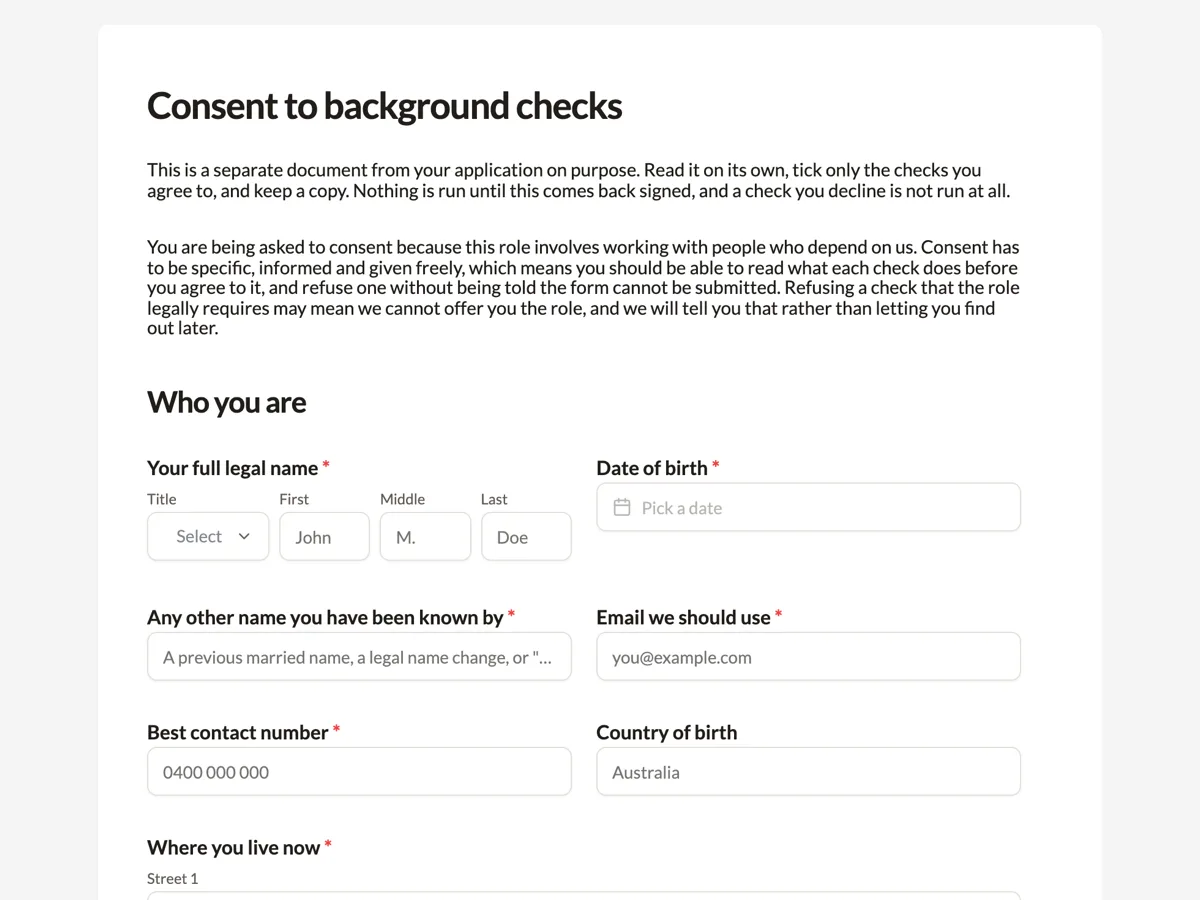
The form itself
A static copy of the finished form, exactly as it renders. Nothing here can be filled in or submitted, so read it as a reference and build your own from the button above.
Every field, and what it collects
The complete field list, in the order respondents meet it.
- Your full legal nameNameRequired
- Date of birthDateRequired
- Any other name you have been known byShort textRequired
- Email we should useShort textRequired
- Best contact numberShort textRequired
- Country of birthShort text
- Where you live nowAddressRequired
- Everywhere you have lived in the last five yearsTable
- Columns: Address · Suburb and state · From, month and year · To, month and year
- I consent to each of the checks I have tickedMultiple choiceRequired
- Options: Confirming my identity from the documents I provide · A nationally coordinated criminal history check · Confirming my right to work in this country · Verifying the qualifications I have listed · Confirming the employment history I have listed with those employers · A working with vulnerable people or children check, where the role requires one · Checking my driving record, where the role involves driving · A check of professional registration where the role requires it
- Has a check like this ever been refused or withdrawn?Single choiceRequired
- Options: No · Yes, and I have explained below · I do not know
- Do you hold a current check we could rely on instead?Single choiceRequired
- Options: No · Yes, and the details are below · Yes, but it is for a different state
- Anything you would rather we heard from you firstLong text
- Your identity documentsFile uploadRequired
- Up to six files, PDF or photo, 10 MB each. Photograph each document flat, in daylight, with all four corners in frame and no flash glare across the details. A cropped corner or a blurred number is the reason most identity checks stall for a week.
- I have read this sectionMultiple choiceRequired
- Options: I understand what each check I ticked involves · I am giving this consent freely and it is mine to give · I know I can ask for a copy of any result · The information I have given here is true to the best of my knowledge
- Sign hereSignatureRequired
- Date signedDateRequired
Who you are
The checks, one at a time
Proof of identity
What you are entitled to
What makes this form work
The address table is why a police check completes
Four rows of address, suburb, from and to. Checks are run against a five year address history, and the item that most often stalls one is a gap somebody did not think worth mentioning. Asking for it as a table with dates makes the gap visible while the candidate is still in front of the form.
The rights section is written before the result exists
A copy of any result, a route to dispute it, the promise that it is assessed against the role rather than treated as an automatic bar, and a chance to respond before a decision is final. Setting that out at consent time is what turns a checkbox into something a candidate can genuinely agree to.
The upload field teaches people how to photograph a document
Flat, daylight, four corners in frame, no flash across the details. A file upload description is one of only two that a classic form shows the respondent, and using it here removes the week of back and forth that a cropped licence corner otherwise causes.
Questions people ask
Why should the consent be a separate form?
Because consent is only meaningful if the person can see what they are agreeing to. Bundled into an application, it is signed alongside twenty other things and nobody reads it. Some jurisdictions go further and require the disclosure to stand alone in its own document. Separating it also gives you a clean record of exactly what was consented to and when.
Why tick each check individually instead of one box?
One box collects one signature for eight different purposes, and it cannot show which of them the person actually agreed to. Eight lines let a candidate decline a driving record check for a desk role without abandoning the form, and they give you a per check record. The form still has to say plainly that refusing a legally required check may end the process.
Should the signature field be required on this form?
Yes. On a consent form the signature is the consent, so a response without one is weak evidence that the candidate agreed. In this example the Sign here field is required, so a response cannot be submitted unsigned. The drawn or typed mark prints into the response PDF, and the date signed field beside it is already required.
What happens to the identity documents that get uploaded?
They are stored with the response and appear in the responses view and in the response PDF, images inline and PDFs merged in. That makes retention a real decision rather than an afterthought: photographs of passports and licences should not sit in a form's responses indefinitely, so delete them once the check has run and say so in your privacy policy.
Should the form ask whether a check has ever been refused?
Yes, and this one asks before the signature rather than after the result comes back. A refused or withdrawn check is rarely disqualifying on its own, but finding it in a report you have already paid for wastes everyone a week. The next question offers the applicant a current check you could rely on instead.
How far back should the address history go?
Five years is what this form asks for, which is what most police and identity checks need to run. Asking for a full lifetime of addresses collects data you will never use and cannot justify keeping. If a specific check needs more, add that check its own question rather than widening the one everybody answers.
Build your own in about a minute
The button below opens the generator with this use case already described. Change the wording to match your own, generate, then edit anything you like.
Make one like thisOther form examples
Reference check form
A reference done by phone produces notes nobody can find and a memory of a tone of voice. Sent as a form, it produces the same four facts every time, a rating grid the referee can honestly leave blank, and the rehire answer in the referee's own words. This one is written for UK employers, and it is a classic form, because a referee wants to see the whole thing before starting and answer the parts they can.
Staff induction form
An induction record is only worth having if it says what somebody was actually shown. This checklist is written to be filled in while walking the site, with each safety line phrased as a place they stood rather than a document they were sent, and the licences and equipment recorded in tables with tags and expiry dates. It ends with both people signing, and it is written for an Australian worksite. Classic, because an inductor working from a tablet on the floor needs to see every section at once and come back to the ones not yet done.
Internship application form
An internship application has to do two things a job application does not: work for somebody with almost no employment history, and sort a large field quickly on things that are actually disqualifying. This one asks about study, availability and field readiness before it asks anybody to write 300 words. It is a classic form, because two PDF uploads and a referee table need one page where everything can be checked before sending. It is written for an Australian employer, where a placement that a course requires is treated differently under the Fair Work Act from one a student chooses to do.
Want the steps in the builder? Read Every form field and when to use it, then Shape the PDF version of your form. For everything this generator can do, see the form maker.
Sources
Written and checked by the OneCraft team. Last checked .