Classic form
Reference check form
A reference done by phone produces notes nobody can find and a memory of a tone of voice. Sent as a form, it produces the same four facts every time, a rating grid the referee can honestly leave blank, and the rehire answer in the referee's own words. This one is written for UK employers, and it is a classic form, because a referee wants to see the whole thing before starting and answer the parts they can.
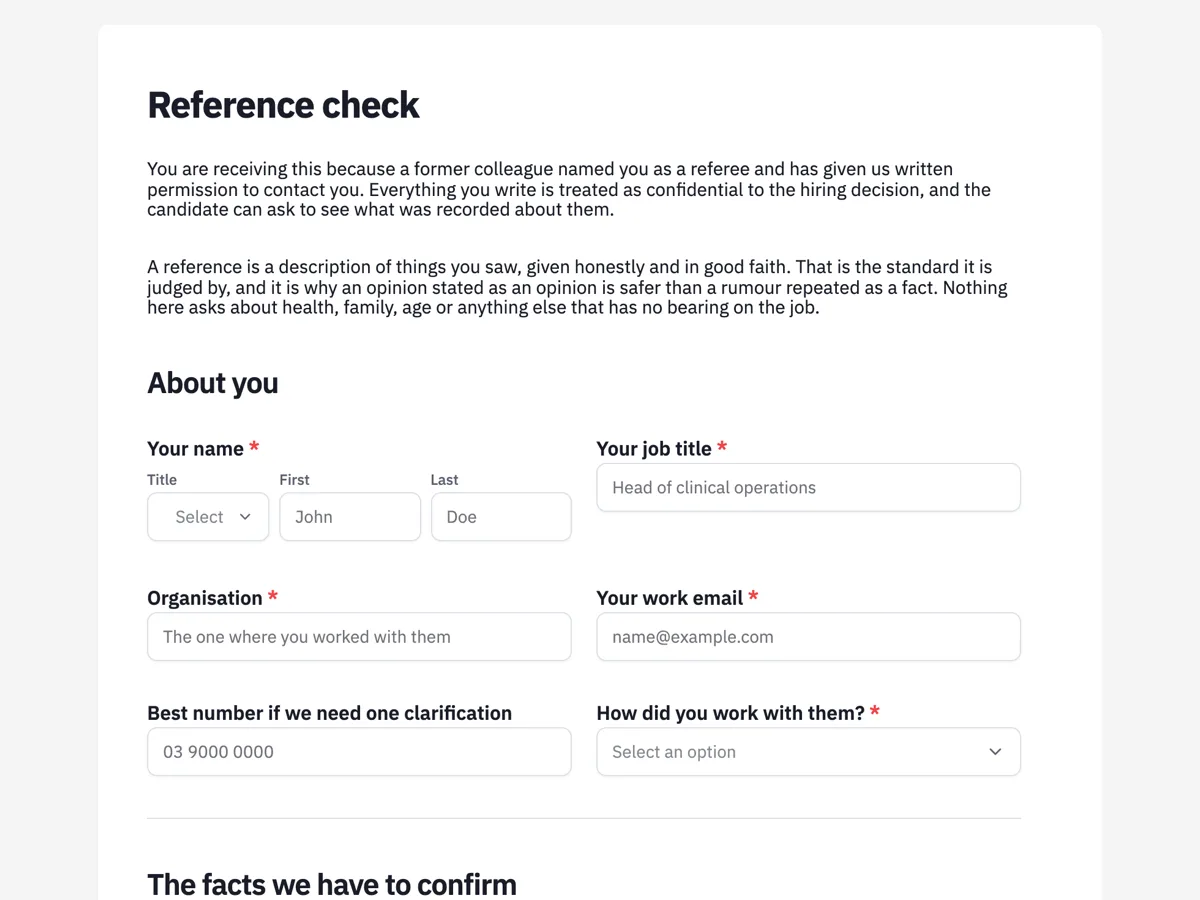
The form itself
A static copy of the finished form, exactly as it renders. Nothing here can be filled in or submitted, so read it as a reference and build your own from the button above.
Every field, and what it collects
The complete field list, in the order respondents meet it.
- Your nameNameRequired
- Your job titleShort textRequired
- OrganisationShort textRequired
- Your work emailShort textRequired
- Best number if we need one clarificationShort text
- How did you work with them?DropdownRequired
- Options: I was their direct manager · I managed their manager · We were peers in the same team · We were peers in different teams · They reported to me for part of the time · I was their client or customer
- Candidate's nameShort textRequired
- The job title they actually heldShort textRequired
- First day with youDateRequired
- Last day with youDateRequired
- Do those dates match your records?Single choiceRequired
- Options: Yes, exactly · Close enough, within a month · No, and the difference matters · I am going from memory
- How did the employment end?Single choiceRequired
- Options: They resigned · Fixed term ended · Redundancy · Dismissed · Still employed there · I would rather not say
- Against what the role asked of themRating gridRequired
- Statements:
- Quality and accuracy of their work
- Turning up, and being where they said they would be
- Working with people who are difficult to work with
- Doing the right thing when nobody was checking
- Handling a busy week without dropping something
- Taking correction and doing something with it
- What were they genuinely good at?Long textRequired
- Where would they need support in a bigger role?Long text
- Would you employ them again?Single choiceRequired
- Options: Yes, without hesitation · Yes, in the right role · Yes, with reservations I have described above · No · My organisation does not permit me to answer this
- Anything else the hiring manager should knowLong text
- How would you like this reference treated?Single choiceRequired
- Options: Ordinary confidence, as described above · Please contact me before any of it is quoted · Dates and title only, please disregard the rest
About you
The facts we have to confirm
How they worked
The two answers that carry the most weight
Before you send it
What makes this form work
The checkable facts are separated from the opinions
Name, actual job title, first day, last day, and a question asking outright whether those dates match the referee's records. Verification and judgement are different jobs, and a form that mixes them produces a reference where nobody can tell which parts were looked up.
The grid lets a referee say they did not see it
Six statements, four columns, and the last one is "did not see". A manager who had somebody for four months is not pushed into inventing a view of how they handle a busy week, and the hiring manager can tell the difference between a middling score and an absent one.
It ends by asking how the reference should be handled
Ordinary confidence, contact me before quoting, or dates and title only. It costs one question, it gives a cautious referee a way to take part, and it records the referee's own intention rather than leaving the recruiter to guess it six weeks later.
Questions people ask
What can a reference check form legally ask?
Things relevant to the job. Dates, title, duties, performance, conduct and whether the referee would rehire are all ordinary. Health, disability, pregnancy, age, marital status, religion, race and union membership are not, and asking about them in writing creates a record of having asked. Keeping the question set narrow is the practical protection.
What if the referee's employer only confirms dates and title?
That is a common policy and the form treats it as a legitimate answer rather than a failure. The rehire question includes "my organisation does not permit me to answer this", and the final question lets a referee mark the whole thing as dates and title only. A form that offers no such option gets abandoned instead.
Should the candidate be told what the referee said?
Assume they can find out. Privacy regimes generally give a person the right to ask what personal information an organisation holds about them, and a completed reference sitting in a recruitment file is exactly that. The form says so plainly to the referee, which produces more careful writing rather than less honest writing.
How do you stop the link being forwarded to the wrong person?
Use the access controls rather than obscurity. A published form can be left open, put behind a secret key you send with the invitation, restricted to signed in users on an allow list, or limited to a domain. For references, a secret key emailed alongside the request is usually the right balance, since referees will not create an account to answer a favour.
Why ask the referee how they worked with the candidate?
Because a direct manager, a peer and a client each see different things, and the weight you give an answer depends on which one is writing. This form asks it in the first section, before any assessment questions, so the hiring manager reads the rest of the reference with the relationship already in mind.
Should the form ask the referee to confirm the employment dates?
Yes. This one asks the referee to enter the first and last day from their side, then asks whether those dates match their records, with an honest going from memory option. Comparing the referee's dates against the CV is a much better check than asking the referee to agree with dates you supply. A mismatch is worth following up, and it closes the most commonly falsified fact on a CV.
Build your own in about a minute
The button below opens the generator with this use case already described. Change the wording to match your own, generate, then edit anything you like.
Make one like thisOther form examples
Background check consent form
Consent that is buried on page four of an application is not really consent. This form stands on its own, lists each check as a separate line the candidate ticks or does not, collects the five years of addresses a police check actually needs, and sets out in plain words what the candidate can ask for afterwards. It is a classic form, so the candidate sees every check, the rights section and the signature on one page and can read the whole document before ticking anything.
Job application form
A job application form template collects contact details, the role and employment type wanted, work rights, work history, education, a resume and referees, in the same shape for every applicant. This one covers five advertised roles and takes about eight minutes. It also asks for an earliest start date and an expected salary, and the questions that create discrimination risk are deliberately absent.
Training request form
Training requests are refused for two reasons far more often than for cost: nobody could tell what would change afterwards, and the days away had no cover. This form asks for both in plain language, and puts the repayment condition in front of the person before they ask rather than after they are approved. It is a classic form, because a cost table and a business case belong on one page an approver can read end to end.
Want the steps in the builder? Read Control who can fill in your form, then Every form field and when to use it. For everything this generator can do, see the form maker.
Sources
Written and checked by the OneCraft team. Last checked .