Classic form
Training request form
Training requests are refused for two reasons far more often than for cost: nobody could tell what would change afterwards, and the days away had no cover. This form asks for both in plain language, and puts the repayment condition in front of the person before they ask rather than after they are approved. It is a classic form, because a cost table and a business case belong on one page an approver can read end to end.
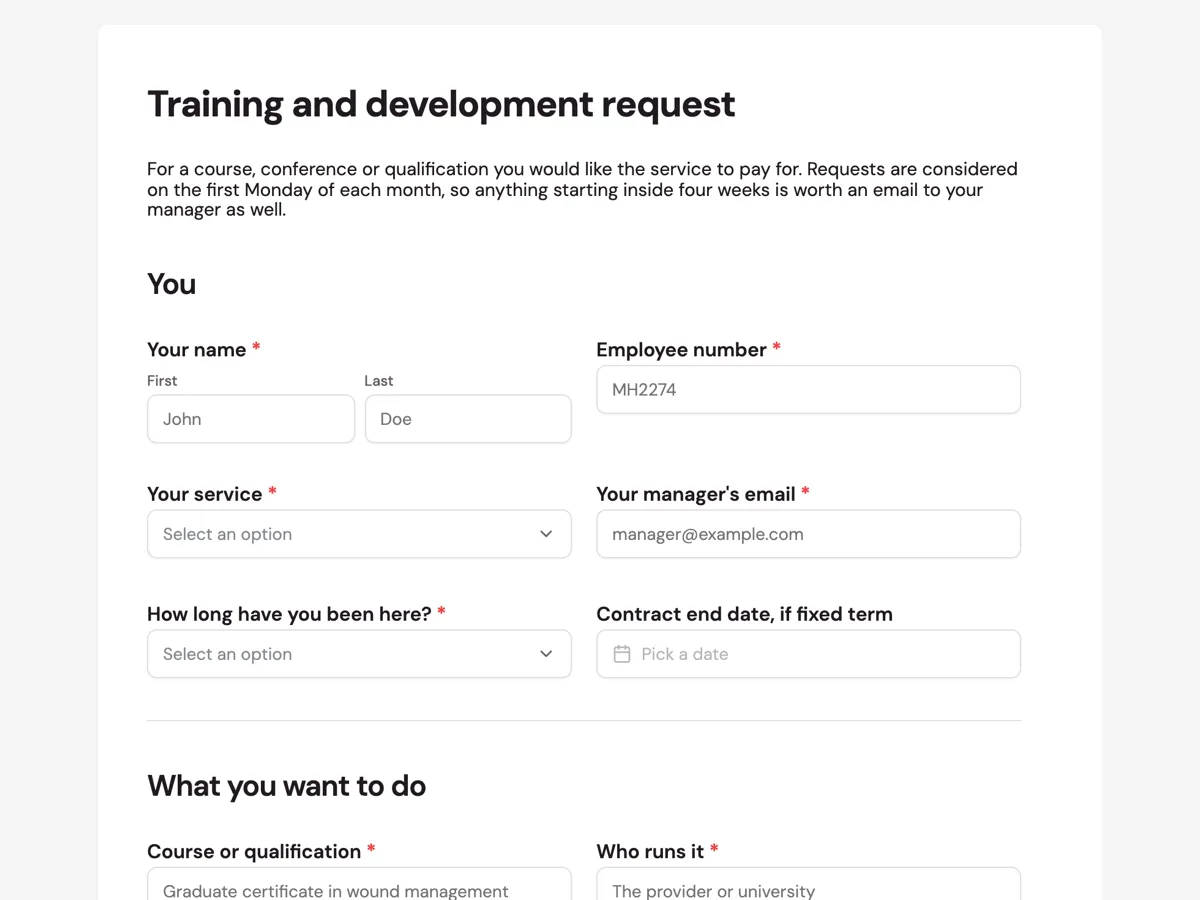
The form itself
A static copy of the finished form, exactly as it renders. Nothing here can be filled in or submitted, so read it as a reference and build your own from the button above.
Every field, and what it collects
The complete field list, in the order respondents meet it.
- Your nameNameRequired
- Employee numberShort textRequired
- Your serviceDropdownRequired
- Options: Community nursing · Allied health · Mental health · Aged care · Administration · Clinical governance · Facilities
- Your manager's emailShort textRequired
- How long have you been here?DropdownRequired
- Options: Under six months · Six to twelve months · One to three years · Three to five years · More than five years
- Contract end date, if fixed termDate
- Course or qualificationShort textRequired
- Who runs itShort textRequired
- Link to the course pageShort textRequired
- How is it delivered?DropdownRequired
- Options: In person · Online, live at set times · Online, at your own pace · A conference or symposium · Part online and part in person
- Is it assessed?Single choiceRequired
- Options: Yes, and I get a qualification · Yes, attendance certificate only · No assessment
- StartsDateRequired
- FinishesDateRequired
- Working days away from the serviceNumberRequired
- Last day to register or payDateRequired
- Cost breakdownTable
- Columns: What · Amount
- Total you are asking forNumberRequired
- How should it be paid?Single choiceRequired
- Options: Raise a purchase order and pay the provider directly · I will pay and claim it back once I have finished · I have already paid and am asking to be reimbursed
- Is any of it funded elsewhere?Single choiceRequired
- Options: No · Partly, by a scholarship or grant · Partly, by my professional body · I will contribute some myself
- Where does this sit?Single choiceRequired
- Options: Required to keep my registration or licence · Required for a role I have already been asked to take on · Recommended in my last development conversation · My own development, and I am asking
- What will you be able to do afterwards that you cannot do now?Long textRequired
- Who else benefits, and how would anyone notice?Long textRequired
- Who covers your work while you are away?Long textRequired
- I understand and agreeMultiple choiceRequired
- Options: If this costs more than $2,000 the repayment condition above applies to me · I will finish the course and any assessment attached to it · I will present what I learned at a team meeting within two months of finishing · If I withdraw, I will tell my manager before the provider's refund date rather than after it
You
What you want to do
What it costs
The case for it
The conditions
What makes this form work
It asks what changes, not why you want it
The placeholder shows the difference: assess and dress a complex wound without escalating, rather than improve my clinical skills. A worked example inside the field is worth more than any amount of guidance, because it is read at the moment of writing.
Cover is a required question, not an afterthought
Four days away is the part a manager can genuinely refuse, so the form asks who covers it and whether they have been spoken to. It moves the conversation that would have happened after approval to before the request.
Where the training sits is one choice field
Registration requirement, a role already agreed, a development conversation, or asking on your own account. Four options sort a monthly pile faster than any amount of prose, and they let a genuinely optional request be made honestly instead of dressed up as mandatory.
Questions people ask
What makes an approver say yes to a training request?
A specific capability at the end of it, a real number including travel, and a named person covering the work. This form asks for all three, and it asks for the capability in a sentence rather than a paragraph. Requests that fail almost always fail on the second or third, not on the first.
Should the repayment condition be on the request form?
The wording, yes, above the tick boxes. The agreement itself, no: a repayment obligation is normally a separate signed instrument, agreed before the employer commits the money rather than at the point somebody resigns. What the form does is make sure nobody asks without knowing, which is worth a paragraph and prevents most of the arguments.
Why break the cost into a table instead of one number?
Because a single total hides the lines a panel argues about. Five rows is enough for a fee, travel, accommodation, materials and an exam. The table renders exactly the rows it was given and there is no add row button, so five is a deliberate size rather than a limit somebody hit.
Can a form route the request to a manager and then a panel?
No. There is no approval chain, no conditional routing and no state a request moves through. What a form can do is email a copy on submission to one address, which for a monthly panel is usually a shared inbox. The routing after that is people, and this page does not pretend otherwise.
Why ask for the last day to register or pay?
Because approval that arrives after the deadline is a decline with extra steps. This form asks for it beside the course dates. An approver seeing a date two weeks away treats the request differently from one three months out, and it lets a manager sequence a queue without asking anybody to chase.
Should the form ask who covers the work?
Yes, and this form asks it as the last question before the conditions. Working days away from the service is already a field, so the cover question is what turns that number into a plan. An approver who can see both is deciding about a roster, not just about money.
Build your own in about a minute
The button below opens the generator with this use case already described. Change the wording to match your own, generate, then edit anything you like.
Make one like thisOther form examples
Expense claim form
Expense claims come back for boring reasons: a missing receipt, a date outside the window, or fuel claimed on top of a kilometre rate. This claim states each of those rules in the block where it applies, and gives the line items a table with six rows so a normal trip fits without an attachment. It is a classic form, because a claim is checked as a whole and a receipt upload has to sit beside the lines it belongs to.
Hazard report form short enough to use
Hazards go unreported because the form is longer than the hazard is worth. This one is nine questions, a photo, a four phrase risk rating and a choice of how soon someone has to come, and it is designed to be filled in standing next to the thing.
Martial arts registration form with grade, injuries and waiver
A dojo has to know two things before somebody steps on the mat: what they can already do and what their body cannot take. This registration asks both, then treats sparring as a separate consent rather than as something a membership implies, so a new member can start training on the first night without agreeing to be hit.
Want the steps in the builder? Read Every form field and when to use it, then Shape the PDF version of your form. For everything this generator can do, see the form maker.
Written and checked by the OneCraft team. Last checked .