Classic form
Hazard report form short enough to use
Hazards go unreported because the form is longer than the hazard is worth. This one is nine questions, a photo, a four phrase risk rating and a choice of how soon someone has to come, and it is designed to be filled in standing next to the thing.
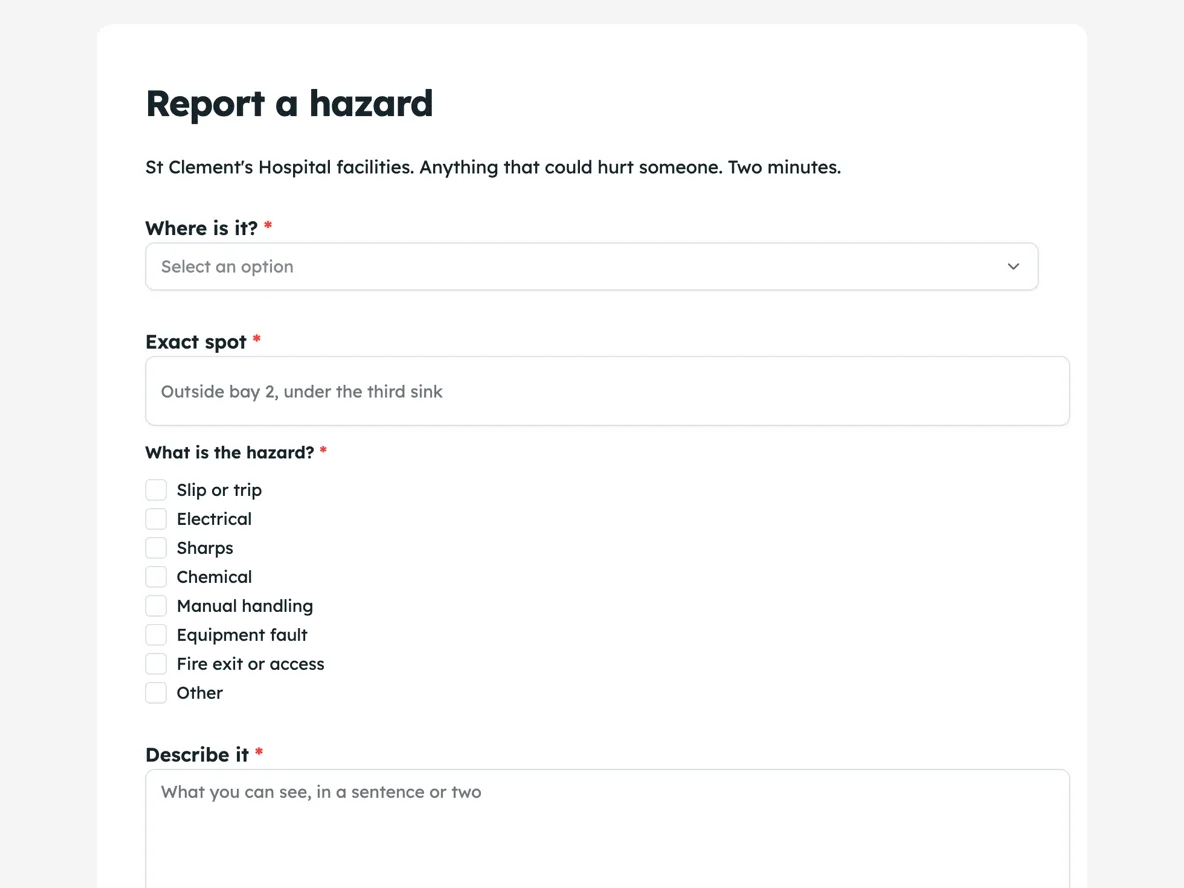
The form itself
A static copy of the finished form, exactly as it renders. Nothing here can be filled in or submitted, so read it as a reference and build your own from the button above.
Every field, and what it collects
The complete field list, in the order respondents meet it.
- Where is it?DropdownRequired
- Options: Ward 3 · Ward 4 · Emergency · Theatres · Kitchen · Loading dock · Car park · Grounds · Other
- Exact spotShort textRequired
- What is the hazard?Multiple choiceRequired
- Options: Slip or trip · Electrical · Sharps · Chemical · Manual handling · Equipment fault · Fire exit or access · Other
- Describe itLong textRequired
- PhotoPhoto upload
- One photo from a safe distance. Do not touch electrical faults.
- How bad could it be?Single choiceRequired
- Options: Could kill or permanently injure · Could send someone to hospital · Could need first aid · Nuisance only
- Does someone need to come today?Single choiceRequired
- Options: Yes, now · Today · This week
- What have you done about it?Multiple choice
- Options: Put a sign or cone · Isolated the area · Told the shift lead · Removed it · Nothing I could do
- Your nameName
- Your email for the report numberShort text
The four phrase risk rating, and the matrix it feeds
Risk matrices score likelihood against consequence, and they are a tool for people trained on them. A nurse next to a frayed cable is not consulting one. So the form asks only the half a worker can answer from what is in front of them, consequence, in four plain phrases from could kill down to nuisance only. The safety officer adds likelihood at the desk and places the report on the standard matrix from the risk management code of practice. Nothing is lost in translation, and the reporter never faces a five by five grid on a phone.
How to adapt this form
A construction site adds a subcontractor company field after the name and swaps the zone dropdown for site areas that change with the build, which means updating the dropdown each phase. A school version keeps everything, shortens the hazard list to what a campus produces, and routes the alert to the business manager. A retail version can drop sharps and chemical, add stock and fittings, and put the QR on the back-of-house door. The one rule that transfers everywhere: the form must stay answerable in two minutes by someone standing next to the hazard, or it will be answered by nobody.
What makes this form work
Consequence in four phrases, not a five by five grid
Could kill or permanently injure, could send someone to hospital, could need first aid, nuisance only. Any worker can pick one honestly without training, and the safety officer, who has the training, adds likelihood afterwards. The rating survives because it never asks for expertise the reporter does not have.
Urgency is its own question, separate from severity
A cone in a fire exit is a nuisance by consequence and an emergency by timing, which is exactly why does someone need to come today stands apart from how bad could it be. The three answers, yes now, today, this week, are the triage the duty supervisor actually runs.
The last line removes the reason people stay quiet
The form ends with one paragraph: anonymous reports are accepted, and nobody is asked why they did not report sooner. Name and email sit above it, both optional. That sentence is aimed at the frayed sling that has been fraying for a month, and the person who noticed it three weeks ago.
Questions people ask
What is the difference between a hazard and an incident?
A hazard could hurt someone; an incident did, or nearly did. The frayed sling is a hazard, the sling that snapped is an incident, and they are different forms because they trigger different processes. This page’s sibling, the incident report form, handles the after; this form exists so the after never happens.
Should hazard reports be anonymous?
They should be allowed to be, and here identity is optional and says so in a paragraph at the end of the form. The report number goes back only if an email is given. A facilities team learns more from a steady stream of anonymous reports than from a trickle of signed ones.
How do you rate risk without training people on a matrix?
Ask only consequence, in words anyone can weigh: could kill, could hospitalise, could need first aid, nuisance. The safety officer adds likelihood later and maps the pair onto the standard matrix. The reporter’s two taps carry exactly the information they actually possess, and no more.
Who receives a hazard report?
An email alert reaches the facilities inbox the moment the form is submitted, with the answers in the body, and the report sits in the responses table for triage. The does someone need to come today answer is in that email, so the inbox can be scanned for the yes, now reports first.
How is a report closed out?
In the responses table, with a note of what was done. The reporter does not get an automatic update, which the thank-you screen is honest about: they can quote the report number and ask. Closing the loop visibly, a fixed notice on the ward board, is what keeps reports coming.
Can this run as a QR poster in each zone?
Yes, one link on a poster at each zone works, and the location dropdown does the sorting that separate QR codes would otherwise do. Someone standing in the kitchen picks Kitchen; facilities does not maintain nine posters with nine links, and the form stays one form.
Build your own in about a minute
The button below opens the generator with this use case already described. Change the wording to match your own, generate, then edit anything you like.
Make my hazard report form short enough to useOther form examples
Training request form
Training requests are refused for two reasons far more often than for cost: nobody could tell what would change afterwards, and the days away had no cover. This form asks for both in plain language, and puts the repayment condition in front of the person before they ask rather than after they are approved. It is a classic form, because a cost table and a business case belong on one page an approver can read end to end.
Visitor sign in form that replaces the book on the counter
A paper visitor book shows every visitor the names of every other visitor, and it is useless in a fire drill because it is on the counter. This form sits behind a QR code, takes under a minute, and keeps the rules acknowledgement and the sign in time in one private record.
Workplace incident report form built for the first hour
The first report of an incident is the one the regulator, the insurer and the investigation all rely on, and it is usually written by the most stressed person on site. This form asks for facts in the order they are known, keeps opinion out until the last field, and asks the one question that decides whether the regulator must be told.
Want the steps in the builder? Read Form builder components, then Automate your form with add-ons. For everything this generator can do, see the form maker.
Written and checked by the OneCraft team. Last checked .