Classic form
Visitor sign in form that replaces the book on the counter
A paper visitor book shows every visitor the names of every other visitor, and it is useless in a fire drill because it is on the counter. This form sits behind a QR code, takes under a minute, and keeps the rules acknowledgement and the sign in time in one private record.
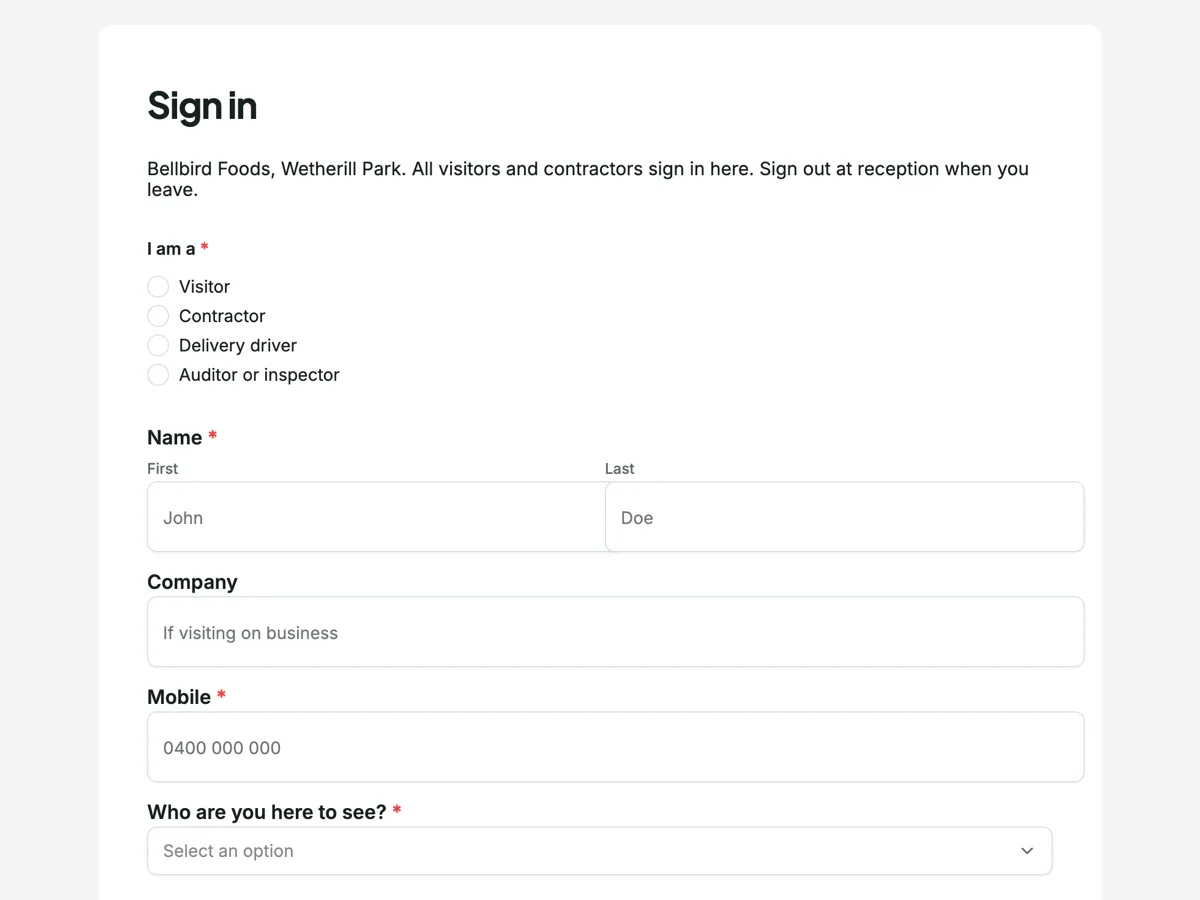
The form itself
A static copy of the finished form, exactly as it renders. Nothing here can be filled in or submitted, so read it as a reference and build your own from the button above.
Every field, and what it collects
The complete field list, in the order respondents meet it.
- I am aSingle choiceRequired
- Options: Visitor · Contractor · Delivery driver · Auditor or inspector
- NameNameRequired
- CompanyShort text
- MobileShort textRequired
- Who are you here to see?DropdownRequired
- Options: Reception will find them · Production · Quality · Warehouse · Office · Maintenance
- Vehicle registration, if parked on siteShort text
- LanyardMultiple choiceRequired
- Options: I will wear the visitor lanyard at all times
- EscortMultiple choiceRequired
- Options: I will stay with my host
- Production floorMultiple choiceRequired
- Options: I will not enter production without a hair net and coat
- EvacuationMultiple choiceRequired
- Options: I will follow the evacuation signs to the car park assembly point
- PhotographyMultiple choiceRequired
- Options: I will not photograph the production floor
- IllnessMultiple choiceRequired
- Options: I have not had vomiting or diarrhoea in the last 48 hours
- AllergensMultiple choiceRequired
- Options: I am not carrying nuts or nut products
- SignatureSignatureRequired
Site rules
Food safety declaration
What a visitor register is actually for
Three things, and the paper book fails all of them. Evacuation: the roll call needs today’s visitors on a phone at the assembly point, not in a book by the door everyone just evacuated past. Privacy: an open book publishes each visitor’s name, company and host to everyone who signs after them, which sits badly with the privacy principles governing how personal information is handled. Evidence: when an auditor asks whether visitors acknowledge the site rules, seven ticked boxes with a timestamp and a signature answer in one row. The QR code at the door costs a laminated sheet.
How to adapt this form
An office swaps the food safety declarations for an NDA acknowledgement, one checkbox with the sentence spelled out in a paragraph above it. A school adds a working with children check number field for contractors and visitors who will be near students. A construction site replaces the production floor rule with high-vis and white card lines and adds the card number. The structure never changes: who you are, who you are here for, the site’s specific promises ticked one by one, and a signature over the lot.
What makes this form work
Five rules, five deliberate ticks
Each site rule is a separate required checkbox, from the lanyard to the no-photography line, so the acknowledgement is five distinct taps rather than one tick over a block of text. When quality shows an auditor the record, every rule carries its own yes.
The food safety lines are the two an auditor asks about
No vomiting or diarrhoea in the last 48 hours; not carrying nut products. A food factory’s visitor risk is those two sentences, so the declaration is those two sentences, each its own required tick, and nothing else padding the minute.
Submit time is the sign in time, and the form says so
The last line states that time in is recorded on submission, so nobody types a time and nobody backdates one. The evacuation list, the host notification and the record all hang off a timestamp the visitor cannot get wrong.
Questions people ask
How do visitors actually reach the form?
A QR code at the door and, for the phone-less, a tablet at reception open the same link. There is nothing to install; the form is a public web page. The dropdown of hosts and the one minute length matter more than the technology, because a queue at the door kills any sign in system.
Where is the sign out?
At reception, where the lanyard comes back, and the form says so twice rather than pretending otherwise. This form records arrival; a mirror-image second form can record departures if the site needs both timestamps. Honesty about what is recorded beats a fake in-out board.
Is a paper visitor book really a privacy problem?
An open book on a counter discloses every previous visitor’s personal information to every later one, and in Australia organisations covered by the Privacy Act are expected to handle personal information more carefully than that. A form record is seen by reception and nobody else, which is the whole difference.
How does this help in an evacuation?
The responses table filtered to today is the visitor roll call, readable on a phone at the assembly point. The submission timestamp is the time in, which is why the form prints that fact in its last line instead of asking anyone to type a time.
Why is each site rule its own checkbox?
Because a required checkbox is satisfied by ticking at least one option, so five rules inside one field could be acknowledged with a single tick. Five separate required checkboxes mean five deliberate ticks, and the record shows each rule was individually acknowledged, which is what the acknowledgement is for.
What extra do contractors need?
A current site induction card, which the rules paragraph states, and for regular contractors the full induction checklist linked from this page. The I am a question at the top exists so reception knows to ask for the card before the lanyard is handed over.
Build your own in about a minute
The button below opens the generator with this use case already described. Change the wording to match your own, generate, then edit anything you like.
Make my visitor sign in form that replaces the book on the counterOther form examples
Work from home request form
Most flexible work requests are refused on a hunch about whether the work will still get done, because the form never asked. This one asks which parts of the job travel and which do not, then spends its longest section on the home workspace, because an employer's safety duty follows the employee home and that is the part managers are actually nervous about. It is a classic form, so the safety self check and the photo of the space sit together on one page.
Emergency contact form
The emergency contact on file is usually the one somebody typed on their first day, three phone numbers ago. This form exists to be resent every year without asking anybody to confirm their bank details again, and it asks two questions most versions leave out: how much may be disclosed, and whether anybody must not be contacted. It is a classic form, because a first aider reading it needs the whole record on one page.
Workplace grievance form
A grievance form that only asks "describe your complaint" produces a page of frustration nobody can act on. This one asks for the account and then a dated table of incidents beside it, keeps witnesses separate, and finishes with the question that decides what happens next: what would a good outcome look like. It is a classic form, because somebody writing something difficult needs to see the whole shape of it before they start.
Want the steps in the builder? Read Form builder components, then Control who can fill in your form. For everything this generator can do, see the form maker.
Written and checked by the OneCraft team. Last checked .