Conversational form
Newsletter signup form
One field is the correct length for a newsletter signup, and everything beyond it has to earn its place by changing what gets sent. This one asks six questions: the address, an optional name, what somebody wants to hear about, how often, how they buy, and a consent line that starts unticked and names the sender. It is conversational, because six one line questions on six screens is faster on a phone than a block of them on one.
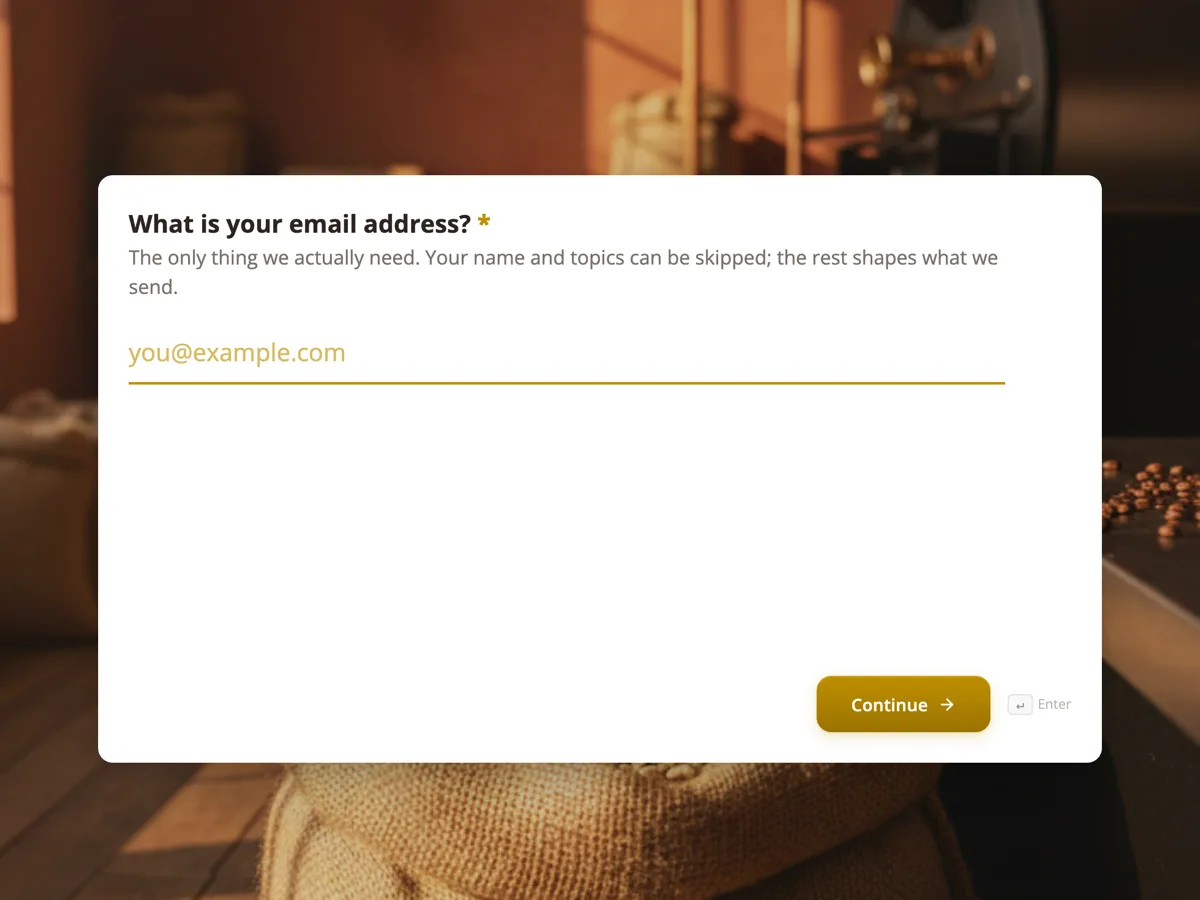
The form itself
The first screen of the form. A conversational form shows one question per screen, so the remaining screens are listed in the field table below. Nothing here can be filled in or submitted, so read it as a reference and build your own from the button above.
Every field, and what it collects
The complete field list, in the order respondents meet it.
- What is your email address?Short textRequired
- The only thing we actually need. Your name and topics can be skipped; the rest shapes what we send.
- What should we call you?Short text
- Optional, and we only ask because the letter opens with a greeting. If you would rather not, the greeting says "Hello" and nothing is lost.
- What do you want to hear about?Multiple choice
- Tick as many as you like, or none, in which case you get everything. This is the question that decides whether you unsubscribe in March.
- Options: New single origins as they land · Restocks of the regulars · Brewing notes and recipes · Cupping sessions and classes at the roastery · Wholesale and cafe supply · Seconds and end of season discounts
- How often would you like to hear from us?Single choiceRequired
- We default to monthly because that is what we can write well. The weekly option is genuinely weekly and it is mostly restock notices.
- Options: Once a month, the main letter · Weekly, including restocks · Only when something new lands · A few times a year at most
- How do you usually buy from us?DropdownRequired
- Options: Online, delivered · At the roastery · Through a cafe that stocks you · I have not bought anything yet · I buy for a business
- One last thingMultiple choiceRequired
- Marketing email needs your active permission, so this box starts empty and stays empty unless you tick it. Every letter we send carries our business name and address and a working unsubscribe link, and leaving is one click rather than a reply and a wait.
- Options: Yes, send me the Fenwick Roasters letter at the frequency I picked
What makes this form work
The email comes first, and the name and topics are optional
Four of the six questions are required: the email, how often, how they buy and the consent line. The name and the topics are optional, so nobody has to hand over more personal detail than the list needs. The email screen's own note says only the name and topics can be skipped, which matches the required flags.
The consent tick is its own screen with its own explanation
It starts empty, it names the business, it repeats the frequency the person chose, and the help text explains why the box is not pre ticked. Bundled consent buried under a submit button is precisely what the rules were written to stop, and separating it costs one screen.
The thank you screen sets up the confirmation email
It says plainly that nobody is on the list until they click the link, and why that step exists. Without it, the confirmation email looks like a stray message and gets ignored, and the address is lost anyway after the person thought they had signed up.
Questions people ask
What does a compliant consent line actually say?
It names who is sending, what they will send, and how to stop it, and the box starts empty. Under Australian rules express consent means the person knows and accepts they will get marketing from you, the sender must be able to prove it, and an unsubscribe request has to be honoured within five working days. UK rules add that the consent request must be clearly distinguishable from everything else and as easy to withdraw as it was to give.
Is double opt in required?
Not by statute in Australia, the UK or the United States. It is the practical way to satisfy the rules that are statutory: proving consent later, and keeping mistyped addresses off the list. The thank you screen on this form tells people to expect the confirmation email, which is where the second step lives, since a form cannot send it itself.
Why ask about frequency instead of picking one?
Because "too many emails" is the reason people leave, and the frequency question is the cheapest way to keep somebody who would otherwise unsubscribe in March. It also sets an expectation you have to meet. Do not offer weekly unless you will write weekly.
Can this form send the emails?
No. It collects the addresses and the preferences, and something else sends. Export the responses as a spreadsheet or point the webhook add on at your mailing platform, which fires once per submission with the answers keyed by field label. There is no retry if that endpoint is down, so the export is the reliable backstop.
Should a signup form ask what topics somebody wants?
If you actually send more than one kind of email, yes. This form asks what you want to hear about, then how often. Two questions let a small business send three relevant emails a month instead of twelve generic ones, and the answers give you something to segment on before the list is big enough to justify a tool.
Why ask how somebody usually buys from you?
Because it separates the people who walk in from the people who order online, and those two want different emails. This form asks it as the fifth question, after consent is effectively settled. Knowing the channel means a shop can send opening hours to locals and shipping cut offs to everybody else.
Build your own in about a minute
The button below opens the generator with this use case already described. Change the wording to match your own, generate, then edit anything you like.
Make one like thisOther form examples
Dental treatment consent form with item numbers and fees
A dental treatment consent form has to record the procedure, what it will cost, the other options the patient heard, the risks they read and how they will be sedated. This one asks for each in turn, with a four row table for the item numbers and fees from the treatment plan and a signature at the end.
Tattoo consent form signed on a tablet before the needle
A tattoo consent form is a health questionnaire, an age check and a design confirmation, signed in the same minute. This one does all three on a tablet, asks the eight health questions an artist needs, takes a photo of the ID, and files a PDF the studio can produce two years later.
Social media consent form for staff, platform by platform
A social media consent form for staff has to record where an employer may post photos of them, how they are named and how they can take that back. This one asks platform by platform in a five row grid, so a barista can say yes to the website and no to TikTok, and prints the withdrawal steps above the signature.
Want the steps in the builder? Read Control who can fill in your form, then Create a conversational form with AI. For everything this generator can do, see the form maker.
Written and checked by the OneCraft team. Last checked .