Classic form
Tattoo consent form signed on a tablet before the needle
A tattoo consent form is a health questionnaire, an age check and a design confirmation, signed in the same minute. This one does all three on a tablet, asks the eight health questions an artist needs, takes a photo of the ID, and files a PDF the studio can produce two years later.
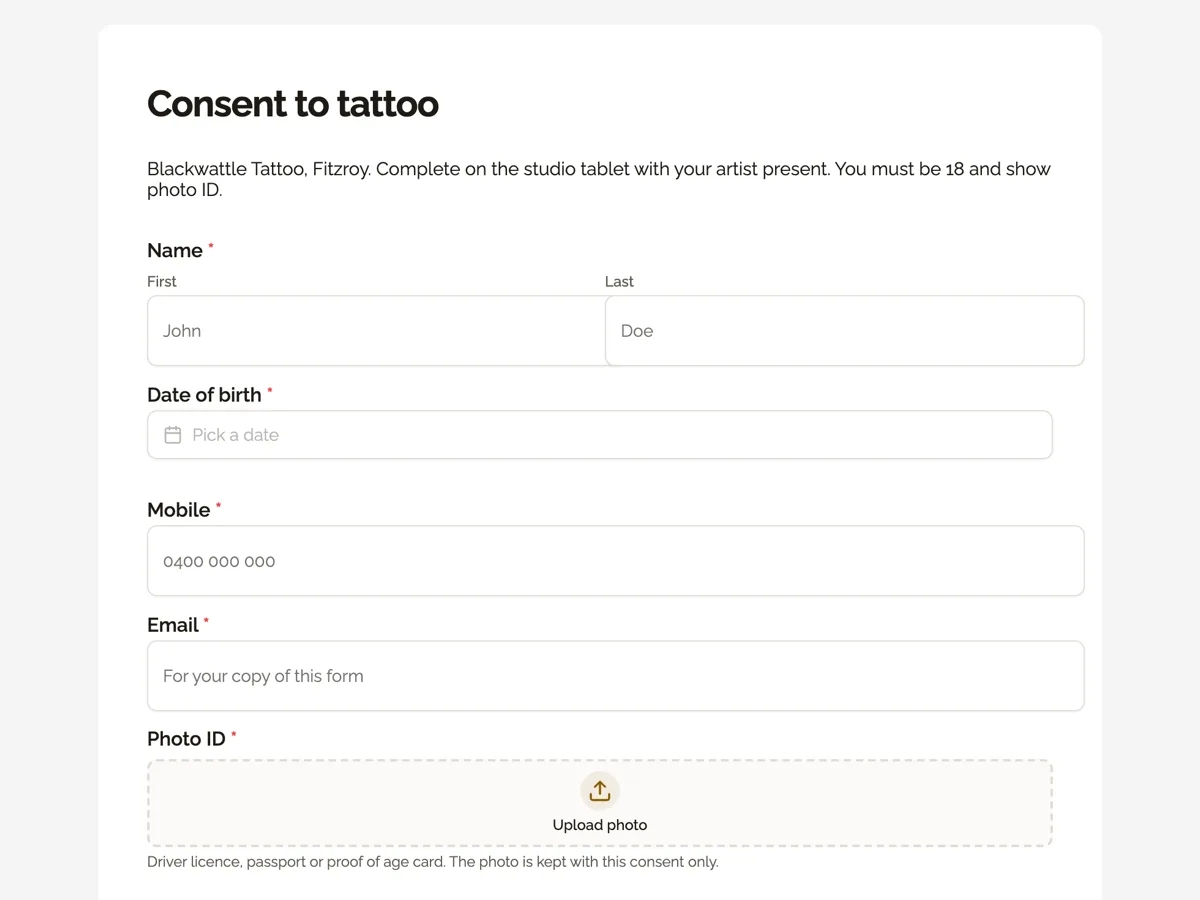
The form itself
A static copy of the finished form, exactly as it renders. Nothing here can be filled in or submitted, so read it as a reference and build your own from the button above.
Every field, and what it collects
The complete field list, in the order respondents meet it.
- NameNameRequired
- Date of birthDateRequired
- MobileShort textRequired
- EmailShort textRequired
- Photo IDPhoto uploadRequired
- Driver licence, passport or proof of age card. The photo is kept with this consent only.
- Tick everything that appliesMultiple choiceRequired
- Options: Diabetes · Heart condition · Haemophilia or blood thinners · Epilepsy · Skin condition at the site (eczema, psoriasis, keloid scarring) · Pregnant or breastfeeding · Allergy to latex, nickel or ink · Alcohol or drugs in the last 24 hours · None of these
- Medications and allergiesLong text
- Are you being treated for anything else we should know about?Short text
- ArtistDropdownRequired
- Options: Mira · Jonah · Guest artist
- PlacementShort textRequired
- Approximate size in cmShort textRequired
- The designMultiple choiceRequired
- Options: I have seen the final stencil and approve the design, spelling, placement and size
- RisksMultiple choiceRequired
- Options: The risks above have been explained to me
- PermanenceMultiple choiceRequired
- Options: I understand the tattoo is permanent
- AftercareMultiple choiceRequired
- Options: I will follow the aftercare instructions I am given
- SobrietyMultiple choiceRequired
- Options: I am not under the influence of alcohol or drugs
- AgeMultiple choiceRequired
- Options: I am 18 or over and the ID above is mine
- May we photograph the finished tattoo for the studio portfolio?Single choiceRequired
- Options: Yes · No
- SignatureSignatureRequired
- Artist initialsShort textRequired
Health
The tattoo
Consent and aftercare
What a tattoo consent form has to cover
Five things, in the order the appointment happens. Age, which the date of birth, the ID photo and the artist initials verify between them. Health, because diabetes, blood thinners and skin conditions at the site change whether and how the work proceeds, and the 24 hour question is asked in writing so it does not have to be asked awkwardly aloud. Design, confirmed against the final stencil with spelling named explicitly. Risks, acknowledged one tick at a time rather than as a block signature. And records: skin penetration businesses operate under state public health rules, and the response PDF, with the ID photo and drawn signature inside it, is the record that survives.
How to adapt this form
A piercing studio swaps placement and stencil lines for jewellery material and initial piercing size, keeps every health question, and adds a healing time acknowledgement. Cosmetic tattooing adds a patch test date field and a touch-up expectation line, since brows fade by design. Where a state allows minors to be tattooed with parental consent, and several do not, the adaptation is a guardian block with its own ID photo and signature, plus the state's specific wording. This studio version stays 18 plus, which is the cleanest rule and the easiest one to defend.
What makes this form work
The health list ends with None of these
Eight conditions that genuinely change tattooing, from blood thinners to skin conditions at the site, plus a none option so the checklist can be required without trapping healthy clients. The artist reads one field and knows whether today needs a conversation first.
Two humans verify the age, not one
The client dates their birth, uploads the ID and ticks the age line; the artist initials the form after checking the card against the face. That last field turns the age check from a client claim into a studio procedure, which is what a regulator asks about.
The tablet flow matches the real minute
Single column, no welcome screen: the tablet is handed over open at the first field, with the artist present, and the drawn signature lands in the response PDF next to the ID photo. The paperwork takes the two minutes the stencil is drying and is filed before the needle moves.
Questions people ask
Is a signed consent form a legal defence?
It is evidence of informed consent, not a waiver of negligence. Australian consumer law guarantees services performed with due care and skill regardless of what was signed. What the form does is prove the risks were disclosed, the ID was checked and the design was approved, which is exactly the evidence a dispute turns on.
Should the studio keep the ID photo?
The consent record must show ID was checked; the photo makes that check self-evident. The caption on the field promises the photo is kept with the consent only, and studios that prefer not to hold ID images can note the licence number instead and delete the photo after the record period.
Can a minor be tattooed with parental consent?
It depends on the state: some ban tattooing under 18 outright, others allow it with written parental consent for specific circumstances. This form is built for an 18 plus studio, which sidesteps the question entirely; the age tick and the ID photo are the enforcement.
Why is the spelling called out in the stencil tick?
Because misspelled tattoos are the dispute every studio eventually meets, and the form is where it is prevented. The tick says design, spelling, placement and size were approved on the final stencil, so the person who approved MUM spelled MOM did so in writing, with a signature under it.
Why five separate consent ticks instead of one?
A required checkbox is satisfied by any single tick, so five statements in one field could be acknowledged with one tap. Five separate required checkboxes force five deliberate acknowledgements, and the record shows risks, permanence, aftercare, sobriety and age were each answered on their own.
Why is the portfolio photo a separate yes or no?
Because consent to be tattooed is not consent to be published. The radio makes the choice explicit and equal, no is as easy to pick as yes, and the studio's social feed only ever shows work whose owner said yes on a form it can find again.
Build your own in about a minute
The button below opens the generator with this use case already described. Change the wording to match your own, generate, then edit anything you like.
Make my tattoo consent form signed on a tablet before the needleOther form examples
Newsletter signup form
One field is the correct length for a newsletter signup, and everything beyond it has to earn its place by changing what gets sent. This one asks six questions: the address, an optional name, what somebody wants to hear about, how often, how they buy, and a consent line that starts unticked and names the sender. It is conversational, because six one line questions on six screens is faster on a phone than a block of them on one.
New vet client form with the pet record and the consent together
A vet's first consult is shorter when the microchip number, the last vaccination and the previous clinic's name are already on file. This form collects the owner, one pet and the consent a clinic needs, and asks for the previous vet so the records arrive before the appointment does.
Therapy intake form that asks the safety question properly
A counselling intake form does two things a medical one does not: it lets the client say in their own words why they came, and it asks about safety in a way that is honest about what happens to the answer. This form does both, then takes the consent to counselling and the cancellation terms before the first session.
Want the steps in the builder? Read Form builder components, then Shape the PDF version of your form. For everything this generator can do, see the form maker.
Written and checked by the OneCraft team. Last checked .