Classic form
Research participant consent form with a withdrawal clause
A research participant consent form has to show that the participant read the information sheet, agreed to each use of their data separately and knew how to withdraw. This one does that for a university sleep study, with three data statements ticked one by one, a recording choice, a dated withdrawal cut off and both participant and researcher signatures.
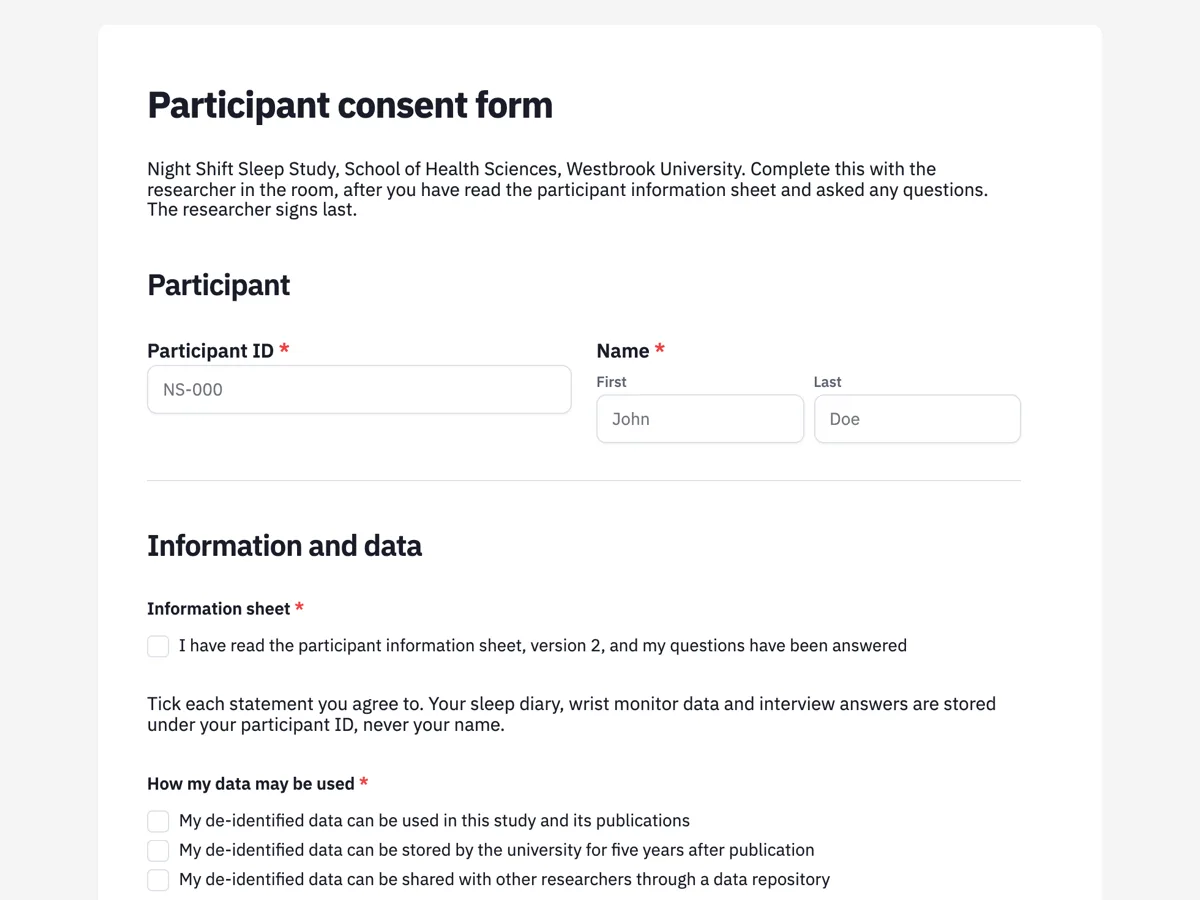
The form itself
A static copy of the finished form, exactly as it renders. Nothing here can be filled in or submitted, so read it as a reference and build your own from the button above.
Every field, and what it collects
The complete field list, in the order respondents meet it.
- Participant IDShort textRequired
- NameNameRequired
- Information sheetMultiple choiceRequired
- Options: I have read the participant information sheet, version 2, and my questions have been answered
- How my data may be usedMultiple choiceRequired
- Options: My de-identified data can be used in this study and its publications · My de-identified data can be stored by the university for five years after publication · My de-identified data can be shared with other researchers through a data repository
- The interview at the end of the study is audio recorded. Do you agree to the recording?Single choiceRequired
- Options: Yes, record my interview · No, the researcher will take written notes instead
- May the study team contact you about future studies?Single choiceRequired
- Options: Yes · No
- Email for future contact, only if you answered yesShort text
- Participant signatureSignatureRequired
- DateDateRequired
- Researcher signature, confirming the study was explainedSignatureRequired
Participant
Information and data
Withdrawal
What each field on this form collects
Participant ID and name sit side by side, and the ID placeholder shows the study format. A single tick confirms the participant read version 2 of the information sheet. A paragraph explains that data are stored under the ID, then a checkbox of three data statements covers this study, five year storage and sharing through a repository. The recording radio offers written notes as the alternative. Future contact is a yes or no radio, followed by an optional email. The withdrawal paragraph sets the four week cut off, then the participant signs beside the date and the researcher signs last. Nine of the ten fields are required.
Why each data use is its own statement
Using data in this study, keeping it for five years and sharing it with other researchers are three different decisions. Bundled into one sentence, a participant who is happy with the first but not the third has to refuse the whole study or agree to all three. Separate ticks let them agree to what they are comfortable with. The checkbox is required, so at least one statement is ticked, and the researcher reads the response before the participant leaves to see which uses were agreed. The information sheet tick names its version, so a later amendment shows which sheet each person read.
What ethics guidance asks for
The Australian National Statement on Ethical Conduct in Human Research, published by the NHMRC, expects consent to be voluntary, based on enough information, and open to withdrawal, with the consequences of withdrawal explained. The Declaration of Helsinki sets the same principles for medical research worldwide. Both expect participants to know how their data will be stored and shared. A human research ethics committee approves the exact wording, so a real study uses the version its committee approved.
How to adapt this form
An online survey study drops the researcher signature and the recording radio and puts consent on the first screen. A study with children adds a parent signature and a simple assent paragraph. A clinical trial adds the insurer and the trial registration number to the intro.
What makes this form work
Three data statements, three ticks
This study, five year storage and repository sharing are listed separately. A participant can agree to the first two and decline sharing without leaving the study.
A withdrawal cut off in plain words
The paragraph says data can be removed until analysis begins, four weeks after the last visit. Participants know the exact limit before they sign.
The information sheet version is named
The tick says version 2. If the sheet is amended during the study, every response shows which version that participant read.
Questions people ask
Why does the researcher sign a research consent form too?
The researcher signature confirms the study was explained and the participant had a chance to ask questions. It is the evidence that consent was taken properly, not just collected. Because both signatures are required, this form is completed in the room with the researcher, which the intro says at the top.
What is a participant ID for if the name is on the form?
The consent form is the only document that links the name to the ID. Every other record, the sleep diary, the monitor data and the interview transcript, carries only the ID. The consent forms are kept apart from the data, so a data file on its own does not identify anyone.
Why set a date after which data cannot be withdrawn?
Once data are analysed and combined, removing one person can be impossible without redoing the whole study. A clear cut off, four weeks after the last visit, tells participants exactly how long they have. Being honest about that limit is part of informed consent, and ethics committees expect it to be stated.
What happens if a participant says no to audio recording?
The interview still goes ahead, and the researcher takes written notes instead. The radio gives that as the second answer so saying no is easy and does not exclude anyone. A study where the recording is essential would say so in the information sheet and make taking part conditional on it.
Can participants keep a copy of what they agreed to?
The thank-you screen says the researcher gives them a copy of the information sheet. The owner can also download the response as a PDF with both signatures and hand it over. The form itself does not email the participant, so the study team arranges the copy in person.
Build your own in about a minute
The button below opens the generator with this use case already described. Change the wording to match your own, generate, then edit anything you like.
Make one like thisOther form examples
Medication consent form for childcare, dose by dose
A medication consent form for childcare has to authorise educators to give a named medicine at a set dose, time and route, and show when the child last had it. This one puts those four details in a table copied from the pharmacy label, then asks the reason, prescriber, expiry, storage and last dose before a guardian signs.
Laser hair removal consent form with skin type and sun exposure
A laser hair removal consent form records the facts that decide safe laser settings, such as skin type, recent sun and light sensitising medicines, and that the client understands the risks. This one asks twelve questions before the patch test, with all six Fitzpatrick skin types described in plain words.
Cosmetic treatment consent form with an eight item risks checklist
A cosmetic treatment consent form records that a client understood the treatment, its risks and the alternatives before agreeing to it. This one, for a skin clinic offering peels and microneedling, lists eight risks to tick, then asks about alternatives, aftercare and before and after photos before the client signs.
Want the steps in the builder? Read Form builder components, then View, export and manage your responses. For everything this generator can do, see the form maker.
Sources
Written and checked by the OneCraft team. Last checked .