Classic form
Laser hair removal consent form with skin type and sun exposure
A laser hair removal consent form records the facts that decide safe laser settings, such as skin type, recent sun and light sensitising medicines, and that the client understands the risks. This one asks twelve questions before the patch test, with all six Fitzpatrick skin types described in plain words.
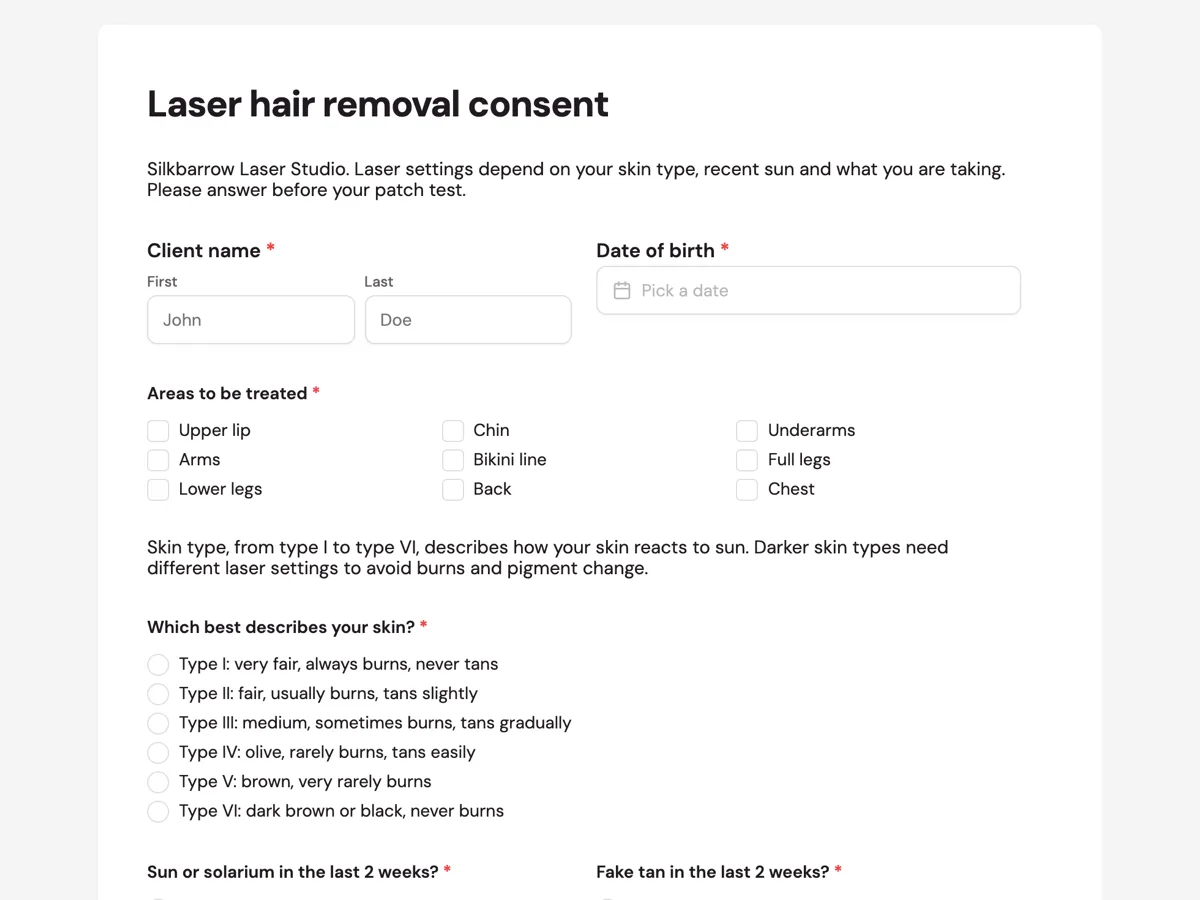
The form itself
A static copy of the finished form, exactly as it renders. Nothing here can be filled in or submitted, so read it as a reference and build your own from the button above.
Every field, and what it collects
The complete field list, in the order respondents meet it.
- Client nameNameRequired
- Date of birthDateRequired
- Areas to be treatedMultiple choiceRequired
- Options: Upper lip · Chin · Underarms · Arms · Bikini line · Full legs · Lower legs · Back · Chest
- Which best describes your skin?Single choiceRequired
- Options: Type I: very fair, always burns, never tans · Type II: fair, usually burns, tans slightly · Type III: medium, sometimes burns, tans gradually · Type IV: olive, rarely burns, tans easily · Type V: brown, very rarely burns · Type VI: dark brown or black, never burns
- Sun or solarium in the last 2 weeks?Single choiceRequired
- Options: Yes · No
- Fake tan in the last 2 weeks?Single choiceRequired
- Options: Yes · No
- Are you taking any of these?Multiple choiceRequired
- Options: Antibiotics · Acne medicine taken by mouth, now or in the last 6 months · St John's wort · Retinol or acid creams on the areas · None of these
- Tattoos in the treatment areas?Single choiceRequired
- Options: Yes · No
- Are you pregnant?Single choiceRequired
- Options: Yes · No · Not sure
- Patch testSingle choiceRequired
- Options: I will have a patch test and wait the advised time before treatment · I had a patch test here in the last 6 months
- I understand these possible risks:Multiple choiceRequired
- Options: Redness and swelling around follicles for a day or two · Burns or blisters · Darker or lighter patches of skin · Hair regrowth, as results vary · Eye injury without protective eyewear
- SignatureSignatureRequired
What each field on this form collects
The client's name sits beside date of birth. A checkbox of nine treatment areas follows. A paragraph explains skin types, then a radio describes types I to VI by colour and how the skin burns and tans. Recent sun or solarium and fake tan share a row. A paragraph introduces a checkbox of four light sensitising medicines or products and "none of these". Tattoos in the area and pregnancy share a row. The patch test radio comes next, then a checkbox of five risks and the signature. All twelve fields are required.
Why skin type and sun come first
Laser hair removal works by heating the pigment in the hair. Pigment in the skin absorbs the same energy, so darker or recently tanned skin needs different settings, and getting them wrong causes burns and lasting patches of lighter or darker skin. That is why the Fitzpatrick scale is spelled out, not left as a number a client may not know, and why sun and fake tan are asked separately: fake tan colours the surface and can absorb energy too. Tattoos are asked for the same reason, since the ink absorbs the light and the therapist works around it.
What the therapist checks at the patch test
At the patch test, the therapist compares the skin type the client chose with what they see, because people often pick a type lighter or darker than their skin. Sun, fake tan and medicines can each delay the appointment, and the thank-you screen tells clients how to prepare. Tattoos are covered or worked around. The risk ticks are reviewed aloud, especially pigment change and regrowth, before the first shot is fired.
How to adapt this form
An IPL studio keeps the structure and adds a question on previous IPL reactions. A clinic offering laser skin rejuvenation adds a risks list for that treatment and a cold sore history question. A studio that treats men adds face and neck areas and a question on ingrown hairs and shaving rash.
What makes this form work
Six skin types in plain words
Each Fitzpatrick type is described by skin colour and how it burns and tans, so a client can choose correctly without knowing the scale.
Sun and fake tan asked apart
Two side by side radios separate a real tan from fake tan, because both colour the skin and change how much laser energy it absorbs.
Medicines as categories
Antibiotics, acne medicine by mouth, St John's wort and retinol creams are listed by type, which clients recognise more reliably than a list of drug names.
Questions people ask
What is the Fitzpatrick skin type?
A six point scale, type I to type VI, that describes how skin responds to sun: from very fair skin that always burns to dark skin that never burns. Laser therapists use it to choose the wavelength and energy. This form describes each type in plain words because many clients do not know their number.
Why does a laser clinic ask about antibiotics?
Some antibiotics, along with some acne medicines, St John's wort and retinol creams, make skin more sensitive to light, which raises the risk of burns. The form lists them as categories rather than brand names. A yes means the therapist checks the details and may delay treatment until the course has finished.
What is a laser patch test?
A small test shot on the area to be treated, usually followed by a wait of a day or more to check how the skin reacts. It confirms the settings before a full session. The form asks whether the client will have one or had one at the studio in the last six months.
Can you have laser hair removal while pregnant?
Most clinics postpone treatment during pregnancy, mainly because hormone changes affect hair growth and skin pigment and there is little research on safety. That is why the form asks, with "not sure" as an honest option. A yes or not sure means the therapist discusses postponing treatment until after the pregnancy.
Why avoid the sun before laser hair removal?
Tanned skin holds more pigment, which absorbs laser energy and increases the risk of burns and patchy skin colour. Clinics usually ask clients to avoid sun, solarium and fake tan on the area for a couple of weeks before each session. The thank-you screen repeats that advice so it reaches the client at the right moment.
Is laser hair removal permanent?
It usually gives long term reduction rather than complete permanent removal, and results vary with hair colour, skin type and hormones. Several sessions are normal, and some regrowth is common. "Hair regrowth, as results vary" is in the risk checklist so clients start with realistic expectations.
Build your own in about a minute
The button below opens the generator with this use case already described. Change the wording to match your own, generate, then edit anything you like.
Make one like thisOther form examples
PAR Q form online: seven questions, clearance and a signature
A PAR Q form is a short physical activity readiness questionnaire that asks seven yes or no questions to find people who should check with a doctor before exercising more. This one puts the seven questions online for a Pilates studio, then asks about clearance for any yes and takes a dated signature.
Piercing consent form with an ID check and aftercare
A piercing consent form records who is being pierced, where, with what jewellery, and that the client is old enough, has declared relevant health conditions and has received aftercare instructions. This one, for an Australian studio, adds a photo of photo ID and a guardian signature for clients aged 16 or 17.
Cosmetic treatment consent form with an eight item risks checklist
A cosmetic treatment consent form records that a client understood the treatment, its risks and the alternatives before agreeing to it. This one, for a skin clinic offering peels and microneedling, lists eight risks to tick, then asks about alternatives, aftercare and before and after photos before the client signs.
Want the steps in the builder? Read Form builder components, then Design your welcome and thank-you screens. For everything this generator can do, see the form maker.
Written and checked by the OneCraft team. Last checked .