Classic form
Piercing consent form with an ID check and aftercare
A piercing consent form records who is being pierced, where, with what jewellery, and that the client is old enough, has declared relevant health conditions and has received aftercare instructions. This one, for an Australian studio, adds a photo of photo ID and a guardian signature for clients aged 16 or 17.
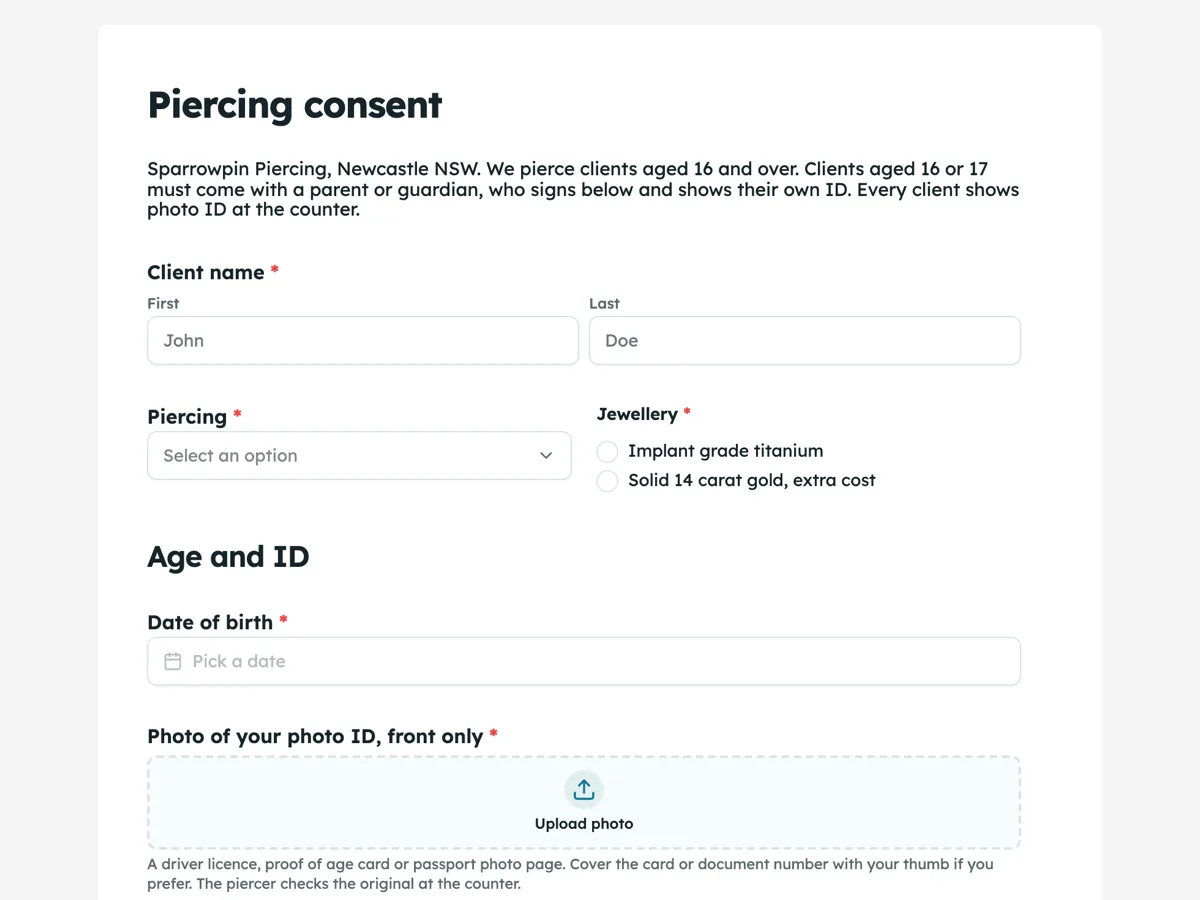
The form itself
A static copy of the finished form, exactly as it renders. Nothing here can be filled in or submitted, so read it as a reference and build your own from the button above.
Every field, and what it collects
The complete field list, in the order respondents meet it.
- Client nameNameRequired
- PiercingDropdownRequired
- Options: Earlobe · Helix · Conch · Tragus · Nostril · Septum · Eyebrow · Navel
- JewellerySingle choiceRequired
- Options: Implant grade titanium · Solid 14 carat gold, extra cost
- Date of birthDateRequired
- Photo of your photo ID, front onlyPhoto uploadRequired
- A driver licence, proof of age card or passport photo page. Cover the card or document number with your thumb if you prefer. The piercer checks the original at the counter.
- Do any of these apply to you?Multiple choiceRequired
- Options: Diabetes · Bleeding disorder or blood thinners · Heart condition · Epilepsy · Metal allergy · Pregnant or breastfeeding · Keloid scarring · None of these
- Aftercare acknowledgementMultiple choiceRequired
- Options: I have received the aftercare instructions above and a printed card, and I will follow them
- Parent or guardian nameName
- Parent or guardian signatureSignature
- Client signatureSignatureRequired
Age and ID
Health
Guardian, for clients aged 16 or 17
Client
What each field on this form collects
The client's name opens the form. The piercing dropdown lists eight placements beside a jewellery radio of titanium or solid gold. Under age and ID, date of birth comes first, then a required photo of the front of a photo ID, with a description that allows the document number to be covered. A privacy paragraph introduces a health checkbox of seven conditions and "none of these". The aftercare paragraph gives cleaning steps and healing times before an acknowledgement tick. The guardian name and guardian signature are optional, for clients aged 16 or 17, and the client signs last. Eight of the ten fields are required.
Why date of birth and ID sit together
Age is the question a piercing studio cannot afford to get wrong. Typing a date of birth is easy to fudge; a photo of photo ID beside it gives the piercer something to check against, and the original is still checked at the counter, as the intro and thank-you screen both say. The photo field only asks for the front of the card and invites the client to cover the number, because the studio needs the name, photo and date of birth, not the document number. Clients aged 16 or 17 bring a guardian who signs in the guardian section, so both signatures sit in one record.
The Australian rules behind it
Piercing is a skin penetration procedure, and each state regulates it. In New South Wales the Public Health Act 2010 and Public Health Regulation 2022 set the hygiene and premises standards, businesses notify their local council, and council officers inspect without notice. Some states also restrict piercing of minors; Western Australia, for example, prohibits piercing intimate body parts of anyone under 18. The details differ by state, so the studio's own minimum age of 16 sits above them. Health details are sensitive information under the Australian Privacy Principles, which is why the form says who reads them.
How to adapt this form
A studio that also tattoos adds a separate tattoo section with its own minimum age of 18. A studio in another state changes the council line in the privacy paragraph to its own regulator. A mobile ear piercing service for events drops the cartilage options and the gold upgrade.
What makes this form work
Date of birth beside photo ID
A typed date of birth is checked against a photo of the ID's front, which the client may take with the document number covered, before the original is checked at the counter.
Healing times in the aftercare
Six weeks for an earlobe and up to twelve months for cartilage or a navel are written into the aftercare paragraph, so the acknowledgement covers how long care lasts.
Two signatures, one record
A guardian name and signature for clients aged 16 or 17 sit above the client's own signature, so both consents are stored together.
Questions people ask
What age can you get a piercing in Australia?
It depends on the state and the piercing. Rules differ between states, and Western Australia, for example, prohibits intimate piercings on anyone under 18. Many studios set their own minimum age above the legal floor. This one pierces clients aged 16 and over, with a parent or guardian present and signing for 16 and 17 year olds.
Why does a piercing studio need photo ID?
To confirm the client's age and identity before piercing, which protects both the client and the studio. This form asks for a photo of the front of the ID so the piercer can check it before the appointment, and the original is still checked at the counter. Covering the document number is allowed.
Why ask about diabetes and bleeding disorders?
Diabetes can slow healing and raise infection risk, and a bleeding disorder or blood thinners can make a piercing bleed more than expected. Neither always rules a piercing out, but the piercer may suggest a placement that heals faster or ask the client to check with their doctor first. "None of these" keeps the question quick.
How long do piercings take to heal?
An earlobe usually heals in about six weeks. Cartilage piercings such as helix, conch and tragus, and navel piercings, can take six to twelve months. The aftercare paragraph gives these times so the client knows how long to keep cleaning and avoiding pools, and when to come back to have the jewellery downsized.
What jewellery is safest for a new piercing?
Implant grade titanium or solid gold of 14 carat or above, because they are least likely to cause a reaction. The jewellery radio offers only those two. Metal allergy is also in the health checklist, so a client allergic to nickel is steered to titanium before the appointment.
Does the guardian need to be present?
At this studio, yes, for clients aged 16 or 17. The guardian completes their name and signature on the form and shows their own ID at the counter. A signature sent from home is not enough here, because the piercer needs to confirm the guardian's relationship to the client in person.
Build your own in about a minute
The button below opens the generator with this use case already described. Change the wording to match your own, generate, then edit anything you like.
Make one like thisOther form examples
Medication consent form for childcare, dose by dose
A medication consent form for childcare has to authorise educators to give a named medicine at a set dose, time and route, and show when the child last had it. This one puts those four details in a table copied from the pharmacy label, then asks the reason, prescriber, expiry, storage and last dose before a guardian signs.
Laser hair removal consent form with skin type and sun exposure
A laser hair removal consent form records the facts that decide safe laser settings, such as skin type, recent sun and light sensitising medicines, and that the client understands the risks. This one asks twelve questions before the patch test, with all six Fitzpatrick skin types described in plain words.
Gym waiver form with a health declaration, signed online at join
A gym waiver form records that a new member understands the risks of training, has declared any health conditions and accepts the club's terms before using the floor. This one is filled online at join for an Australian strength gym, with a six item health declaration, a clearance question and a signature.
Want the steps in the builder? Read Form builder components, then Design your welcome and thank-you screens. For everything this generator can do, see the form maker.
Written and checked by the OneCraft team. Last checked .