Classic form
Medication consent form for childcare, dose by dose
A medication consent form for childcare has to authorise educators to give a named medicine at a set dose, time and route, and show when the child last had it. This one puts those four details in a table copied from the pharmacy label, then asks the reason, prescriber, expiry, storage and last dose before a guardian signs.
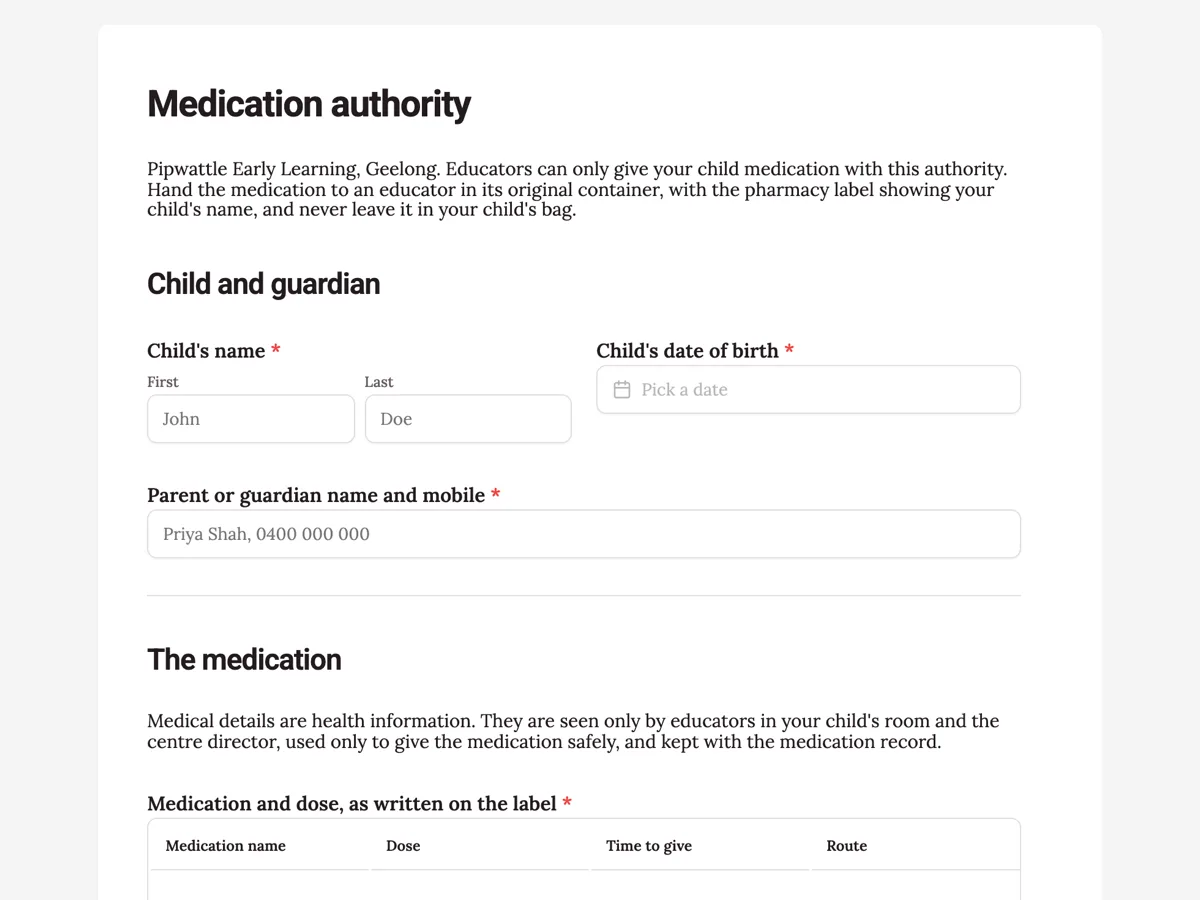
The form itself
A static copy of the finished form, exactly as it renders. Nothing here can be filled in or submitted, so read it as a reference and build your own from the button above.
Every field, and what it collects
The complete field list, in the order respondents meet it.
- Child's nameNameRequired
- Child's date of birthDateRequired
- Parent or guardian name and mobileShort textRequired
- Medication and dose, as written on the labelTableRequired
- Columns: Medication name · Dose · Time to give · Route
- What it is forShort textRequired
- Prescribed byShort text
- Expiry date on the packetDateRequired
- StorageSingle choiceRequired
- Options: Fridge · Room temperature, locked cupboard
- Time of the last dose given at home todayTimeRequired
- Parent or guardian signatureSignatureRequired
Child and guardian
The medication
What each field on this form collects
Child name and date of birth sit side by side, then a short text takes the guardian name and mobile. A privacy paragraph explains who sees the details. The dose table has two rows of medication name, dose, time to give and route, copied from the label. What it is for is a short text with a course length in the placeholder. Prescribed by and expiry date share a row; prescribed by is the one optional field, for medicines bought without a prescription. Storage is a radio of fridge or room temperature in a locked cupboard. A paragraph explains the last dose question, a time field records it, and the guardian signs. Nine of the ten fields are required.
Why the last dose time matters most
Most medication errors in early childhood settings are double doses or missed doses, not wrong medicines. A parent who gave paracetamol at 7 am and an educator who gives it again at 9 am have both followed the label. The time field closes that gap: the educator sees the last home dose before giving the first centre dose. Route is in the table for the same reason. Drops for the ear and drops for the eye can look the same, and the route column says which.
The Australian regulations behind it
The Education and Care Services National Regulations, overseen by ACECQA, require written authorisation from a parent before medication is given to a child, except in an emergency, and a medication record that shows the medicine, dose, how it is given, when it was last given and who gave it. Medication must be in its original container, with a pharmacy label for prescribed medicine, and not past its expiry date, which is why the form asks for expiry. Medical details are sensitive information under the Australian Privacy Principles.
How to adapt this form
An outside school hours care service adds the school class and a self administration question for older children with asthma. A family day care educator adds a line for the medicine being kept at the educator's home. A centre that gives sunscreen under a standing authority drops this form for sunscreen and uses it only for medicines.
What makes this form work
Four columns from the label
Medication name, dose, time to give and route are copied straight from the pharmacy label. Educators compare like with like before every dose.
The last home dose, by the minute
A required time field records when the child last had the medicine at home. The first centre dose is timed from it, which prevents double dosing.
Expiry checked at the door
The required expiry date means an out of date packet is caught when the form arrives. The director can call before the dose is due.
Questions people ask
Does a childcare medication consent form cover a whole course of medicine?
Yes, when the table and the reason say so. A seven day antibiotic course is one authority with the dose and times in the table and the course length in the reason field. A change of dose, or a new medicine, needs a new form, which the welcome screen makes clear by saying one form per medicine.
Can educators give medicine without a doctor's prescription?
Many centres will, with the parent's written authority and the medicine in its original packet, which is why prescribed by is optional. Some centre policies refuse non-prescribed medicine except paracetamol for a fever while waiting for pick up. The centre's own medical conditions policy decides, and the form follows it.
Why does the form ask for the route?
Route is how the medicine goes in: by mouth, in the ear, in the eye, on the skin or inhaled. Liquids, drops and creams can be confused in a busy room, and the label route is what the educator checks. A medication record also needs it, so asking here saves writing it twice.
What happens if the expiry date has passed?
Educators should not give expired medicine, so the director calls the parent to bring a new supply. The required expiry field means the check happens when the form arrives, not at 11 am when the dose is due. The thank-you screen asks parents to hand the medicine over at drop off for the same reason.
Is the parent told each time a dose is given?
The thank-you screen says the parent sees the medication record at pick up, which lists each dose, the time and the educators who gave and checked it. The form itself does not send messages. The record is kept by the centre, separate from this authority.
Build your own in about a minute
The button below opens the generator with this use case already described. Change the wording to match your own, generate, then edit anything you like.
Make one like thisOther form examples
Photo consent form for a childcare centre, one use at a time
A photo consent form records where a child's photo may be used, for how long, and how a parent can withdraw that permission. This one asks Australian childcare families yes or no for four separate uses, whether a first name may appear, and whether there is a safety reason the child must not be identifiable.
Research participant consent form with a withdrawal clause
A research participant consent form has to show that the participant read the information sheet, agreed to each use of their data separately and knew how to withdraw. This one does that for a university sleep study, with three data statements ticked one by one, a recording choice, a dated withdrawal cut off and both participant and researcher signatures.
Dental treatment consent form with item numbers and fees
A dental treatment consent form has to record the procedure, what it will cost, the other options the patient heard, the risks they read and how they will be sedated. This one asks for each in turn, with a four row table for the item numbers and fees from the treatment plan and a signature at the end.
Want the steps in the builder? Read Form builder components, then Control who can fill in your form. For everything this generator can do, see the form maker.
Sources
Written and checked by the OneCraft team. Last checked .