Classic form
PAR Q form online: seven questions, clearance and a signature
A PAR Q form is a short physical activity readiness questionnaire that asks seven yes or no questions to find people who should check with a doctor before exercising more. This one puts the seven questions online for a Pilates studio, then asks about clearance for any yes and takes a dated signature.
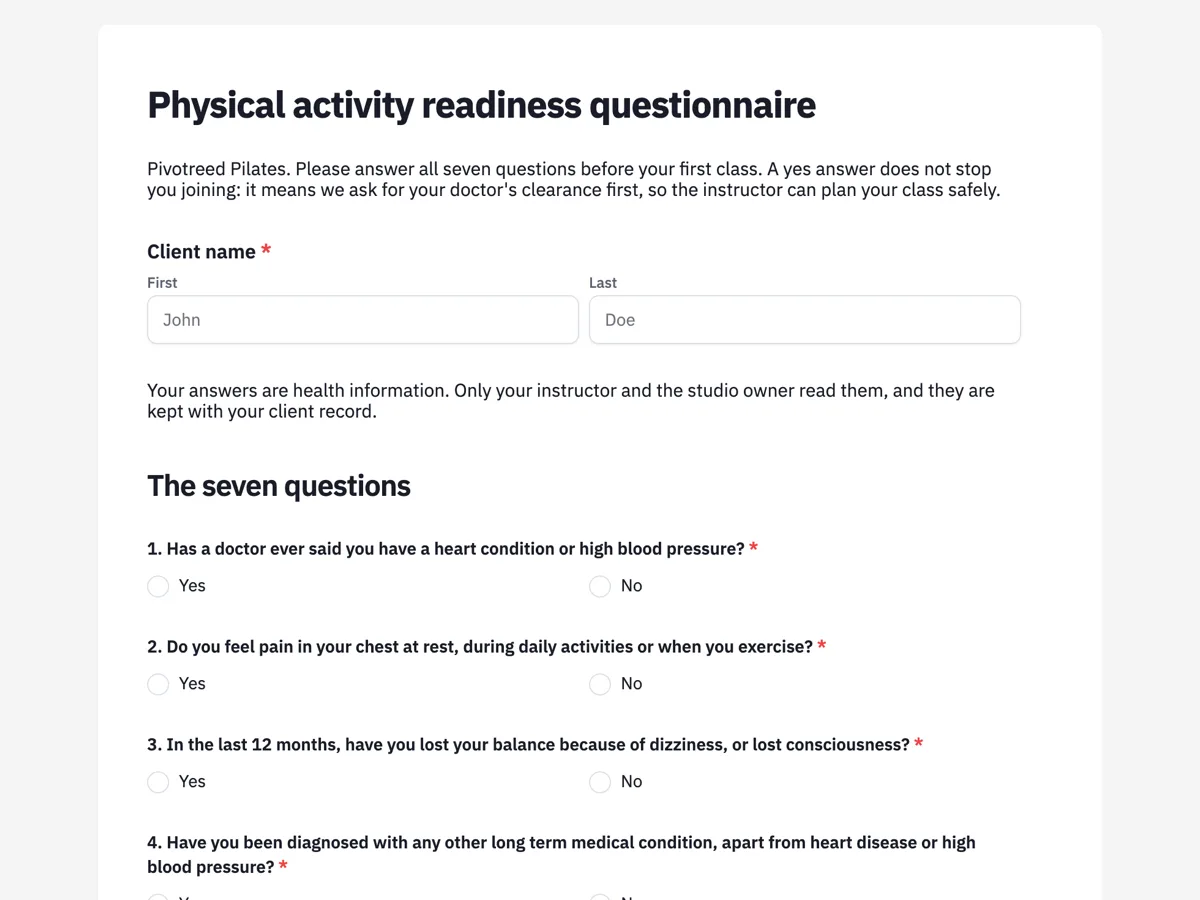
The form itself
A static copy of the finished form, exactly as it renders. Nothing here can be filled in or submitted, so read it as a reference and build your own from the button above.
Every field, and what it collects
The complete field list, in the order respondents meet it.
- Client nameNameRequired
- 1. Has a doctor ever said you have a heart condition or high blood pressure?Single choiceRequired
- Options: Yes · No
- 2. Do you feel pain in your chest at rest, during daily activities or when you exercise?Single choiceRequired
- Options: Yes · No
- 3. In the last 12 months, have you lost your balance because of dizziness, or lost consciousness?Single choiceRequired
- Options: Yes · No
- 4. Have you been diagnosed with any other long term medical condition, apart from heart disease or high blood pressure?Single choiceRequired
- Options: Yes · No
- 5. Are you taking prescribed medication for a long term medical condition?Single choiceRequired
- Options: Yes · No
- 6. Do you have a bone, joint or soft tissue problem that could be made worse by being more active?Single choiceRequired
- Options: Yes · No
- 7. Has a doctor ever said you should only exercise under medical supervision?Single choiceRequired
- Options: Yes · No
- If you answered yes to any question, has your doctor cleared you to exercise?Single choiceRequired
- Options: Yes, I have clearance · Not yet, I will bring it to my first class · I answered no to all seven
- DateDateRequired
- Parent or guardian (under 18s only)Name
- SignatureSignatureRequired
The seven questions
What each field on this form collects
The client's name opens the form, followed by a privacy paragraph. Seven numbered yes or no questions cover a heart condition or high blood pressure, chest pain, dizziness or fainting in the last 12 months, any other long term condition, prescribed medication for it, a bone, joint or soft tissue problem, and a doctor's advice to exercise only under supervision. The clearance radio follows, with an answer for people who said no to all seven. The date, an optional guardian name and the signature close the form. Eleven of the twelve fields are required.
What a yes answer means
A yes is not a refusal. The questionnaire is a screen, built to be oversensitive so that nobody with a real risk slips through. A yes to question 1 or 2 is the most important, because heart conditions and chest pain are where exercise can cause harm. A yes to question 6 usually means an instructor needs to adapt movements, not stop them. The clearance radio turns each yes into one of two clear next steps: the client already has clearance, or brings a doctor's letter to the first class. Many people with managed conditions do Pilates safely once their doctor and instructor know.
Where the seven questions come from
The PAR Q was developed in Canada and has been revised several times; the current version, the PAR Q+, keeps seven general health questions and adds follow up pages for anyone who answers yes. The questions on this form are written in plain words for a studio and follow the same seven themes. Organisations that need the full PAR Q+ follow up, or the adult pre-exercise screening systems used by exercise professionals, can take those from the official sources linked below.
How to adapt this form
A personal trainer adds goals and a training history section after the seven questions. A yoga studio adds pregnancy as its own question with weeks of pregnancy. A school sport program makes the guardian field required and asks for the student's year level.
What makes this form work
Seven separate, required answers
Each readiness question is its own yes or no radio, so a no is recorded as clearly as a yes and nothing can be skipped.
A yes leads somewhere
The clearance radio straight after the seven questions turns any yes into a next step: clearance already held, or a doctor's letter at the first class.
Dated, so it can be renewed
The required date beside the signature shows how old each answer set is, which tells the studio when to send the questionnaire again.
Questions people ask
What does PAR Q stand for?
Physical Activity Readiness Questionnaire. It is a short screening tool that helps decide whether someone should talk to a doctor before becoming much more active. It is not a diagnosis. Most people answer no to every question and can start straight away; a yes means getting advice first, then exercising with the right adjustments.
What should happen if a client answers yes on a PAR Q?
They should get clearance from a doctor or relevant health professional before starting, especially for the heart and chest pain questions. This form asks whether they already have clearance or will bring it. The instructor reads the answers before the first class and plans modifications once clearance arrives.
How often should a PAR Q be completed?
At the start, and again whenever health changes, such as a new diagnosis, medication or injury. Many studios ask for a fresh form every year. Because the form is dated, an instructor can see at a glance how old each client's answers are and send the link again when it is due.
Is a PAR Q enough for older adults?
It works as a first screen for adults of any age, and an older client who answers no to all seven can usually start gently. For people with several conditions or a higher risk, a fuller screen from an exercise professional, such as an exercise physiologist, may be wiser. The PAR Q is a first filter, not a full assessment.
Why are the seven questions separate fields instead of one checkbox?
Because a no matters as much as a yes. A checkbox only records what was ticked, so an empty answer could mean no or could mean skipped. Seven required yes or no questions mean every client has answered every question, which is the point of a readiness screen and what an instructor needs to see.
Can a PAR Q be signed online?
Yes. The signature field takes a drawn or typed signature on a phone or computer, stored with the response and the date. Clients complete it at home before their first class, which gives the instructor time to read it and the client time to get clearance if they answered yes.
Build your own in about a minute
The button below opens the generator with this use case already described. Change the wording to match your own, generate, then edit anything you like.
Make one like thisOther form examples
Laser hair removal consent form with skin type and sun exposure
A laser hair removal consent form records the facts that decide safe laser settings, such as skin type, recent sun and light sensitising medicines, and that the client understands the risks. This one asks twelve questions before the patch test, with all six Fitzpatrick skin types described in plain words.
Surf lesson waiver on swimming ability and ocean conditions
A surf lesson waiver confirms that a surfer can swim, has declared anything that matters in the water and accepts the risks of the ocean before a lesson. This one asks an Australian surf school's students whether they can swim 50 metres unaided, then covers health, experience, conditions, wetsuit size and a guardian for under 18s.
Piercing consent form with an ID check and aftercare
A piercing consent form records who is being pierced, where, with what jewellery, and that the client is old enough, has declared relevant health conditions and has received aftercare instructions. This one, for an Australian studio, adds a photo of photo ID and a guardian signature for clients aged 16 or 17.
Want the steps in the builder? Read Form builder components, then Design your welcome and thank-you screens. For everything this generator can do, see the form maker.
Written and checked by the OneCraft team. Last checked .