Classic form
Workplace incident report form built for the first hour
The first report of an incident is the one the regulator, the insurer and the investigation all rely on, and it is usually written by the most stressed person on site. This form asks for facts in the order they are known, keeps opinion out until the last field, and asks the one question that decides whether the regulator must be told.
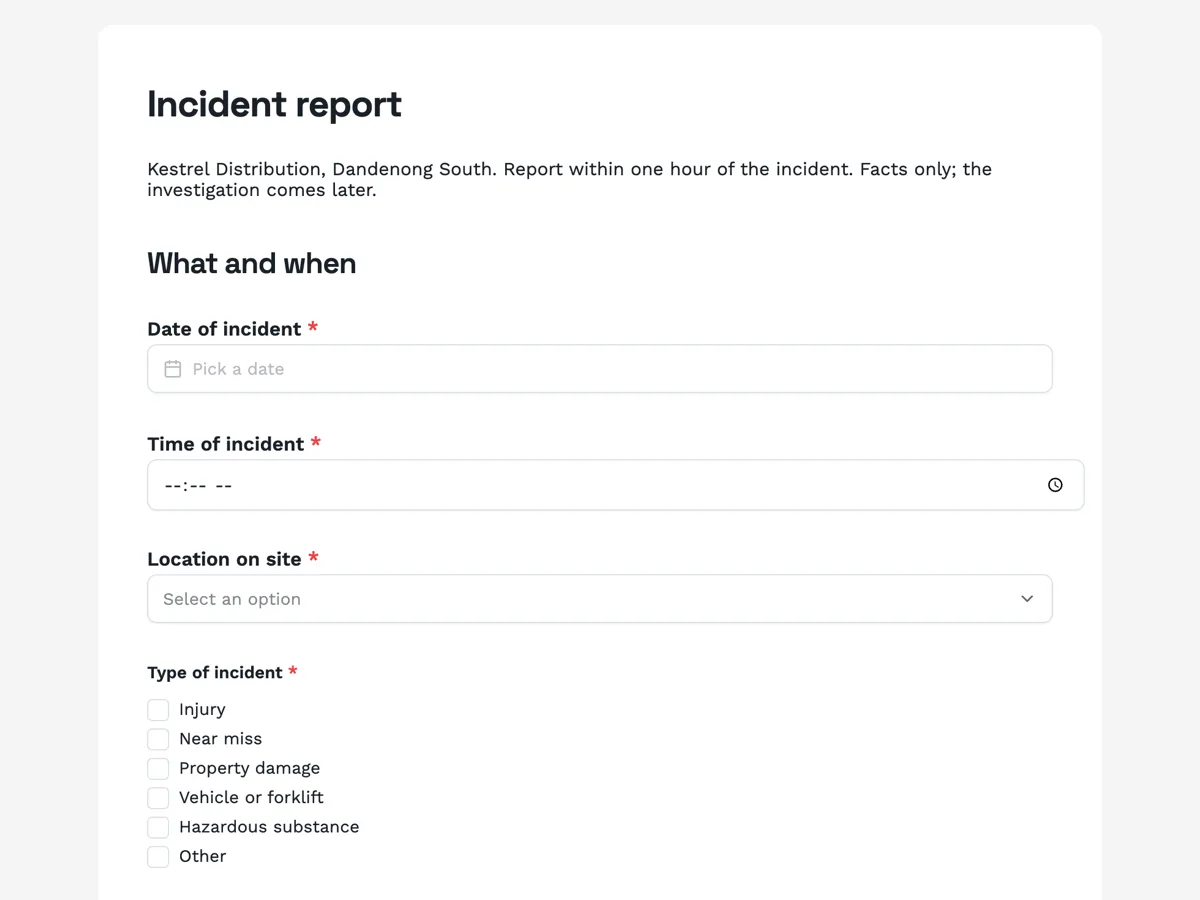
The form itself
A static copy of the finished form, exactly as it renders. Nothing here can be filled in or submitted, so read it as a reference and build your own from the button above.
Every field, and what it collects
The complete field list, in the order respondents meet it.
- Date of incidentDateRequired
- Time of incidentTimeRequired
- Location on siteDropdownRequired
- Options: Loading dock · Racking aisles · Forklift lane · Office · Car park · Yard · Other
- Type of incidentMultiple choiceRequired
- Options: Injury · Near miss · Property damage · Vehicle or forklift · Hazardous substance · Other
- What happenedLong textRequired
- Reported byNameRequired
- Your roleDropdownRequired
- Options: Employee · Contractor · Visitor · Supervisor
- Person injured or involved, if not youShort text
- WitnessesTable
- Columns: Name · Contact · What they saw
- Was anyone injured?Single choiceRequired
- Options: No · Yes, first aid on site · Yes, sent to doctor or hospital · Yes, ambulance called
- Part of body and nature of injuryShort text
- Was this notifiable to the regulator?Single choiceRequired
- Options: Yes · No · Not sure
- Photo of the scenePhoto upload
- One photo of the area as it was when you arrived. Do not move anything to take it.
- More photos or documentsFile upload
- Up to 5 files, images or PDF.
- Immediate actionsMultiple choiceRequired
- Options: Area isolated · First aid given · Supervisor told · Equipment tagged out · Nothing yet
- Reporter signatureSignatureRequired
What and when
People
Injury and treatment
Evidence
Actions taken
When an incident is notifiable
Under the model WHS law there are three categories: a death, a serious injury or illness, and a dangerous incident, the near miss that could have killed someone. Any of the three means the regulator is told immediately by phone, with written notice inside 48 hours, and the incident notification records kept for at least five years. Safe Work Australia’s incident notification guidance and each state regulator, WorkSafe Victoria for this site, spell out the categories. The form does not ask the reporter to make that legal call alone: the three categories are summarised in plain words, Not sure is an accepted answer, and the safety officer confirms.
How to adapt this form
An office version trims the location dropdown to floors and meeting rooms and usually loses the forklift option within the hour. A vehicle fleet version adds registration and third party fields after the location question, and keeps everything else, because a prang is an incident like any other. A school version adds a student and parent block and routes the email alert to the principal as well as first aid. What must not change in any variant: report within the stated window, facts before fault, and a Not sure option on the notifiable question so nobody guesses the law under stress.
What makes this form work
The injury answer triages the report by itself
No, first aid on site, sent to doctor or hospital, ambulance called: the four options map straight onto the seriousness ladder the safety officer thinks in. Read from the email alert alone, that one answer decides whether the next move is a note, a follow up or an immediate call.
The fault instruction is a paragraph, because it has to be
On a published classic form, helper text under most fields is not rendered, so the one instruction that protects the whole report, facts in order, no blame, sits as a paragraph directly above the account field where every reporter reads it before typing.
The scene photo says do not move anything
The photo field is the one classic field whose description renders, and this form spends that single visible instruction on the sentence that preserves evidence: photograph the area as you found it. One photo, framed by that rule, outweighs a page of recollections.
Questions people ask
Who should fill in an incident report?
The person who saw it or was involved, within the hour, while the order of events is still sharp. A supervisor who arrives later files their own report rather than editing the first one, because two accounts written independently are worth more to an investigation than one account written by committee.
Which incidents must be reported to the regulator?
Deaths, serious injuries or illnesses, and dangerous incidents, the three categories in the model WHS Act. The regulator is phoned immediately and written notice follows within 48 hours. The form summarises the categories in a paragraph and lets the reporter answer yes, no or not sure, with the safety officer making the final call.
Should the form ask whose fault it was?
No, and this one instructs the opposite: a paragraph above the account says to describe what happened in order and not to write who was at fault. First reports that assign blame poison investigations and discourage the near miss reports that prevent the next injury. Facts first is the whole design.
How long do incident records need to be kept?
For notifiable incidents, at least five years under the model regulations, and states can add their own record keeping rules on top. The response PDF, with the photo inline and the signature printed into it, is the record you keep; the responses table is where you find it five years later.
Can staff really file this from a phone?
That is what the single column layout is for: every field full width, top to bottom, with the photo taken on the spot by the camera and the signature drawn with a finger. Five minutes standing next to the racking beats a paper form filled in from memory in the lunch room an hour later.
What happens after submit?
An email alert reaches the safety officer with the answers, the response lands in the table with everything the triage needs, and the injury question’s four options tell them at a glance whether this is a bandage, a doctor or a phone call to the regulator. The reporter is contacted within a working day.
Build your own in about a minute
The button below opens the generator with this use case already described. Change the wording to match your own, generate, then edit anything you like.
Make my workplace incident report form built for the first hourOther form examples
Hazard report form short enough to use
Hazards go unreported because the form is longer than the hazard is worth. This one is nine questions, a photo, a four phrase risk rating and a choice of how soon someone has to come, and it is designed to be filled in standing next to the thing.
Contractor registration form for site access and WHS records
A contractor registration is the paperwork that has to exist before a gate opens, and the parts that matter are the ones with a date on them. This form collects the licence class, the supervisor white card number, a SWMS written for this site, three insurance policies with their expiry dates, the plant coming through the gate and a signed acknowledgement of the site rules.
Visitor sign in form that replaces the book on the counter
A paper visitor book shows every visitor the names of every other visitor, and it is useless in a fire drill because it is on the counter. This form sits behind a QR code, takes under a minute, and keeps the rules acknowledgement and the sign in time in one private record.
Want the steps in the builder? Read Form builder components, then Shape the PDF version of your form. For everything this generator can do, see the form maker.
Written and checked by the OneCraft team. Last checked .