Classic form
Budget request form with a cost breakdown and outcomes
A budget request form makes the case for money: how much, what it buys, what it achieves and why it beats the alternatives. This one does that for a council program bid, with a five line cost breakdown, start and end dates for the funding, measurable outcomes and a required answer on what doing nothing would mean.
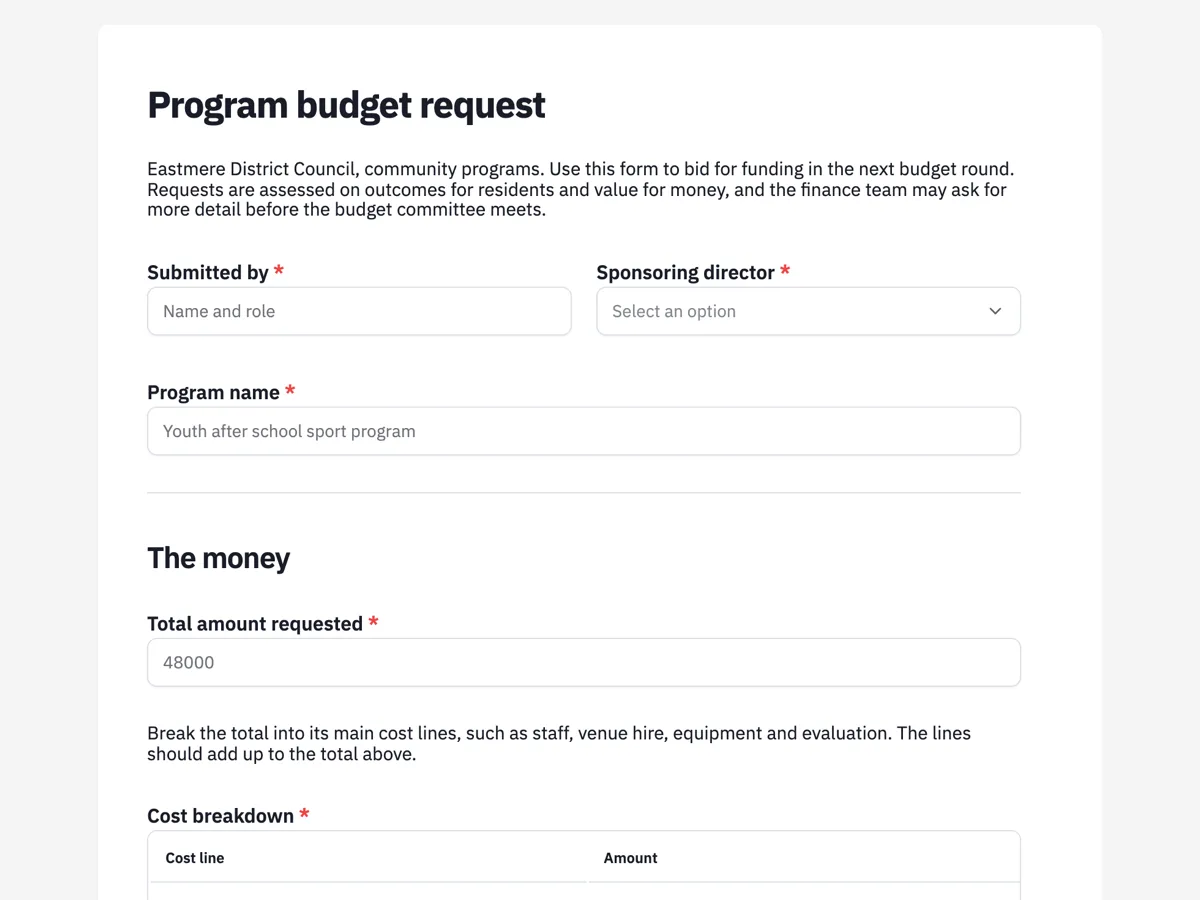
The form itself
A static copy of the finished form, exactly as it renders. Nothing here can be filled in or submitted, so read it as a reference and build your own from the button above.
Every field, and what it collects
The complete field list, in the order respondents meet it.
- Submitted byShort textRequired
- Sponsoring directorDropdownRequired
- Options: Director, Community Services · Director, Environment and Infrastructure · Director, Corporate Services
- Program nameShort textRequired
- Total amount requestedNumberRequired
- Cost breakdownTableRequired
- Columns: Cost line · Amount
- Funding startsDateRequired
- Funding endsDateRequired
- Outcomes: what will be different for residents, and how will you measure it?Long textRequired
- Alternatives considered, including doing nothingLong textRequired
The money
The case
What each field on this form collects
Submitted by sits beside the sponsoring director, a dropdown of three. Program name follows. Total amount requested is a number. A paragraph asks for the main cost lines, then the cost breakdown table has five rows of cost line and amount. Funding starts and funding ends share a row. Outcomes asks what will change for residents and how it will be measured, and alternatives asks for each option including doing nothing. All nine fields are required.
Why doing nothing is an alternative
Every budget bid competes with every other bid and with the option of spending nothing. Asking the requester to describe doing nothing makes them say what is lost if the program is not funded, which is the strongest part of most cases and the part most often left out. It also gives the committee a fair comparison. A request whose doing nothing answer is nothing much happens is easy to defer, and the form makes that visible early.
Measurable outcomes, not activities
Public sector appraisal guidance, such as HM Treasury's Green Book, asks for the options, the costs and the benefits to be set out so they can be compared, and Managing Public Money sets the expectation that funds are spent on what they were approved for. The outcomes placeholder shows the difference between an activity, running weekly sessions, and an outcome, 120 young people attending, measured by records. The form does not add up the breakdown; the paragraph asks that the lines match the total, and finance checks it.
How to adapt this form
A charity uses it for internal grant rounds and swaps the directors for program managers. A school adds the curriculum area and the number of students. A company adds a payback period and a cost centre, and turns on paginated layout so the case reads as a second step.
What makes this form work
Doing nothing is a required answer
The alternatives question names doing nothing. Every bid states what is lost without funding, which is what the committee weighs.
Outcomes with a measure
The placeholder pairs a number of young people with how attendance is counted. Requesters write outcomes, not activities.
Start and end dates for the money
Two dates bound the funding period. Finance sees whether a request is one year or three before reading the case.
Questions people ask
What should a budget request include?
The amount, what it pays for line by line, the period it covers, the result it will achieve and how that will be measured, and the alternatives. This form asks each as its own required field. A sponsor is named too, because a bid without a senior owner rarely survives the committee.
Does the form check that the breakdown adds up?
No. The form records the total and the lines as typed, and the paragraph asks that they match. Finance checks the sum when it reviews the request. Keeping the arithmetic with finance avoids a form that looks correct but hides a wrong formula.
Why five lines in the cost breakdown?
Five covers the usual cost groups for a program, such as staff, venue, equipment, materials and evaluation, without inviting a 30 line spreadsheet. A table shows a fixed number of rows. Requesters with more detail group their costs into five lines and keep the full workings for finance questions.
Why must a sponsoring director be named?
The sponsor presents the bid to the budget committee and answers for it if it is funded. Naming one on the form means the request has senior support before finance spends time on it. The dropdown lists the three directors so a request cannot be sent without one.
Can the request be saved and finished later?
No. Nothing is stored until the form is submitted, so the requester should have the cost lines and outcomes ready before starting. The welcome screen says to have the cost lines ready. Drafting the two long answers in a document first and pasting them in works well.
How is a budget request assessed?
The intro says outcomes for residents and value for money. Finance reads the breakdown against the total, the committee reads the outcomes against the cost, and the alternatives answer shows whether a cheaper option was ruled out for a good reason. A request with a measurable outcome and an honest doing nothing answer usually goes furthest.
Build your own in about a minute
The button below opens the generator with this use case already described. Change the wording to match your own, generate, then edit anything you like.
Make one like thisOther form examples
Purchase requisition form with line items and an approver
A purchase requisition form asks permission to buy before anyone orders: what is needed, what it costs, which budget pays and who signs off. This one lists the items in a four line table with unit cost and supplier, takes the total and budget code, and lets the requester pick the approver by spend limit.
Change request form with an impact table
A change request form records a proposed change to a project and what it does to scope, time and cost, so someone can decide before the work starts. This one puts the impact in a four row table with days and cost per area and leaves the decision and notes at the end for the project board.
Travel request form with itinerary and estimate
A travel request form gets a work trip approved before anything is booked: why the trip is needed, the route, what it will cost and who signs off. This one sets the route out as a four leg itinerary table and puts the estimate, cash advance and travel policy tick on the same page as the manager who approves it.
Want the steps in the builder? Read Form builder components, then Paginate a classic form into steps. For everything this generator can do, see the form maker.
Written and checked by the OneCraft team. Last checked .