Conversational form
Demo request form
A demo request form that opens with company size and budget is asking the buyer to qualify themselves before they have any reason to. This one takes the three contact fields first, then spends five questions working out who should run the session and what to actually show. It is conversational, one question per screen, because a booking form on a phone is finished when nothing on screen looks like work.
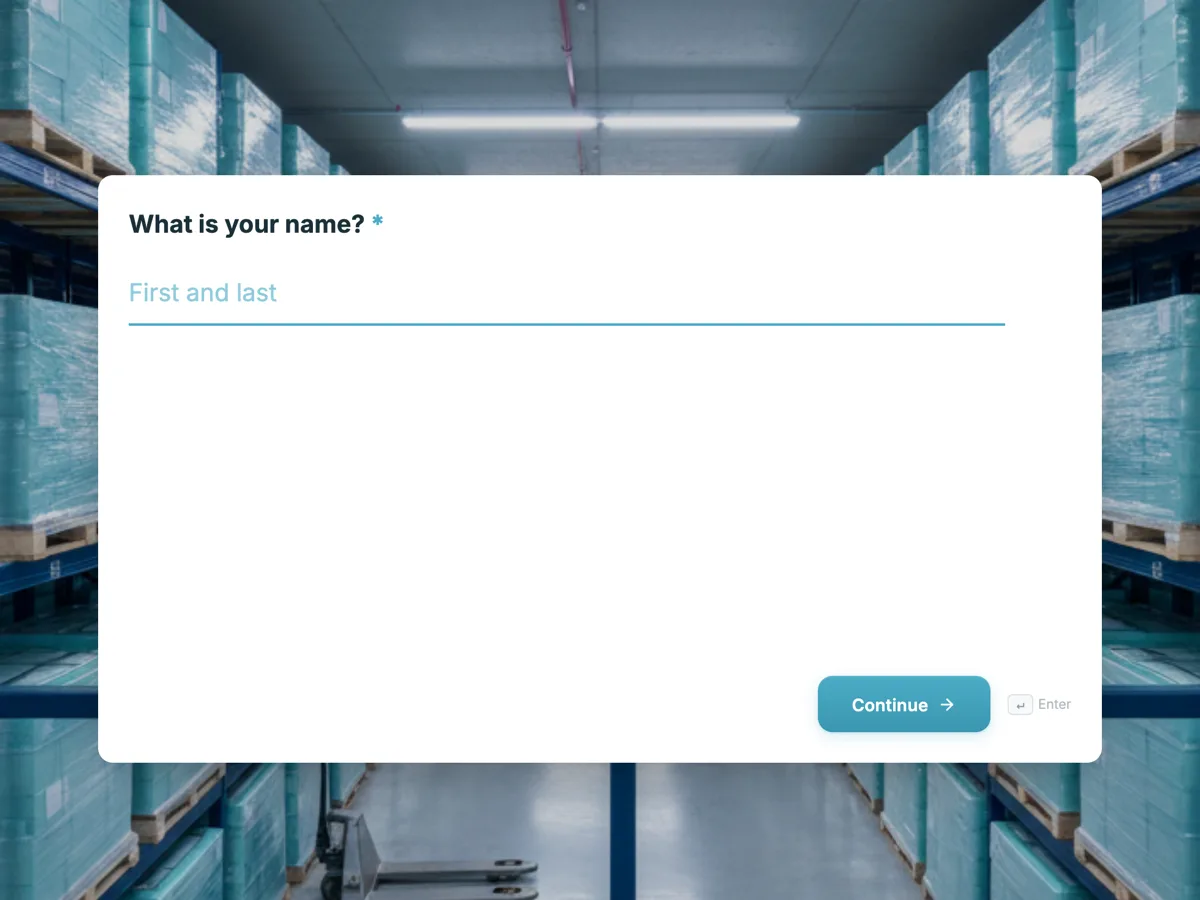
The form itself
The first screen of the form. A conversational form shows one question per screen, so the remaining screens are listed in the field table below. Nothing here can be filled in or submitted, so read it as a reference and build your own from the button above.
Every field, and what it collects
The complete field list, in the order respondents meet it.
- What is your name?Short textRequired
- What is your work email?Short textRequired
- We send the times to this address. A personal address is fine, it just means we cannot tell which company you are from and the session is more generic.
- Which company?Short textRequired
- What is your part in this?DropdownRequired
- It decides who runs the session. An operations manager gets somebody who has run a pick face; a technology lead gets somebody who can talk about the integration.
- Options: I run the warehouse or the floor · I run operations across sites · Technology or systems · Finance or procurement · Owner or executive · I am researching it for somebody else
- How many people work in the warehouse?DropdownRequired
- Options: Fewer than 10 · 10 to 30 · 30 to 100 · 100 to 400 · More than 400 · Several sites, varies
- What are you running today?DropdownRequired
- There is no wrong answer, and spreadsheets is the most common one. It tells us what to compare against instead of guessing.
- Options: Spreadsheets and paper · The warehouse module of an accounting system · A dedicated warehouse system we have outgrown · Something built in house · Nothing, we are opening a new site
- What would you like to see?Multiple choiceRequired
- Pick two or three. Forty minutes covers about that much properly, and a demo that tries to cover everything shows nothing.
- Options: Receiving and putaway · Pick, pack and dispatch · Stocktake and cycle counting · Barcode scanning on the floor · Reporting for the people who never enter the warehouse · How it connects to our accounting system · What the first month of setting it up looks like · Pricing, in detail
- How soon are you deciding?Single choiceRequired
- Options: This month · This quarter · Within six months · No date, I am building a picture
- Who else should be on the call?Single choiceRequired
- We will ask for their addresses in the reply. Getting the right people on the first call is the difference between one demo and three.
- Options: Just me · Me and one colleague · A small group, three or four of us · I want to see it alone first, then bring others
- Is there anything specific you want answered?Long text
What makes this form work
The role question says what it changes
Six options, and help text explaining that an operations manager gets somebody who has run a pick face while a technology lead gets somebody who can talk about the integration. People answer routing questions honestly once they can see the routing.
It caps what the demo covers, in the form
Pick two or three, because forty minutes covers about that much properly. Saying so in the field description sets the expectation before the call rather than in the first five minutes of it, and it produces a shortlist rather than every box ticked.
"Spreadsheets and paper" is the first option, not the last
The current tooling question leads with the honest answer and says there is no wrong one. Buried at the bottom under a list of named competitors, that option gets skipped, and a demo built on the wrong assumption about what somebody is replacing lands badly.
Questions people ask
Which questions actually change what happens after a demo request?
Four: the person's role, the size of the operation, what they are using now, and when they are deciding. Those decide who runs the call and what gets shown. Anything else is enrichment you can look up yourself, and public service design guidance is blunt about it: if you cannot say what you need a field for and how you will use it, delete the field.
Why ask for the contact details before the qualifying questions?
Because the first screens should be the ones the person came to fill in. The qualifiers are for you, not for them, so they belong after the commitment rather than in front of it. It is the same reasoning behind deferring secondary options to a later step: put the thing the user came for first and the detail behind it.
Does a conversational form work for a booking?
For ten short questions, yes. The progress bar shows how much is left, each screen carries the question, its help text and one control, and the whole thing works with a thumb. What it cannot do is take a payment or hold a calendar slot, so this form ends by promising two times in a reply rather than pretending to book one.
Should the form ask for a phone number?
Only if somebody is genuinely going to ring. This one does not, because the reply is two time slots in an email and a phone field would be a required box collected for nothing. A field you collect and never use costs you completions and gives you an obligation to store it.
Should a demo form ask what the buyer is running today?
Yes, because it changes who takes the call. This form asks what you are running today straight after the warehouse size. A prospect on spreadsheets needs a different demo from one migrating off a competitor, and knowing which before the call is the difference between a tailored thirty minutes and a generic product tour.
Is asking about timing pushy on a demo request?
Not when it is phrased as a decision rather than a purchase. This form asks how soon you are deciding, which a buyer can answer honestly without committing to anything. The answer sets the follow up cadence, so somebody looking six months out is not chased weekly and somebody deciding this month is not left waiting.
Build your own in about a minute
The button below opens the generator with this use case already described. Change the wording to match your own, generate, then edit anything you like.
Make one like thisOther form examples
Request a quote form
Most quote request forms collect a name, a phone number and the sentence "I need a fence", which guarantees a call, then a visit, then a price. This one asks for the four things that actually let a trade put a number on a job: a measured run, a photo down the whole line, the ground conditions and a budget band. It is a classic form, because the photo field and the measurement have to be visible together while somebody stands at the job.
Event sponsorship enquiry form
A sponsorship enquiry is not a booking, it is the two minutes that decide which pack gets sent. This one asks the three things a partnerships team has to guess at otherwise: roughly what the budget is, what the sponsor actually wants, and when they have to decide. It is conversational, one question per screen, because an enquiry is a conversation and nine boxes at once reads as a credit check.
Lead capture form
A lead capture form has one job: find out quickly whether there is anything here for either side. This one asks nine questions, three of which are the contact details and five of which are genuine qualifiers, and it tells people outright what spend level makes the numbers work rather than booking a visit to break the news. It is conversational, because a short qualifying form that shows one question at a time gets finished on a phone.
Want the steps in the builder? Read Create a conversational form with AI, then Control who can fill in your form. For everything this generator can do, see the form maker.
Written and checked by the OneCraft team. Last checked .