Classic form
Equipment request form
An equipment request that only says "I need a new laptop" costs two more emails before anybody can act on it. This one asks for a rough price per line so the approver knows whether it is theirs to sign, takes a photo of the fault when something is being replaced, and puts the asset return terms on the page before the request is sent rather than in a policy nobody opened. It is a classic form, because the photo field and the item table have to sit beside each other.
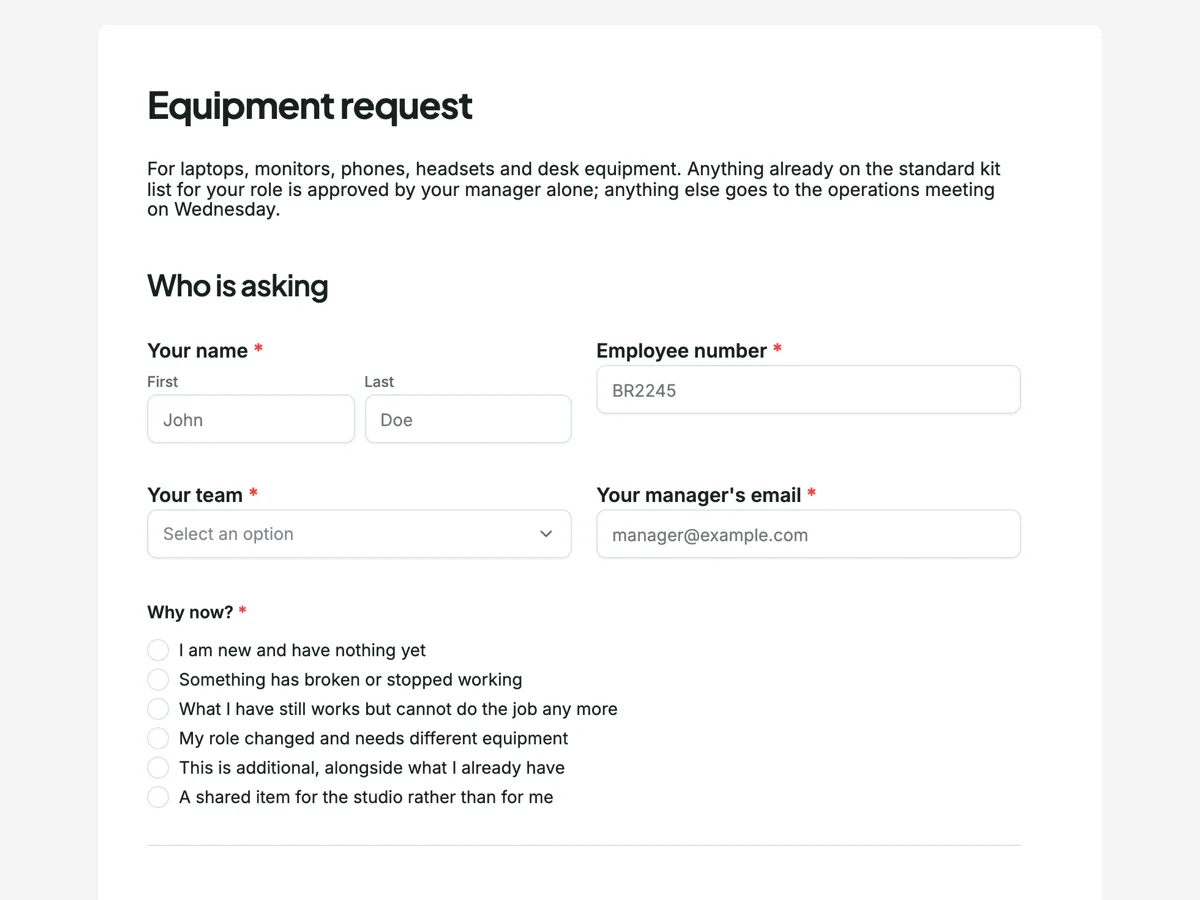
The form itself
A static copy of the finished form, exactly as it renders. Nothing here can be filled in or submitted, so read it as a reference and build your own from the button above.
Every field, and what it collects
The complete field list, in the order respondents meet it.
- Your nameNameRequired
- Employee numberShort textRequired
- Your teamDropdownRequired
- Options: Design · Motion · Production · Client services · Studio operations · Finance
- Your manager's emailShort textRequired
- Why now?Single choiceRequired
- Options: I am new and have nothing yet · Something has broken or stopped working · What I have still works but cannot do the job any more · My role changed and needs different equipment · This is additional, alongside what I already have · A shared item for the studio rather than for me
- ItemsTable
- Columns: Item · Specification or model · How many · Rough cost each
- Rough total for everything aboveNumberRequired
- Cost centre it belongs toDropdownRequired
- Options: Studio overhead · A named client project · New starter setup · Capital replacement programme · Not sure, please decide
- What are you trying to do that your current setup cannot?Long textRequired
- Asset tag of the item being replacedShort text
- What should happen to it?Single choice
- Options: Return it to the studio · Keep it as a spare, on the register · It is beyond repair · It has been lost or stolen
- Photo of the faultPhoto upload
- One photo, taken in decent light, close enough that the fault is actually visible. A cracked hinge, a dead pixel band, a swollen battery lifting the case. This is the field that turns "it is broken" into a repair or a warranty claim, and a photo of a closed laptop lid proves nothing.
- DeliverySingle choiceRequired
- Options: The studio, and I will collect it · The studio, and hold it at reception · To my home address below
- Home address, only if you chose home deliveryAddress
- Date you need it byDate
- Is that a hard date?Single choiceRequired
- Options: No, it is a preference · Yes, a client shoot · Yes, a new starter's first day
- I understandMultiple choiceRequired
- Options: This equipment stays studio property and returns when I leave · It will be tagged and added to the register on arrival · I will report damage or loss the same week rather than at the next audit · Software installed on it follows the studio licence policy
Who is asking
What you are asking for
If this replaces something
Where it should go
Before you send it
What makes this form work
The cost sits next to the item, not at the end
A price column per row plus one rough total. An approver can see at a glance which line is the expensive one, and a request that turns out to be a four hundred dollar monitor and a nine hundred dollar chair gets split rather than refused wholesale.
Replacement is treated as an asset movement
The old item has an asset tag field and four honest options for its fate, including lost or stolen. Equipment goes missing from registers because forms only ever record what arrives, never what left, and this one asks both in the same breath.
The return terms are read before the request, not after the resignation
Four acknowledgements covering ownership, tagging, reporting damage and software licensing, placed above the submit button. The awkward conversation on somebody's last day happens because nobody ever put those four lines in front of them at the moment they wanted something.
Questions people ask
Why ask for a rough cost rather than a real quote?
Because the number is being used to route the request, not to buy anything. An approver needs to know whether this is inside their own limit or heading for a group decision, and that is answered by an order of magnitude. Asking for a real quote pushes work onto the requester and produces a stale figure by the time purchasing gets to it.
Does the photo field really help?
It is the difference between a repair and a shrug. A photo upload and a file upload are the only two classic fields whose description a respondent actually sees, so this is one of the few places you can tell somebody how to take a useful shot. The photo field takes a single image by design, which suits one clear picture of one fault.
What happens to the address field when somebody picks studio delivery?
It stays visible and empty. A classic form has no conditional logic, so every field is shown to everyone, which is why the label says "only if you chose home delivery". Writing the condition into the label is the honest way to handle it, and it beats a form that silently collects home addresses from people who did not need to give one.
How does the item table come back?
As one column in the export holding the filled rows as JSON, rather than four spreadsheet columns. In the responses table it reads cleanly enough for one request. If you are aggregating a quarter of equipment spend, that column needs parsing, and the rough total field is there partly so a human number exists alongside it.
Should an equipment request capture manager approval on the form?
Capture the manager, not the approval. This form asks for the manager email in the first section so the request routes correctly, and leaves the actual sign off to whatever your finance process already uses. A checkbox saying my manager approved this proves nothing, and it puts the requester in the position of speaking for somebody else.
Why ask whether the date is a hard date?
Because every request has a date and most of them are hopeful. This form asks for the date it is needed by, then asks whether that date is hard. The second answer is what lets a procurement team sequence twenty requests sensibly instead of treating a new starter start date and a nice to have as equally urgent.
Build your own in about a minute
The button below opens the generator with this use case already described. Change the wording to match your own, generate, then edit anything you like.
Make one like thisOther form examples
Staff induction form
An induction record is only worth having if it says what somebody was actually shown. This checklist is written to be filled in while walking the site, with each safety line phrased as a place they stood rather than a document they were sent, and the licences and equipment recorded in tables with tags and expiry dates. It ends with both people signing, and it is written for an Australian worksite. Classic, because an inductor working from a tablet on the floor needs to see every section at once and come back to the ones not yet done.
IT access request form
Access requests go wrong quietly. Somebody asks for the same access as a colleague, gets it, changes team, and keeps it for four years. This form asks for one line per system with the level and an end date beside it, makes anything elevated justify itself in writing, and forces a review date and a named owner for that review. It is a classic form, because an approver needs the whole request in one view before signing it.
Self assessment form
A self assessment collapses when it is written the night before the meeting and asks for a rating first. This one asks for the record before the reflection, gives the misses their own question, and ends on the one thing a manager can act on immediately. It is a conversational form, asked one question per screen, because written answers get longer when nothing else is on the page competing for the box.
Want the steps in the builder? Read Every form field and when to use it, then View, export and manage your responses. For everything this generator can do, see the form maker.
Written and checked by the OneCraft team. Last checked .