Conversational form
Self assessment form
A self assessment collapses when it is written the night before the meeting and asks for a rating first. This one asks for the record before the reflection, gives the misses their own question, and ends on the one thing a manager can act on immediately. It is a conversational form, asked one question per screen, because written answers get longer when nothing else is on the page competing for the box.
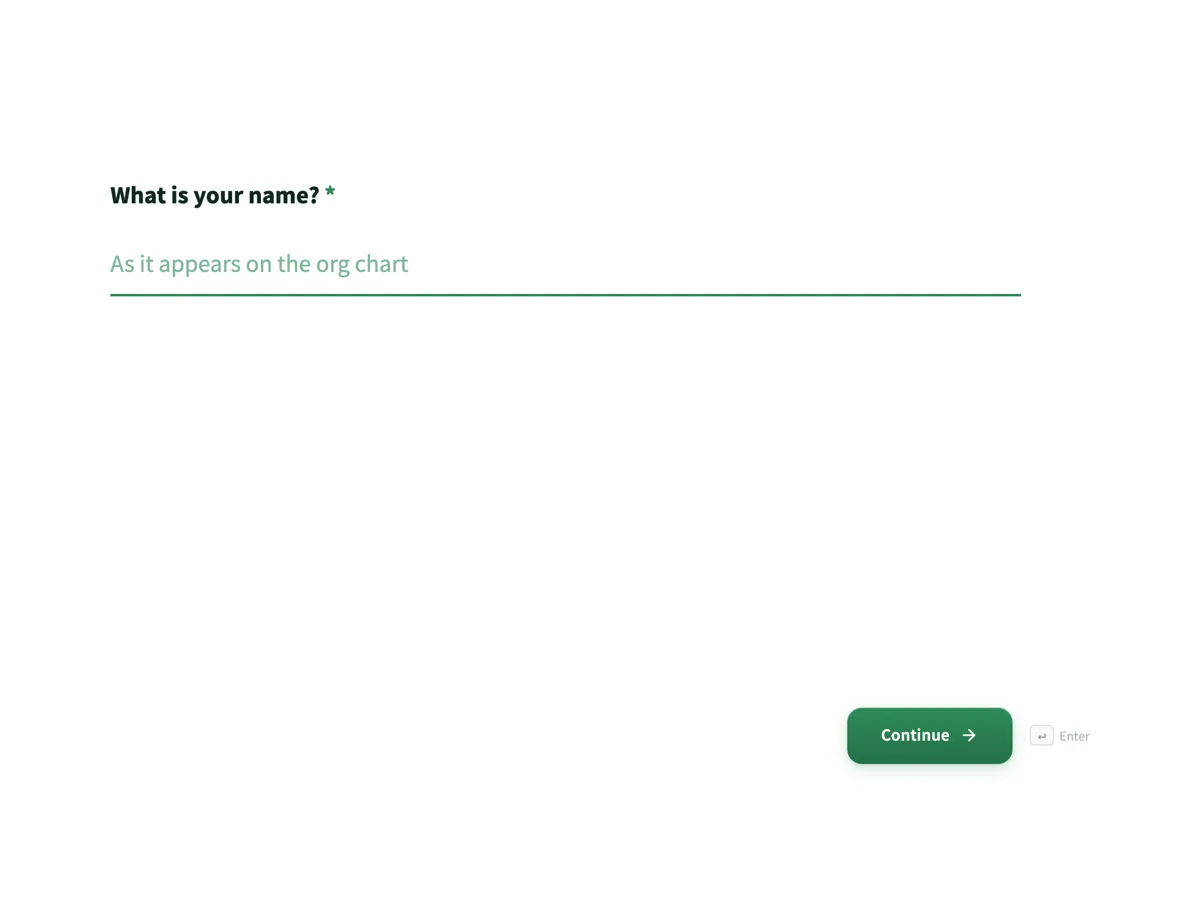
The form itself
The first screen of the form. A conversational form shows one question per screen, so the remaining screens are listed in the field table below. Nothing here can be filled in or submitted, so read it as a reference and build your own from the button above.
Every field, and what it collects
The complete field list, in the order respondents meet it.
- What is your name?Short textRequired
- What is your role, and which team are you in?Short textRequired
- If your title and your actual job have drifted apart, write both. That gap is often the most useful thing on the page.
- Which period are you writing about?DropdownRequired
- Options: The six months to 30 June · The six months to 31 December · My first ninety days · A full year · A period that does not fit these, described below
- What did you actually deliver in this period?Long textRequired
- Start with the record rather than the reflection. Nobody remembers March by the time December arrives, and a manager reviewing six people remembers less than you do.
- Which single piece of it are you proudest of, and why that one?Long textRequired
- What did not go the way you wanted?Long textRequired
- This is the question that changes how the rest is read. An assessment with no misses in it is not modest, it is unfinished.
- How would you rate your own performance overall?Single choiceRequired
- Published research on self ratings finds people cluster above the middle, and that the people furthest from accurate are the ones with least experience of the work. Pick the box you would defend with the evidence you just wrote.
- Options: Below what I expected of myself · About what I expected · Better than I expected in parts, ordinary in others · Clearly ahead of what the role asked for
- Which of these did you carry this period, on top of your own work?Multiple choice
- The invisible half of a job. It rarely appears in an objective and it is most of what a team runs on.
- Options: Mentored or onboarded somebody · Sat on interview panels · Carried an on call roster · Wrote or rewrote documentation other people use · Took over work when somebody left or was away · Ran a process nobody owned · Represented the team outside it
- What is getting in your way?Long text
- Answered well, this is the only line in a self assessment your manager can act on the same week.
- What do you want to be doing in twelve months that you are not doing now?Long textRequired
- What would help you get there?Multiple choiceRequired
- Options: A project with more scope than I have now · Time set aside for a formal course or certification · A mentor outside my own team · Conference or industry time · Shadowing somebody in a different role · Fewer things at once, so I can finish them properly · Clearer feedback more often than twice a year
- Is there anything your manager has not seen?Long text
- A manager sees a slice of what you do, and this is the only question in the form that fills the rest in.
- How confident are you that your manager knows what you actually worked on?Single choiceRequired
- It is not a trick question. A low answer here is a prompt to spend the meeting on the record rather than on the rating.
- Options: Completely, we talk about it constantly · Mostly, with a couple of gaps I have filled in above · Only the headline projects · Not really, and that is part of what I want to change
Question banks built on this form
What makes this form work
The record comes before the reflection
Question four asks what actually shipped, closed or stopped being a problem, with a number where there is one. Everything after it has something to lean on. Assessments that open with "how do you think you went" produce a paragraph of mood and no evidence.
The misses get a question of their own
A dedicated field for what did not work, with a line saying a blank answer reads worse than an honest one. It removes the guesswork about whether admitting something is safe, and it is the answer that makes a manager trust the rest of the page.
It counts the work that never reaches an objective
Mentoring, on call, interview panels, documentation, covering for somebody who left. Seven checkboxes for the load that keeps a team upright and never appears in a goal, so it is on the page when the conversation happens.
Questions people ask
Should a self assessment ask for a rating?
Yes, but after the evidence and not before it. Ratings written first become the thing the rest of the answers are bent to justify. Here the four point scale is the seventh question, so the person picking a box has already written down what they delivered and what missed, and the box has something behind it.
Why one question per screen instead of a single page?
Because six of the thirteen questions want a paragraph. A full page of empty text areas reads as homework and gets one line each. A conversational form shows the question, the help text under it and one box, and the answers come back noticeably longer. It also renders the field description, which a classic form does not.
Can somebody save this and come back to it?
No. A published form is filled in one sitting and there is no draft or resume link, so a twenty minute form is worth saying twenty minutes on the welcome screen. For a long written assessment, people usually draft the paragraphs somewhere else and paste them in, which is fine and worth suggesting when you share the link.
Does the manager see this before or after they write their own review?
That is a policy choice, not a form setting. This one is worded on the assumption the self assessment is read first, which is the order that makes the meeting a conversation. Whichever order you pick, say it on the welcome screen, because people write differently when they think their words arrive after the decision.
Why ask what is getting in your way?
Because it is the only question on the form a manager can act on immediately. This one sits after the rating and before the twelve month question. Answers tend to name a tool, a dependency or a meeting load rather than a person, and fixing one of those often does more for the next period than any development plan.
Should a self assessment ask what somebody carried on top of their own work?
Yes, because that work is invisible in every objective list. This form asks which of a set of extras you carried, things like onboarding, on call and interviewing. Those are the tasks a manager forgets when writing a review, and they are usually done by the same two people every period.
Build your own in about a minute
The button below opens the generator with this use case already described. Change the wording to match your own, generate, then edit anything you like.
Make one like thisOther form examples
Performance review form
Most review forms fail in the same place: the objectives from last period are nowhere on the page, so the rating gets argued from memory. This one puts them in a table with the measure beside them, keeps the behaviour grid to six statements with a "not seen" column, allows exactly one rating, and gives the employee a box to disagree in writing. It is a classic form, because a manager writing it up needs the whole record visible at once.
Workplace incident report form built for the first hour
The first report of an incident is the one the regulator, the insurer and the investigation all rely on, and it is usually written by the most stressed person on site. This form asks for facts in the order they are known, keeps opinion out until the last field, and asks the one question that decides whether the regulator must be told.
Rental application form
A rental application form template collects the property and offer, the applicant's identity, their current and previous address, employment and income, references and signed consent to screening. This one is a residential application, one per adult, that takes about ten minutes with identification and payslips to hand. It covers occupants and pets, agent contacts, an employment table, a proof of income upload, two non family references, and a signed consent to a tenancy database and credit check.
Want the steps in the builder? Read Create a conversational form with AI, then Classic or conversational, and when to use each. For everything this generator can do, see the form maker.
Written and checked by the OneCraft team. Last checked .