Classic form
Fundraiser order form with the seller name and line totals
A fundraiser order form has to record who sold the order as well as what was bought, because product drives reward sellers and track each family's total. This one asks the swimmer first, takes the items in a five row table with quantity and line total columns, then the buyer, handover and payment.
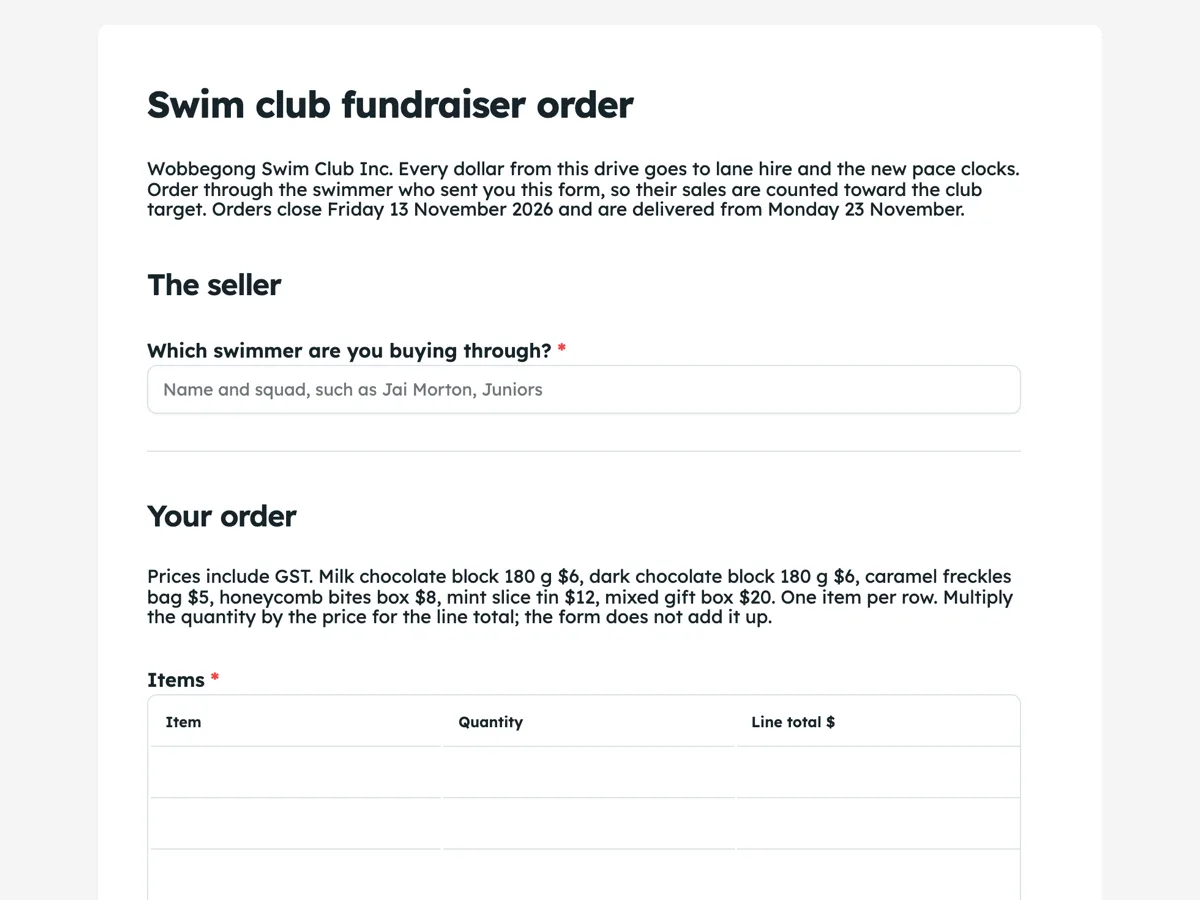
The form itself
A static copy of the finished form, exactly as it renders. Nothing here can be filled in or submitted, so read it as a reference and build your own from the button above.
Every field, and what it collects
The complete field list, in the order respondents meet it.
- Which swimmer are you buying through?Short textRequired
- ItemsTableRequired
- Columns: Item · Quantity · Line total $
- Your nameShort textRequired
- MobileShort textRequired
- How do you want it?Single choiceRequired
- Options: From the swimmer, at school or training · Collect from the club canteen · Delivered within 5 km of the pool
- How will you pay?Single choiceRequired
- Options: Cash to the swimmer · Bank transfer to the club · Card at the club canteen
- Anything else?Long text
The seller
Your order
You
What each field on this form collects
The seller question comes first: which swimmer the buyer is ordering through, a required short text with a placeholder showing name and squad. A paragraph lists six products with GST inclusive prices and says the form does not add up totals. Items is a required five row table with item, quantity and line total columns. The buyer's name and mobile sit side by side. How do you want it is a radio of three, from the swimmer, at the club canteen, or delivered within 5 km, beside how will you pay, a radio of cash to the swimmer, bank transfer or card at the canteen. An optional note takes a gift message or a delivery address. Six of the seven fields are required.
Why the seller comes before the items
Product drives run on families competing to sell, and many clubs give a prize or a fee discount to the top sellers. If the seller is the last question, buyers skip it or write the parent's name instead of the swimmer's. Asking it first, with the squad in the placeholder, ties every order to a swimmer from the start. The club export then sorts by that column to give each family a pick list and a total owed. The line total column serves the same count: the buyer does the multiplication once, and the treasurer checks it against the payment.
Australian terms behind the form
Prices are stated GST inclusive, which is how Australian consumer prices must be shown. The club is an incorporated association, shown by Inc. after its name. Raising money from the public is regulated by the states, and Consumer Affairs Victoria, for example, sets out when a club needs to register a fundraising appeal. A not for profit club that is also a registered charity reports its fundraising to the Australian Charities and Not-for-profits Commission.
How to adapt this form
A school running a cookie dough drive adds a class column for the seller and a pickup day. A club selling raffle tickets with the chocolate adds the ticket numbers sold to each buyer. A scout group delivering door to door drops the delivery radio and adds the street the seller covered.
What makes this form work
The seller is the first question
Which swimmer are you buying through comes before any product, with name and squad in the placeholder. Every order is counted toward the right family and reaches the right kit bag.
Line totals are the buyer's job
The items table has item, quantity and line total columns, and the paragraph says the form does not add up. The buyer does the sum once and the treasurer checks it at handover.
Handover and payment sit side by side
Three handover options beside three payment methods let the club pair them up, cash to the swimmer at training or card at the canteen, without a follow up message.
Questions people ask
Why does a fundraiser order form ask for the seller?
Because the club needs to know which family sold each order, both to hand the products to the right person and to count sales toward any prize or target. Placing the seller question first, before the items, makes it hard to skip. The response export can then be sorted by seller into one pick list per family.
Can the form add up the order total?
No. The form records answers and does not calculate. That is why the items table has a line total column for the buyer to fill in, and the paragraph above it says the form does not add it up. The club treasurer checks the line totals against the payment when the order is handed over.
Should fundraiser prices include GST?
In Australia, prices shown to consumers must include any GST that applies, so the paragraph says all prices include GST. Whether the club charges GST at all depends on its registration and turnover. A small club that is not registered for GST still states the full price the buyer pays.
Does a sports club need a permit to run a chocolate drive?
Rules vary by state. Some states require registration for fundraising appeals to the public, with exemptions for small or member based activities. A club should check its state's consumer affairs or fair trading guidance before the drive starts. The form itself is the same either way; only the intro wording may change.
Why is delivery limited to 5 km?
Volunteers deliver, and a radius keeps the delivery runs short enough for one afternoon. Naming the distance in the option stops a buyer across town choosing delivery and waiting. Anyone outside it collects from the swimmer or the club canteen, which most buyers do anyway because they know the family selling.
How many items can one buyer order?
The table has five rows, one per product, and the quantity column has no limit. Five rows match the six product range closely enough for nearly every order. A buyer ordering all six products writes two in one row. A table renders a fixed number of rows, so it is set to the common case.
Build your own in about a minute
The button below opens the generator with this use case already described. Change the wording to match your own, generate, then edit anything you like.
Make one like thisOther form examples
Team merch order form with name and number printing
A team merch order form has to collect the items and sizes for a bulk order, plus the name and number to print on each one, from every player before the order closes. This one does it for a netball club with member and non member prices, a printing section with the rules for names, and a plain note that the treasurer sends the total.
Lunch order form for a school canteen, one day at a time
A school lunch order form has to tell the canteen which child, which class, which day and exactly what to make, and flag any food that child must not eat. This one prints the priced menu above a four row items table, makes the allergy question required, and closes with a parent signature on the allergy details.
School uniform order form for a primary school uniform shop
A school uniform order form has to say which child, which class, which items in which sizes, and how the parcel and the money will meet. This one lists GST inclusive prices above a six row item table, sends orders to the classroom or the shop counter, and asks for the bank transfer reference so payment can be matched.
Want the steps in the builder? Read Form builder components, then View, export and manage your responses. For everything this generator can do, see the form maker.
Written and checked by the OneCraft team. Last checked .