Classic form
Gala dinner booking form
A gala dinner booking form takes a table or seat booking, the invoice details and the terms, so an organisation can commit to the night before it knows who is coming. This one is built for a black tie fundraising gala that sells most of its room to organisations on invoice: it takes the booking and the money trail now, and leaves the ten guest names to a second email in October. It is a classic form, because a booking that ends in an invoice has to be read end to end before it is sent.
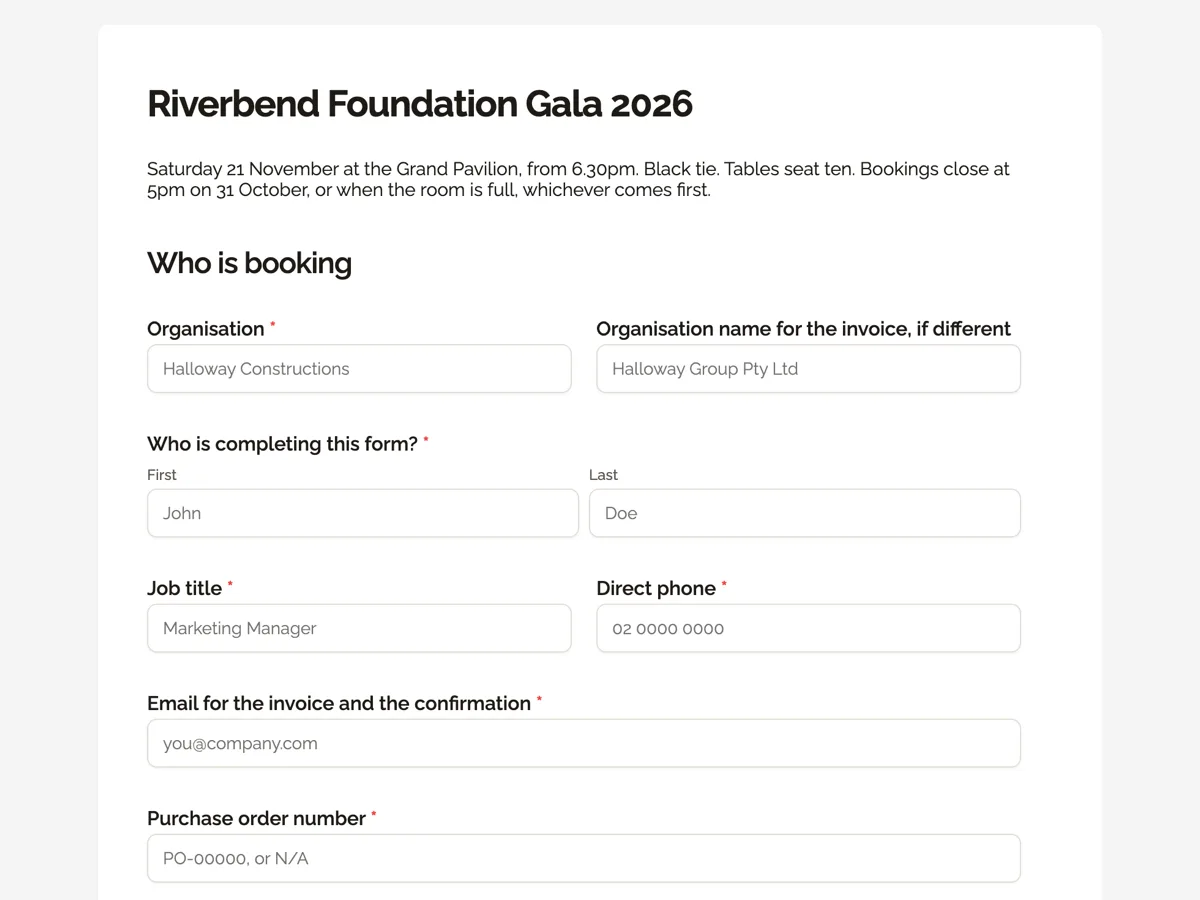
The form itself
A static copy of the finished form, exactly as it renders. Nothing here can be filled in or submitted, so read it as a reference and build your own from the button above.
Every field, and what it collects
The complete field list, in the order respondents meet it.
- OrganisationShort textRequired
- Organisation name for the invoice, if differentShort text
- Who is completing this form?NameRequired
- Job titleShort textRequired
- Direct phoneShort textRequired
- Email for the invoice and the confirmationShort textRequired
- Purchase order numberShort textRequired
- If your accounts team does not need one, write N/A. Leaving it blank is what holds invoices up.
- Send the invoice toAddress
- What would you like to book?Single choiceRequired
- Options: Table of ten, Foundation partner rate, $2,550 · Table of ten, standard rate, $2,950 · Half table of five, $1,550 · Individual seats, $310 each
- How many of those?NumberRequired
- Tables, half tables or seats, whichever you picked above.
- Program book advertisingSingle choice
- Options: None · Quarter page, $250 · Half page, $450 · Full page, $800 · Inside back cover, $1,200
- Would you like to be part of the fundraising on the night?Multiple choice
- All optional. The auction and the raffle are where most of the evening is actually raised.
- Options: Register a paddle for the live auction · Buy a raffle book, $50 for ten tickets · Donate an item to the auction
- Seating requestsLong text
- Seating is set by the event team, so this is a request rather than a booking. Tell us who you would like near you and we will do our best.
- Accessibility requirements for anyone at your tableLong text
- Asked now rather than with the guest names, because the room plan is drawn first and it is much harder to move later.
- How did you hear about the Gala?Single choice
- Options: We came last year · A colleague · The Foundation newsletter · Social media · A board member asked us
- List your organisation on the shared guest list?Single choice
- Circulated to attendees a week before.
- Options: Yes, list us · No, keep us off it
- Before you finishMultiple choiceRequired
- Options: I am authorised to make this booking for the organisation named above · I accept the cancellation terms · I understand the evening is black tie and that photography and filming take place throughout
- Anything else we should know?Long text
Who is booking
What you are booking
The room
Guest names come later
Terms
What each block of this booking form collects
Who is booking takes the organisation, an optional separate name for the invoice, the person completing the form with their job title, a direct phone, the email that receives the invoice and confirmation, a purchase order number and an optional invoice address. What you are booking offers four rates, from a partner rate table of ten to individual seats, then a quantity, program book advertising and three optional fundraising ticks. The room block holds the seating request, accessibility needs for anyone at the table, how the buyer heard about the gala and whether to appear on the shared guest list. A paragraph then explains that guest names come later, and the terms block closes with the cancellation paragraph, three ticks and a free text box. Nine of the eighteen fields are required.
Why the guest names wait until October
A table bought in September is filled in November. Collecting ten names at booking means collecting them twice, because half of them change, and the second list is the one the place cards need. So the form says in a paragraph that the contact gets one email in mid October asking for names and dietary needs, and that names can change until 14 November. That email comes from the Foundation, not from the form, and it goes to the contact given here, which is another reason the email field is labelled for the invoice and the confirmation together.
How to adapt this form
A gala that sells mainly individual seats can drop the invoice block to a name and email, and put the dietary question back on the booking because there is no second list to wait for. A sponsor led event replaces the program book options with sponsorship tiers and a logo upload, which takes images or PDF. A school or club dinner with no invoicing can remove the purchase order field altogether rather than making it optional, since an optional field on every booking is a field somebody has to read past.
What makes this form work
Two names for one buyer
The organisation on the guest list and the entity on the invoice are often not the same, and finance systems reject the wrong one. Two adjacent fields, the second clearly optional, fixes that in ten seconds instead of in an email chain three weeks later.
The fundraising ask sits inside the booking
Auction paddle, raffle book, donated item. Three ticks while somebody is already committing money, rather than a separate appeal competing for the same decision a month later. The paragraph above them says plainly that this is where the evening is actually raised, and that the numbers let the Foundation line up the lots.
Cancellation is written where the money changes hands
The clause names a date, a time and a reason, that catering numbers lock with the venue. Then a tick box confirms it. A gala that only puts this in the terms page ends up arguing in November with a sponsor it wants back next year.
Questions people ask
Should a gala booking form collect every guest name?
No. Tables are bought in September and filled in November, so names collected at booking are wrong by the time the place cards are printed. Take the booking now, then send one email in the month before the event asking for names and dietary needs. This form says that on the page so nobody hunts for a field that is not there.
Why is the purchase order field required?
Because a corporate table is paid on invoice, and an invoice without the reference the buyer's finance team expects sits unpaid for a month. A required field gets an answer from everybody. A classic form does not show a field's help text, so if some buyers have no purchase order, put write N/A if none into the label itself rather than a note under it.
Can guests pick their own seats?
Not on this form, and stating that is kinder than implying otherwise. Seating on a round table plan is set by the event team, and the paragraph above the seating field says the answer is a request rather than a booking, and that tables on the same order always sit together. A useful request names a table to sit near, or a need such as being close to a door.
Where do the accessibility questions belong?
With the booking, not with the guest names. The room plan is drawn from the table list weeks in advance, and moving a table after that is far harder than reserving the right one first. Asking early is the difference between an accessible seat and an apology on the night.
Should a gala form ask how the buyer heard about the event?
Yes, because a gala sells through relationships rather than advertising. This form asks it near the end, after the booking is effectively made, so it never blocks a sale. The answers tell a fundraising team which board member, past guest or partner is actually filling tables, which is the number that shapes next year invitations.
Why offer to list the organisation on a shared guest list?
Because corporate tables buy partly to be seen there, and some cannot be. This form asks whether to list you, so the choice sits with the buyer rather than an assumption. It also gives the charity a published list that other organisations read, which is one of the quieter ways a table gets sold.
Is a gala dinner table tax deductible?
Usually not as a gift, because the buyer receives a dinner in return. The ATO has specific rules for contributions at fundraising events, and raffle tickets are never deductible gifts. That is why this form keeps the table price, the auction paddle and the raffle book apart, so the charity can issue the right receipt for each rather than one figure nobody can claim.
Build your own in about a minute
The button below opens the generator with this use case already described. Change the wording to match your own, generate, then edit anything you like.
Make one like thisOther form examples
Raffle ticket form
A raffle is a cash transaction that has to survive a draw four weeks later, so the form has one real job: produce a record both sides will still trust when a number is read out in a hall. This one collects the name that gets called, the address the numbers go to, and the seller who should be credited. It is conversational, because most tickets are bought standing at a market stall with a phone in one hand. Raffle rules in Australia are set by each state; this example is a Victorian brigade, where only a declared community or charitable organisation may run a raffle and buyer contact details have to be recorded.
Trivia night registration form booked by the table captain
A school trivia night is sold by the table, not by the ticket, and the person who books is the person who will chase seven other people for twenty dollars each. This eight screen form is written for that captain, and it asks how the table is paying rather than taking a card, because a P and C runs on bank transfers and envelopes.
Conference registration form
A conference registration form template needs a name, an email, a ticket type and the few answers the organiser has to plan around: days, sessions, catering and access. This finished example for the two day Northbridge Tech Summit does that in three sections: who is coming, your ticket, and access and catering. Seven of its eleven fields are optional, so a Standard, Team or Virtual attendee can register in about three minutes and the organiser still gets a breakout track, a day selection and catering notes from everyone who fills it in.
Want the steps in the builder? Read View, export and manage your responses, then Every form field and when to use it. For everything this generator can do, see the form maker.
Written and checked by the OneCraft team. Last checked .