Conversational form
Raffle ticket form
A raffle is a cash transaction that has to survive a draw four weeks later, so the form has one real job: produce a record both sides will still trust when a number is read out in a hall. This one collects the name that gets called, the address the numbers go to, and the seller who should be credited. It is conversational, because most tickets are bought standing at a market stall with a phone in one hand. Raffle rules in Australia are set by each state; this example is a Victorian brigade, where only a declared community or charitable organisation may run a raffle and buyer contact details have to be recorded.
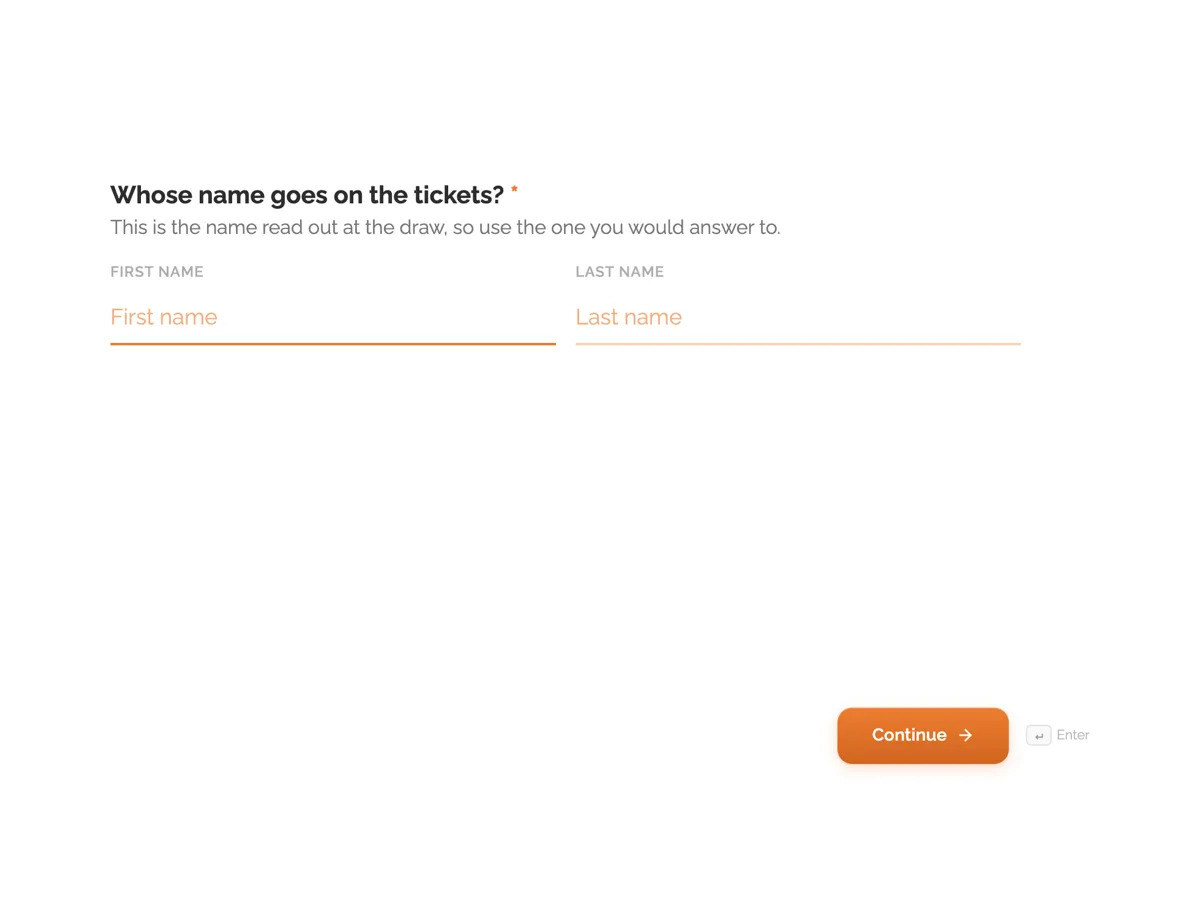
The form itself
The first screen of the form. A conversational form shows one question per screen, so the remaining screens are listed in the field table below. Nothing here can be filled in or submitted, so read it as a reference and build your own from the button above.
Every field, and what it collects
The complete field list, in the order respondents meet it.
- Whose name goes on the tickets?NameRequired
- This is the name read out at the draw, so use the one you would answer to.
- Email for your ticket numbersShort textRequired
- Your numbers are emailed the moment payment clears. Without them you cannot prove you hold a winning ticket.
- Mobile numberShort textRequired
- Winners are rung on the afternoon of the draw. The brigade keeps trying for seven days, and after that an unclaimed prize goes back in the barrel.
- How many tickets?Single choiceRequired
- Options: One ticket, $5 · Five tickets, $20 · Fifteen tickets, $50 · Thirty five tickets, $100
- Are you eighteen or over?Single choiceRequired
- First prize includes a case of wine from the Marrowbrook co-op, so ticket holders have to be adults. Under eighteens are welcome to sell.
- Options: Yes · No
- Who sold you these tickets?Dropdown
- Sellers are in a friendly competition and the ticket you bought at the bakery counts for somebody. Pick the stall or say you found us online.
- Options: Marrowbrook Hall, Friday market · The bakery counter on Wills Street · Junior brigade door knock · Ladies auxiliary morning tea · The brigade Facebook page · Nobody, I found the link myself
- Where should we post the prize if you win?Address
- Only used if you win something that will not fit in a car. Second and third prize are collected from the station.
- Before you go, two things to agree toMultiple choiceRequired
- Both are conditions of the raffle permit, and the second one is the reason we ask so little.
- Options: I understand tickets are only valid once payment clears, and that a reserved ticket is not an entered ticket · I am happy for my name to be read out and printed in the brigade newsletter if I win
- Anything you want to tell the brigade?Long text
What makes this form work
The seller question pays for next year
A dropdown of stalls and sellers turns a pile of ticket sales into a map of where the money came from. The bakery counter either earns its ticket book or it does not, and the committee finds out from the responses table rather than from an argument about whose turn it is to stand at the market.
The email field explains itself
People give a throwaway address when they think an email is marketing. Saying that the numbers arrive there, and that without them a winning ticket cannot be proved, changes what gets typed. The description is visible here because this is a conversational form, where every field prints its own explanation under the question.
The age question is asked plainly and given a reason
A case of wine in first prize is why the question exists, and saying so costs one line. Under eighteens are told in the same breath that they can still sell tickets, which keeps the junior brigade in the fundraiser instead of quietly excluding them.
Questions people ask
What does a raffle ticket form actually need to collect?
A name that can be read out, a way to reach the holder on draw day, and the ticket count. Everything else is optional. The one field people forget is the seller, and without it a brigade cannot tell which stall or which volunteer moved the books, which is the information that decides where next year is worked.
Why ask for both an email and a mobile number?
They do different jobs. The email carries the ticket numbers, which is the buyer's only proof of what they hold. The mobile is for the twenty minutes after the barrel is turned, when somebody is standing in a hall trying to reach a winner. Asking for one and hoping it covers both is how prizes go unclaimed.
Does this form take the payment?
No. The form reserves tickets and records who bought them; money is handled separately, by transfer or in cash at the stall. That is why the first condition says a reserved ticket is not an entered ticket. Being blunt about it at the point of agreement stops the argument that otherwise happens on draw day.
Is a tick box enough to check somebody is old enough?
It is a declaration, not a check. A choice field records what the entrant said and nothing more, and a fundraiser that genuinely has to verify age asks for a date of birth or checks at the point of handover. The tick is worth having because it puts the rule in front of the buyer and creates a record of the answer, and the page should not pretend it does more than that.
Why ask who sold the tickets?
Because volunteer run raffles are settled book by book. This form asks who sold you these tickets, so the brigade can reconcile online entries against the seller who prompted them. It also tells a fundraising coordinator which volunteers are actually selling, which is the number that shapes next year roster.
Should a raffle form ask for a postal address?
Only from winners, in theory, and from everybody in practice. This form asks where to post the prize if you win, phrased as a condition, so it reads as a contingency rather than a data grab. Collecting it at entry avoids chasing an address from somebody who has stopped answering unknown numbers.
Build your own in about a minute
The button below opens the generator with this use case already described. Change the wording to match your own, generate, then edit anything you like.
Make one like thisOther form examples
Gala dinner booking form
A gala dinner booking form takes a table or seat booking, the invoice details and the terms, so an organisation can commit to the night before it knows who is coming. This one is built for a black tie fundraising gala that sells most of its room to organisations on invoice: it takes the booking and the money trail now, and leaves the ten guest names to a second email in October. It is a classic form, because a booking that ends in an invoice has to be read end to end before it is sent.
Trivia night registration form booked by the table captain
A school trivia night is sold by the table, not by the ticket, and the person who books is the person who will chase seven other people for twenty dollars each. This eight screen form is written for that captain, and it asks how the table is paying rather than taking a card, because a P and C runs on bank transfers and envelopes.
Competition entry form
A creative competition lives or dies on whether entries can be judged fairly, so the form has to collect two things at once: the work, and the truth about how it was made. This photography entry does both, and puts every rule where the entrant is standing when it matters. It is a classic form, because an upload and a set of declarations belong on one page where both can be checked before sending.
Want the steps in the builder? Read Create a conversational form with AI, then View, export and manage your responses. For everything this generator can do, see the form maker.
Written and checked by the OneCraft team. Last checked .